
How my life changed…
Sometimes something begins small. A conversation. A place. A name you do not understand.
For me, it began in Normandy, with a veteran speaking about something I could not place. From that moment on, something changed. What started as curiosity grew into a search that would shape my life.
That search brought stories. Encounters. Research. But also unexpected moments of recognition, with many highlights: an Emmy, a meeting with Dame Vera Lynn, a certificate from a famous squadron, and countless encounters with our liberators.
It became writing. It became music.
A way of continuing to understand what had really happened.
My story of 20 years of Back to Normandy, ww2history.eu and now https://history.fredvogels.com
This extensive article takes you through more than 20 years of encounters with the Second World War. An encounter that had in fact begun years earlier, through family stories about Japanese camps, slave labour, the Arbeitseinsatz, and more. On www.fredvogels.com you can hear and see my creative translation of that history. On www.radio-oranje.nl I make it even more specific.
It began like this. The first encounters that asked for deeper understanding were my visits to Normandy. As I often say: June 6 should be celebrated. Because on June 6, 1944, the liberation of Western Europe began. Began… or so you would think. I learned that the beginning of a war, and its end, consist of many moments. Many people were involved. And so it was for me.
When I spoke to my first veteran in Arromanches, I very quickly realized that I understood nothing of his story. Ox and Bucks? What is that? The Oxfordshire & Buckinghamshire Light Infantry. Probably a name that many people still would not recognize. My urge to understand this man, this veteran, was sincere. But I could not understand him. And the only way I could was by understanding the facts. He spoke in his own dialect and from his own background. I wrote it all down, but it became too much. Far too much.
So I devised a system to keep myself from getting stuck in my own overload of information. Everything had to become one: one date, one location, one unit, one… And the system worked. Except that the military hierarchy was… and still is… a black box. It was war, and units were deployed in constantly changing combinations. Then with one, then with another. A challenge.
There were many such challenges I had to overcome while building this website. But the website was noticed. It was quoted and referenced many times. Why? I will try to explain that below. It remains an attempt.
The war through thousands of entrances and many faces
More than 14,000 categories alone, created precisely to keep the information somewhat understandable. Anyone arriving at history.fredvogels.com for the first time mainly sees abundance. Many names. Many subjects. Many directions. It is not a website you take in at a glance. And perhaps that is a good thing. Because war cannot be reduced to one straight line. War is fragmented. Someone dies in one place, another departs from a harbour, a pilot disappears during a mission, a division moves through a village, a name ends up on a stone, in a list, in a register, in a story. What this website does is not flatten all those traces, but allow them to exist side by side.
The current structure of the site shows this beautifully. It is not an ordinary collection of articles, nor a bare table where you only search by name, date or place. It is a constructed world, with main categories that together say something about how the Second World War can be approached. Not in one way, but in many ways at once.
Air Force Operations
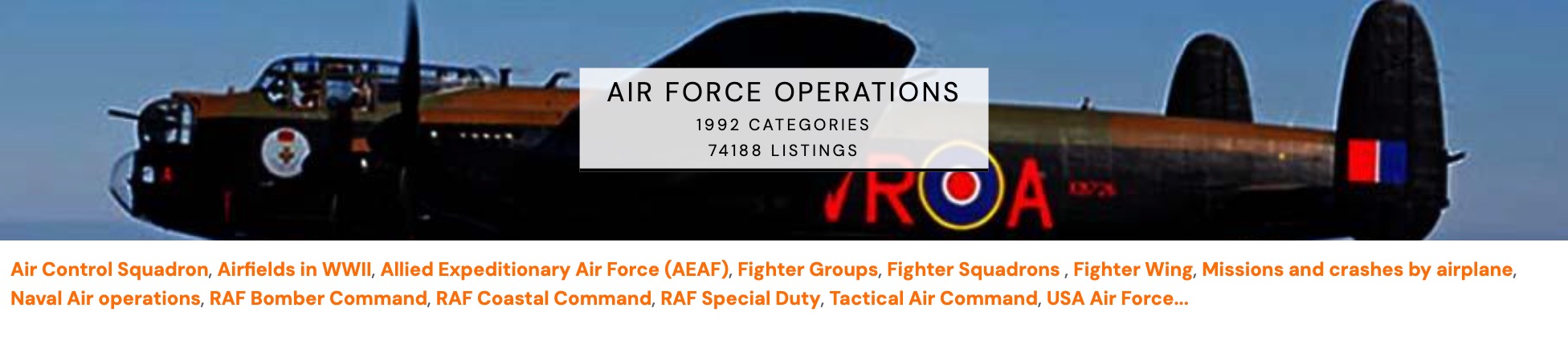
Here the war begins in the air: with missions, airfields, aircraft and crews, many of whom never returned.
You can read the website as a war from the air. For that there is the great domain of Air Force Operations. It contains air force operations, airfields, missions and crashes per aircraft, fighter groups and squadrons, tactical command structures, the American air force and, of course, RAF Bomber Command. That section alone shows that the air war here is not reduced to a handful of familiar terms. It has been broken down, organized and further opened up. Not only the famous names or the major operations matter, but also the infrastructure of the air war, the airfields, the units, the aircraft and the individual movements in the sky.
Naval Operations
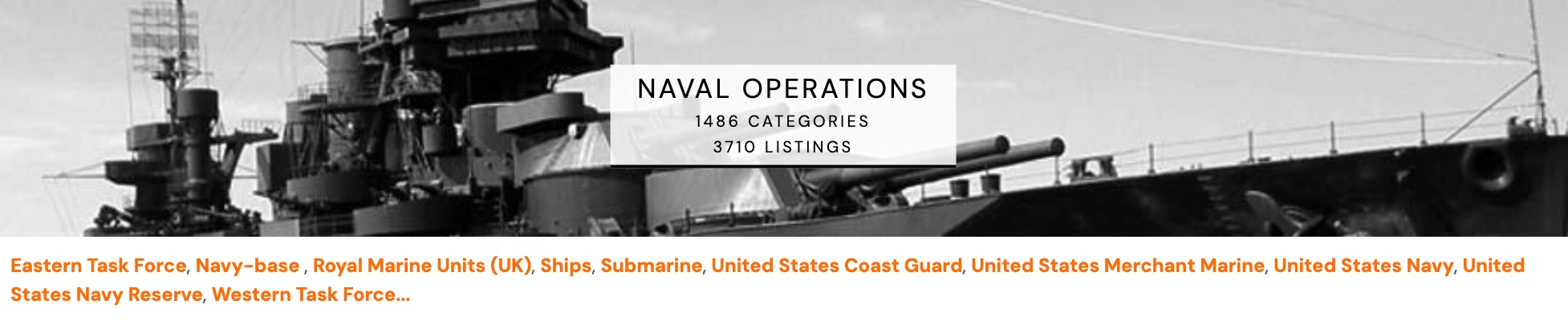
Before the beaches, there was the sea — with ships, routes, supply lines and everything needed to make an invasion possible.
You can also read the war from the sea. The category Naval Operations has that same richness. There you see task forces, naval units, merchant marine, navy reserve, coast guard, submarines and naval bases. That matters, because many histories of D-Day and Normandy stop at the beach. But for me it begins much earlier: at sea, in the supply lines, in the organization, in the ships that do not always get the attention, but without which nothing would ever have reached the shore. Here the sea is not a backdrop, but a full layer of history in its own right.
Engineers

War was not only fought, but also built, repaired, bridged and made technically possible.
Then there is the war on land. And here the structure becomes even more impressive. There are not only Infantry Divisions, but also Airborne Divisions, Armo(u)red Divisions, Army Groups, Corps and Engineers. That is telling. Many websites would already be satisfied with “American divisions” or “British units.” Here you see something else: the war is taken seriously in its military structure. Not as dry hierarchy, but as a way of putting people and events back in their place. A soldier belongs not only to a name, but also to a division. A division belongs to an army group. A movement at the front belongs to a corps, a campaign, an area and ultimately also to a date and a story.
Divisions
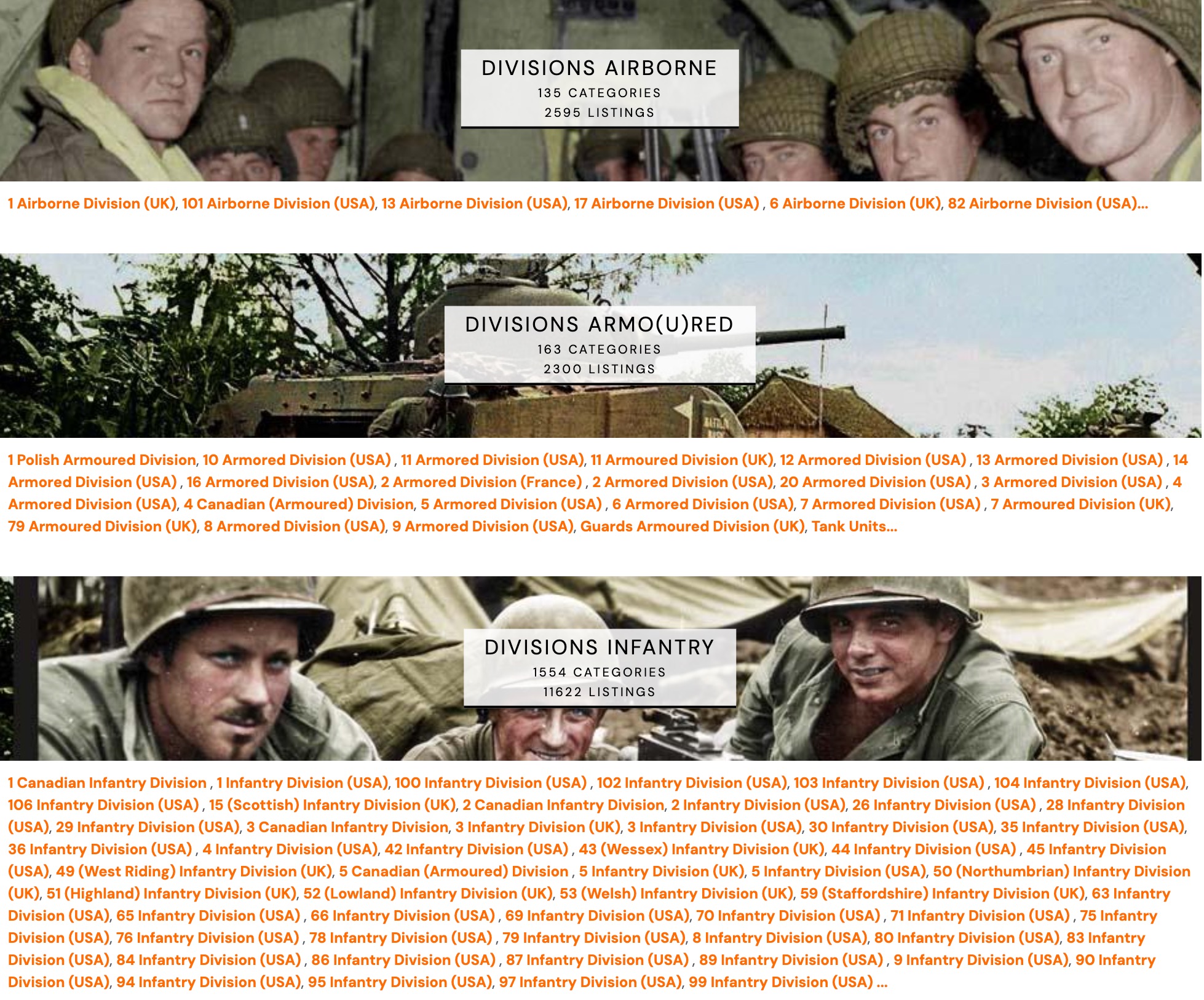
Behind every division lies a world of names, orders, movements, losses and stories.
In the infantry divisions you immediately see how broadly this has been set up. Not one or two famous divisions, but a multitude of American, British and Canadian formations. In the airborne divisions you find not only the great icons such as the 101st and 82nd Airborne, but also the British airborne units. In the armoured divisions you see the same approach: not a narrowing down to famous tank stories, but an orderly structured world in which different national and operational connections reappear. And in the engineers something becomes visible that is often overlooked: war is not only about front-line soldiers, but also about building, repairing, crossing, securing, fire fighting, pioneer work and technical support. The fact that I created a large separate branch for that says something about the way I look. I do not only look at who fought, but also at who made it possible for fighting, movement, supply and survival to happen.
Support Troops
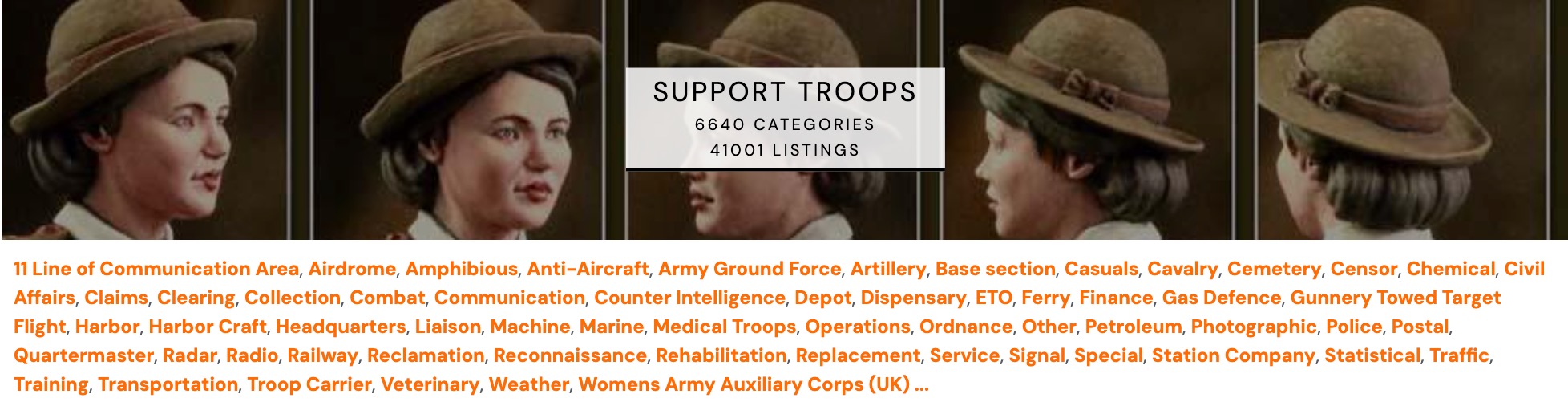
Here you meet the troops without whom the front could not have functioned for a single day.
Perhaps even more telling is the category Support Troops. The name alone deserves attention. There is an attitude in it. As if to say: let us not pretend that the war was decided only by the men in the photographs holding a rifle or sitting in a cockpit. Here there is room for Quartermaster, Ordnance, Medical Troops, Signal, Replacement, Postal, Police, Transportation, Headquarters and more of that indispensable backbone. That is precisely what makes the website human. Because war is not only made up of heroism. War is also made up of distribution, repair, administration, communication, replacement, transport, medical care and the endless machinery behind the front. By including those troops not as a footnote but as a main structure, I give something back to all those people who usually disappear from view. I even argued about it with a military historian. Because, he said, the term Support Troops did not exist. You can imagine my answer.
Places and names to remember

Some places tell more than a book: a name carved in stone, a field, a cross, a silence.
There is more. The website is not only structured militarily. It also contains a strong geographical and commemorative layer. You can see that, for example, in Places and names to remember. It is a beautiful title because it does more than organize. It invites you to pause. In this branch, place and remembrance come together. Think of cemeteries, rolls of honour, memorials, dropping and landing zones, and other places where history can not only be read, but also felt. That is an essential difference. A division can be understood. A stone with a name on it can be experienced. And this website allows both.
I also find it very important that there is a Timeline. That may seem obvious, but it is not. Many historical websites have enough material, but no sense of time. Here that layer of time is explicitly present. The years 1939 through 1945 stand ready as separate entrances. That means you can read the war not only thematically, but also chronologically. That matters, because a visitor without a military background can still gain a grip on the whole through the timeline. First the year, then the context, then the names, then the deeper layer. The timeline makes the site accessible without simplifying it.
Normandy Routes
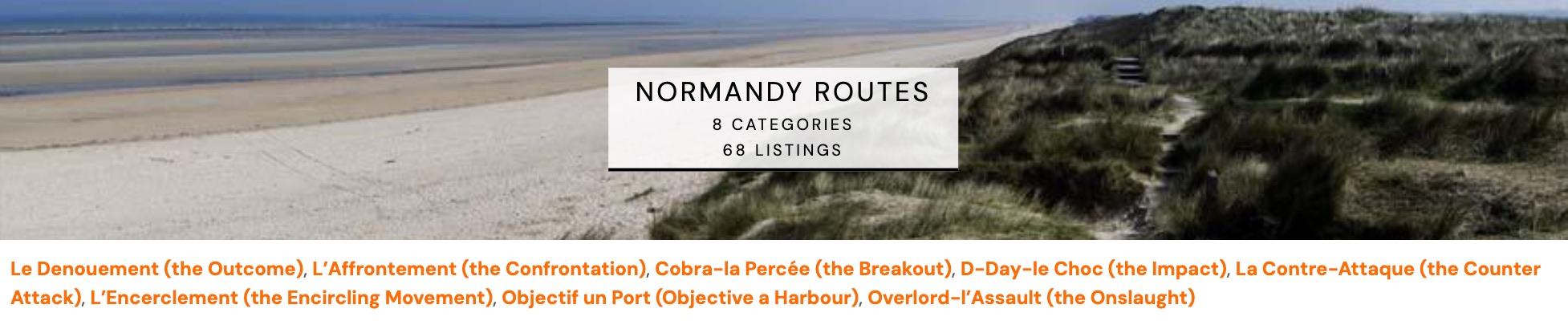
Not isolated facts, but a route through Normandy — step by step, phase by phase, almost like a film.
In addition, there are storylines that feel almost cinematic. Take Normandy routes, with film. These are not just categories, but stages with names that sound like chapters from both a campaign and a journey. Overlord, l’Assault, l’Affrontement, Cobra, la Contre-Attaque, l’Encerclement, le Dénouement. There is movement in that, development, a build-up of tension. As if I am not only giving the visitor information, but also offering a route through which the events can be followed. In that way the war becomes not only a database, but a journey.
A day in 1944 | D-Day
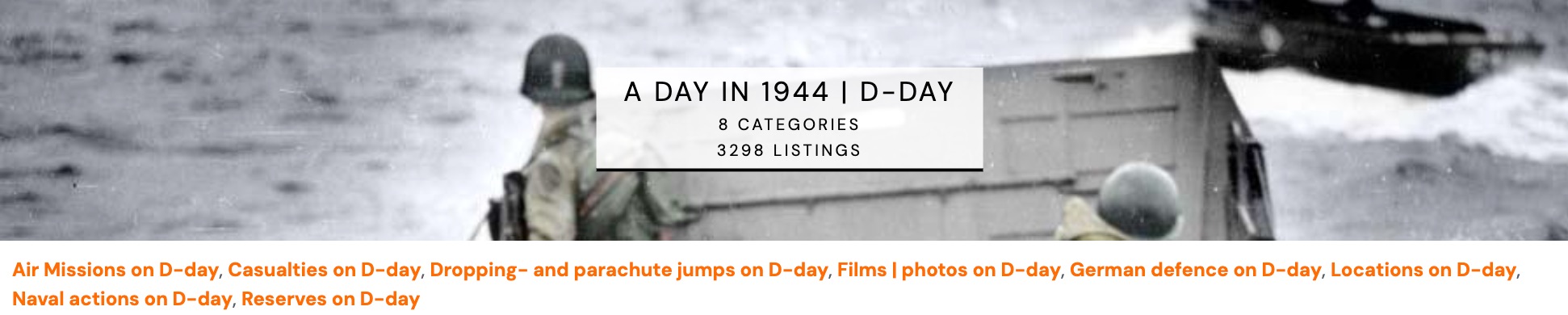
One day. Yet within that one day lies an entire world of landings, air operations, defence and loss.
The same is true of A day in 1944 | D-day. Here the focus becomes very precise. Not “the war in general,” but one single day as a universe of its own. German defences, air missions, landings and parachute drops, reserve troops, locations, films and photographs, casualties. As if you unfold that one day and say: look, this was not one image, not one beach, not one story. It was a whole set of converging realities. That is one of the site’s guiding ideas: to zoom in without losing the larger connection.
Battle of Normandy
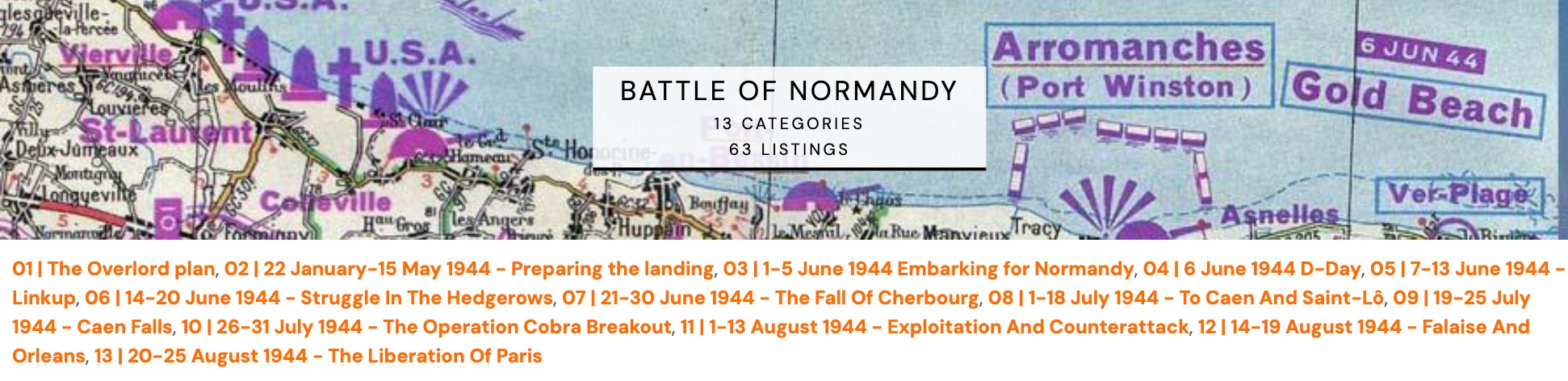
The Battle of Normandy unfolds here not as one single story, but as a sequence of decisive movements.
Battle of Normandy works differently again. There you see a structure in phases: the plan, the preparation, D-Day itself, the linking of the bridgeheads, the fighting in the hedgerows, the fall of Cherbourg, the road to Caen and Saint-Lô, Cobra and the breakout. That makes the website almost readable like a history book, but one whose chapters are not sealed shut. Behind each chapter, other doors can open: units, locations, missions, people.
Nazi and Allied Terror
This is not only about combat, but also about crime, oppression, collaboration and human devastation.
And then there is another, but indispensable, side of my structure: Nazi and Allied Terror. The very existence of that main category shows that the website is not only meant to be a military reconstruction. I also look at violence in its moral and human meaning. Not only at battles, but also at crime, oppression, persecution, destruction and the dark mechanisms behind war. One important part for me is the collaboration of companies with the Nazis, companies that still exist today. That is allowed, of course, because people too may continue to exist as far as I am concerned. Sometimes apologies follow, as happened not so long ago with the Dutch Railways.
Other interesting records
Sometimes an important story is not found on the main road, but דווקא in the side paths and unexpected discoveries.
What I also find important is that there is room for Other countries and Other interesting records. These are not leftovers in a negative sense, but rather breathing spaces. There is room for countries and contingents that do not always appear at the top of standard narratives. And there is room for bridges, bunkers, stories and special finds that do not fit neatly into a single military drawer. A detour perhaps, but often one that leads back to the story I want to tell.
Abbreviations

Abbreviations may seem small, but once you understand them, you suddenly come much closer to the reality of war.
The category Abbreviations says something about the nature of the project. Anyone who truly digs deep into sources knows how many abbreviations war material contains. Abbreviations may seem small, but they are a form of access. I help the visitor not only with content, but also with language.
What ultimately speaks through the current structure is that this website was not built from one single historical model. Not only from Allied units. Not only from D-Day. Not only from the air force. Not only from casualties. Not only from maps. Not only from stories. It is an attempt to let all those ways of looking exist side by side.
And yet, underneath all those thousands of categories, there is a very simple movement. Someone searches for a name. And through that name a world opens up. Or someone begins with a division and finds a place. Or someone begins with a cemetery and finds a story. Or someone begins with D-Day and ends with an individual soldier.
That may well be the core.
That is why this website is more than an archive. An archive preserves. This site connects. It shows how a name is part of a larger whole without allowing that name to disappear. Perhaps that is ultimately the best way to understand this website. Not as a collection of 156,000 records, but as an attempt to make war accessible without simplifying it.
A war begins within yourself and ends within yourself. Mahatma Gandhi said it differently: “If we want to create a lasting peace, we must begin with the children.” How true. Were it not that there are still so many adults who never stopped being children.