The British Operational Picture
The British Operational Picture
Although weather conditions were far from ideal for a sea-borne assault and had already necessitated a twenty-four hour postponement of D-day, the Supreme Commander decided to launch the operation on the night of 5/6 June 1944. What ever may have been the private thoughts as to the wisdom of this decision by those actually on the landing craft in the heavy swell that was running at the time, there is no doubt that the prevailing conditions led to the assault proving to be an even bigger surprise to the enemy than had been hoped. Resistance was fierce in many localities but was generally less formidable than had been anticipated.
During the night 6 Airborne Division made a successful landing with comparatively light casualties They seized the bridges at BENOUVILLE and RANVILLE intact and thereafter proceeded to establish and hold a limited bridge-head across the river ORNE.
At H-hour the assaulting divisions went ashore on the beaches with 50 Infantry Division on the right, 3 Canadian Division in the centre and 3 British Division on the left. Although the village of LE HAMEL was strongly defended and held out until 1700 hours, 50 Division quickly established a bridgehead and by nightfall had made contact with 3 Canadian Division on the left and were on the high ground EAST of BAYEUX, from VAUX-SUR-AURE T7884 to BRECY T8878.
Despite a considerable amount of mortar and shell fire on the beaches, 3 Canadian Division advanced inland in the centre sector to reach the line CREULLY T9080 BENNY-SUR-MER T9680. On the left 3 British Division captured OUISTREHAM, made contact with 6 Airborne Division on its left and established itself on the line PERRIERS-SUR-LE-DAN U0576-BENOUVILLE U0974.
On 7 June BAYEUX was captured and 30 Corps attempted to advance SOUTH on the axis TILLY-SUR-SEULLES/VILLERS BOCAGE. 7 Armoured Division actually outfianked TILLY-SUR-SEULLES and reached VILLERS BOCAGE but were compelled to withdraw again to the high ground North-West of the town. On the 1 Corps front the enemy had delivered several counter attacks both EAST and WEST of the ORNE without success. In fact EAST of the ORNE our positions were improved by the capture of BREVILLE U1374 on 13 June by 6 Airborne Division reinforced by 51 Division.
From 16 to 30 June operations were directed to the capture of CAEN so that a strong left flank could be provided for the bridgehead. On 19 June 30 Corps finally captured TILLY-SUR-SEULLES after very fierce fighting. Regrouping now took place and 8 Corps came into the centre between 30 and 1 Corps.
On 25 June 30 Corps attacked SOUTH across the road CAUMONT—CAEN and by 27 June after repeated counter attacks and a slight withdrawal had secured a firm hold on the RAURAY feature some three quarters of a mile NORTH of BRETTEVILLETTE T8864.
On the same day 15 Division under 8 Corps had secured a bridgehead over the River ODON NORTH of GAVRUS T9262, while the following day the high ground around Point 112 T9562 was captured by 11 Armoured Division.
On the left of the BRITISH front 51 Division improved the bridgehead over the ORNE by capturing SAINT HONORINE but any move by 3 British Division in the direction of CAEN met with the fiercest resistance.
It was planned that from now on Second Army was to continue to contain the main enemy force and even draw further enemy formations towards it, while the US forces made a wide sweep on the right against what was hoped would be weak opposition.
Second Army therefore had three main tasks:
• to contain the main enemy forces in their present area
• to capture CAEN as soon as possible
• to repulse all counter attacks with its own resources so that the AMERICAN sweep SOUTH and IVEST could continue unhampered.
After an attack by 450 heavy bombers of Bomber Command on 7 July, CAEN was finally captured on 9 July. From 10 to 18 July only limited progress was made, but on 18 July a powerful thrust was launched EAST of CAEN preceded by an air bombardment from over two thousand heavy and medium bombers. At the start excellent progress was made by the armour, but after three days heavy fighting a strong anti-tank screen brought the advance to a halt. The CAEN suburbs EAST of the ORNE had been cleared and the advance had reached the general line SAINT MARTIN-DE-FONTENAY U0260—BOURGUEBUS U06—CAGNY U1164.
In order to oppose our attack the enemy had concentrated almost all his armour EAST of the ORNE and Second Army had achieved its object of containing the main enemy forces thus smoothing the way for the US advances.
Administrative Development
Administrative Development
The period from D-day to 25 July saw the support of the armies develop from hastily stacked dumps on the beaches in the first few hours of the operation to the final establishment of the vast and intricate organisation of the Rear Maintenance Area.
The various changes and improvisations that contributed to this result can only be described here in the briefest outline so that a general picture of this development can be obtained.
Division of Assault Area
Division of Assault Area
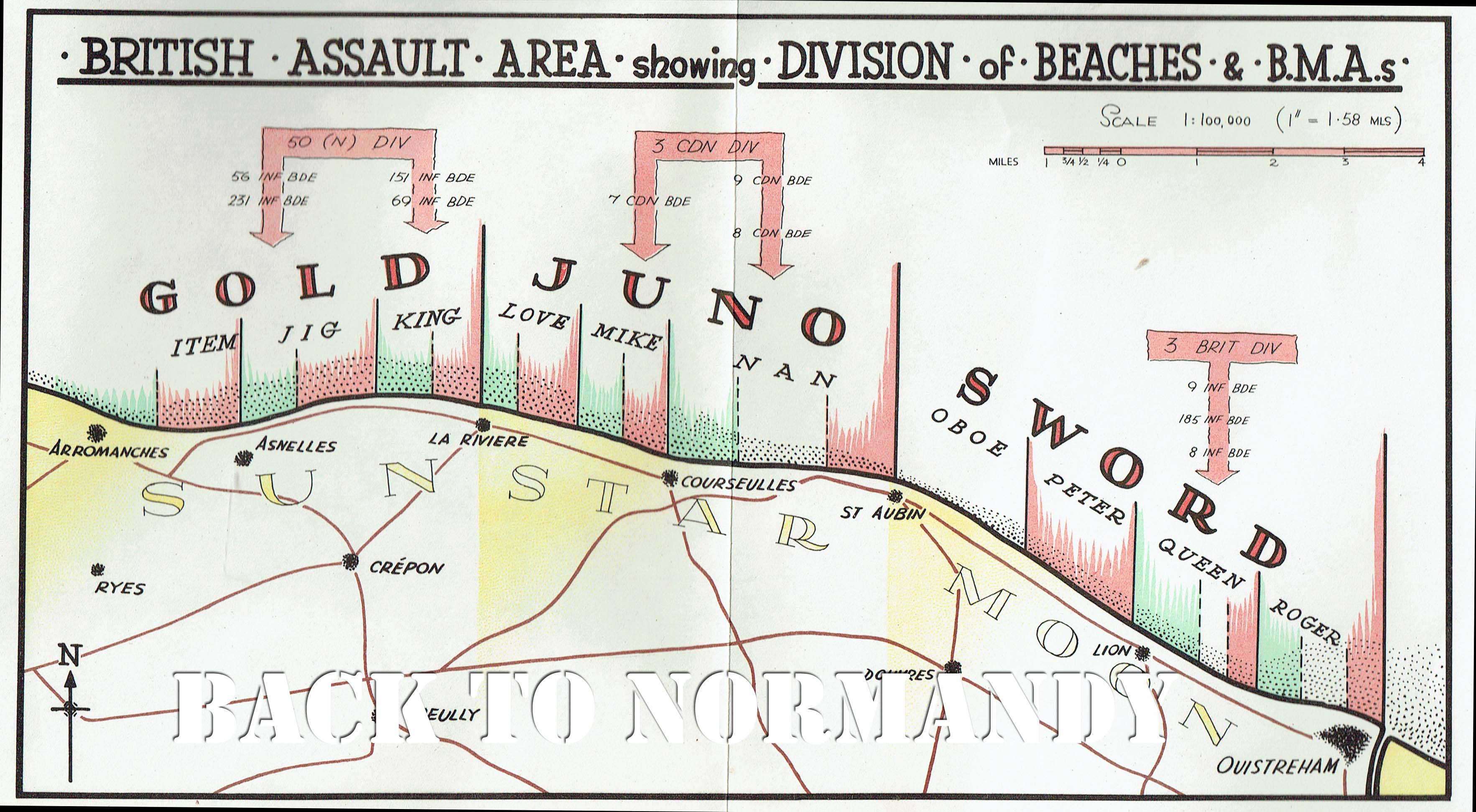
Both for operational and administrative reasons the BRITISH assault area had been divided up into three beach sectors.
On the right was GOLD Sector on to which 50 Division was to assault as the advance formation of 30 Corps. In the centre was JUNO Sector and on the left SWORD Sector on to which 3 Canadian Division and 3 British Division were to assault respectively, both under the command of 1 Corps.
These Beach sectors were further sub-divided down to beaches called in the case of GOLD Sector and reading from WEST to EAST, ITEM, JIG, KING, in the case of JUNO Sector, LOVE, MIKE, NAN and OBOE and in the case of SWORD Sector, PETER, QUEEN and ROGER.
Yet another sub-division was made in each of these beaches whereby the EAST half of the beach was entitled “GREEN” and the WEST “RED”. Thus the eastern half of KING beach would be known as “KING GREEN”.
For the administration of its beach sector 30 Corps had 104 Beach Sub Area under command under which again were 9 and 10 Beach Groups operating on JIG and KING beaches respectively.
For the JUNO Sector 102 Beach Sub Area with 7 and 8 Beach Groups operating MIKE and NAN beaches was placed under command of 1 Corps, while for SWORD Sector, also under 1 Corps, was 101 Beach Sub Area with 5 and 6 Beach Groups in command of QUEEN and ROGER beaches.
From the dumps to be formed on these beaches, Beach Maintenance Areas were to develop and these were given the code words “SUN” in the GOLD Sector, “STAR” in the JUNO Sector and “MOON” in the SWORD Sector.
From D-day until the establishment of the rear army boundary (which did not take place until 23 July), all the operations in the 21 Army Group area were under command of Second Army.
The general picture is one of heavy fighting along the whole of the BRITISH front with only limited advances being made but, fortunately, just sufficlient to give the necessary space for the requisite administrative layout although this was very restricted as compared to the area originally planned.
In addition to these difficulties, the administrative operations in the SWORD Sector on the eastern beaches were further complicated by the fact that the beaches were under observation and fire from the enemy and that the CAEN—OUISTREHAM canal could not be used or cleared owing to the proximity of their forces. The canal lock-gates at OUISTREHAM had, by good fortune, been captured intact but there was constant anxiety as to their safety from enemy artillery fire.
The Beaches
The Beaches
The initial stages of the operation on the BRITISH Sector went according to plan and all the beach sub-areas landed on D-day. There were two main difficulties about the beaches, firstly that the slopes were not steep which meant that except at high water all craft and LSTs had to dry out and secondly that owing to this gentle slope the nearest anchorages for shipping would be some distance off-shore.
Fully laden stores ships for instance would have to drop anchor some five miles from the beach and this imposed considerable delays and difficulties in the turn-round of ferry craft and DUKWs. There was no serious bombing but a gradually increasing number of attacks by E boats and explosive devices were launched particularly against the eastern end of the assault beaches. The work of the beach sub-areas deserves mention as upon their exploits depended the continued existence of the forces ashore.
104 Beach Sub Area under command of 50 Division landed on time despite the bad weather. Opposition on ITEM beach considerably delayed the commencement of the administrative operations across as the beaches as the beach group personnel were busy clearing up a pocket of the enemy and rounding up prisoners until late in the afternoon of D-day.
In order to provide immediate reserves on landing, two initial dump areas were organised immediately behind the beaches into which the pre-loaded vehicles deposited their loads. These dumps were also to be built up from stores loaded in LCT but owing to the weather these did not land as planned and the dump areas had to be built up mainly from stores from the pre-loaded vehicles. Even so they proved invaluable.
The whole of KING beach was planned to be developed by 9 Beach Group and JIG GREEN and ITEM RED beaches by 10 Beach Group. Owing to large patches of peat and soft clay on parts of the beach KING GREEN had to be given up with the exception of making a pontoon causeway for landing personnel and to compensate for this abandonment it was decided to make a hard for LCT on LOVE GREEN beach.
ITEM RED and JIG GREEN beaches were developed as planned. The main depots of the beach maintenance area were not finally ready to receive stores until late on D+2 by which time a considerable quantity of stores had accumulated in the initial dump areas. Once the beach maintenance area depots were established they worked well and no major alterations proved necessary to the pre D-day first key plan.
104 Beach Sub Area also had 36 Beach Brick under command which was provided to replace casualties which were anticipated to be heavy. In actual fact casualties proved negligible and 36 Beach Brick was used as a reserve of labour.
102 Beach Sub Area consisted of 7 and 8 Beach Groups with 4 Beach Group in reserve and had landed under command of 3 Canadian Division slightly behind time owing to the rough weather. It had been planned only to develop the MIKE and NAN beaches, MIKE beach by 7 Beach Group and NAN by 8 Beach Group.
The development of MIKE beach was held up owing to fire from an enemy strong point at VAUX. This strong point was eventually eliminated by an attack by one company from the beach groups supported by tanks on D+2.
The beach maintenance area was laid out in with the first key plan and only minor alterations proved necessary. Owing to bad weather the arrival of four coasters on D-day was delayed until early on D+1 and seven more coasters due to arrive on D+1 did not do so until D+2.
Luckily COURSEULLES was captured virtually undamaged and the utmost use was made of the facilities that this small port provided. Up to 1,000 tons a day were unloaded at this port but the discharge of coasters there proved unsuccessful and was abandoned after D+4.
101 Beach Sub Area landed on QUEEN beach under command 3 British Division, having 5 and 6 Beach Groups under its own command.
5 Beach Group landed with the assault brigade of the Division while 6 Beach Group came in with the follow-up brigade. 5 Beach Group’s role was to command the beaches while 6 Beach Group, having passed through them, was to reconnoitre and control, the maintenance area. In order to meet the maintenance requirements of 3 Division on D-day, four pre-loaded LCTs each containing 200 tons of high priority stores were beached at H+4 hours. These stores were unloaded into sector stores dumps close to the beaches from which the units drew as required.
Unfortunately, owing to minefields the area for these sector stores dumps was very restricted and during the first few days considerable congestion ensued which was increased by the fact that, due to enemy action, the beach maintenance area depots were not ready to accept stores until D+3. It had been planned that maintenance from the sector stores dumps would only last for 24 hours but as the beach maintenance area was not ready to receive stores by the evening of D-day DUKWS and pre-loaded vehicles which should have discharged into the BMA then were switched to the sector stores dumps.
Owing to enemy shelling to the EAST from behind the River ORNE the PETER beaches were gradually developed in the hope that these would be out of accurate gun range. It had been hoped that OUISTREHAM which had been captured on D-day with the locks virtually intact would be operated by 101 Beach Sub Area and would have compensated for the limited capacity of the beaches but this never materialised as the port area was under constant shell fire from enemy positions on the EAST of the CAEN canal.
On D+2 disaster nearly overtook the maintenance build up in this area as a stick of bombs hit one of the four sector stores dumps and 100,000 gallons of petrol and 400 tons of ammunition were lost. A new site was immediately reconnoitred for ammunition and petrol and the latter was brought in on a high priority from a cased petrol carrier lying in the anchorage. In actual fact, enemy interference with the unloading over this sector continued throughout this phase. In spite of the great gallantry and hard work displayed by all ranks which resulted in as high a daily average weight of stores per beach group being brought in as any other beach group achieved in the beach-head, the SWORD beaches were abandoned on 12 July.
The Ports
The Ports
In addition to the unloading over the beaches and at the small ports already mentioned, considerable use was made of PORT EN BESSIN and of MULBERRY B as the latter developed.
In the planning stages it had been considered that PORT EN BESSIN could only be used for shallow draft coasters and would therefore be developed as the bulk petrol port for tankers discharging from within the port and from ship-to-shore lines up to a distance of three miles out.
After its capture on D+1 the port was found to be better than expected and capable of taking tankers up to 14’ draft in the outer harbour. The quays also were relatively undamaged and it was forthwith decided to use it for mixed cargoes in addition to bulk -petrol, and also for heavy lifts unloaded in the GOLD Sector.
The first cargo was unloaded on D+5 although due to various delays imposed by the weather bulk petrol was not discharged until 24 June (D+19). Both BRITISH and US tankers used the port, the BRITISH pipeline being on the EAST of the harbour and the AMERICAN on the WEST. The first ship-to-shore petrol line was opened on 1 July.
Meanwhile, the initial development and construction of MULBERRY B proceeded according to plan. The various tows of floating pier-heads etc arrived from UK without serious incident despite the somewhat unfavourable weather.
Commander 4 L of C Sub Area reconnoitred a transhipment area which proved to be suitable although the approaches to it were difficult owing to the high ground immediately behind the beaches. The first coasters commenced to discharge their loads on 11 June which was four days after work on the port began.
From 19—2-2 June a gale of unprecedented force raged. To a large degree the import of personnel, vehicles and stores ceased as a result of its violence. The delay in the discharge of shipping resulted in a back-log being built up in the UK and convoys had to be stepped back while the time of turn-round of shipping was considerably lengthened over that planned.
But even more important was the damage that was done to the installations of MULBERRY A and MULBERRY B.
The MULBERRY A in the AMERICAN sector was so badly damaged that further work on it was abandoned. Without this decision it would have been impossible to complete MULBERRY B to the scale envisaged owing to the damage it incurred and to the number of component parts which were lost in transit across the Channel. However, the portions salvaged from the AMERICAN MULBERRY and those destined for it were diverted to enable MULBERRY B to be completed to its full scale. Despite this severe set-back the construction proceeded and in actual fact the port achieved its target figure of 4,000 tons per day on 22 June.
Administrative Command and Control
Administrative Command and Control
From D+5 HQ Second Army controlled the beach sub areas through the Corps HQs but as it was obviously desirable that corps should not have to look over their shoulders for longer than was necessary, HQ 11 L of C Area took over the local administration of the beach sub-areas on the same date.
HQ Second Army Troops simultaneously took over command of the depots in the BMAs which were now being expanded into two L of C terminals later called army roadheads. The technical control of the depots, however, remained under the appropriate Services of HQ Second Army.
Meanwhile, 4 L of C Sub Area, under command 11 L of C Area, had assumed the responsibility for the adminstration of MULBERRY B and of PORT EN BESSIN through HQ 10 Garrison.
On the arrival of First Canadian Army it became necessary to establish a coordinating HQ for the administration of the rear areas.
On D+37, assisted by a staff and service increment from HQ 21 Army Group, HQ L of C assumed this responsibility until HQ 21 Army Group took over administrative control in the theatre on D+44.
Also on D+37 the second key plan for the RMA was produced. Throughout this period, and actually until D+46, the armies retained operational control of their respective roadhead depots.
5 L of C Sub Area was made responsible for the local administral it on of the RMA as it developed from No. 2 Army roadhead in the BAYEUX area.
On 23 July the rear army boundaries of Second Army and First Canadian Army became eifective.
On 25 July 7 Base Sub Area, originally scheduled to operate the SEINE ports when captured, took over the ports of CAEN and OUISTREHAM relieving 101 Beach Sub Area which had assumed this responsibility on 11 J uly, two days after the capture of CAEN. The latter HQ relieved HQ 10 Garrison at PORT EN BESSIN who were placed under command Second Army for duties in the forward areas.
On the assumption of administrative control on the Continent by HQ 21 Army Group, the RMA was formed from Nos. 1 and 2 Army roadheads which were referred to respectively as RMA EAST and RMA WEST.
First Canadian Army continued to draw from RMA EAST and Second Army from RMA WEST, but 21 Army Group co-ordinated the issues in order to regulate the stocks. Ammunition and ordnance stores in the RMA EAST were gradually to be eaten down as eventually the RMA would be centred around BAYEUX by which time armies would have established new roadheads.
Achievement
Achievement
An illustration of the enormous expansion is the fact that on D-day 59,900 personnel, 8,900 vehicles and 1,900 tons of stores were landed while by D+50 631,000 personnel, 153,000 vehicles and 689,000 tons of stores, in addition to 68,000 tons of bulk POL had been transported into the bridgehead.
Movements Problem
The Movements Problem
Clearly in an amphibious operation of this nature the movements aspect looms very large and in the early stages the principal interest rests on the shipping side. An advanced element of the shipping branch of HQ 21 Army Group was sent over with HQ Second Army. As the latter formation moved forward this element was attached to HQ 11 L of C Area until the arrival of HQ L of C. Initially it was solely concerned with shipping problems but very soon the necessity for central co-ordination of all movement was realised and the element was appropriately increased.
PERSONNEL AND VEHICLES
The conveyance of personnel and vehicles to the Continent was carried out by means of LCT Marks III and IV, LST, MT ships, LS1 and, on D+l and D+2, in large personnel ships transporting over 2,000 personnel each.
It is interesting to note that the only casualty apart from minor damage, was one MT ship which was hit by gun fire when passing through the Straits of DOVER on D+l. Although the Royal Navy was apprehensive of the results, LCT were beached for discharge and as no serious damage ensued this practice continued for a very considerable time.
The discharge of LST had been planned to be by the use of Rhino ferries which were floating rafts of naval pontoon equipment with their own engines and tugs. Owing to rough seas a number of Rhino ferries were lost or damaged en route and therefore insufficient were available to discharge the LST as planned.
The beaching of LST was then resorted to and proved successful. This practice naturally resulted in a larger number of LST having to be repaired, but the advantages gained by the rapid disembarkation of troops and embarkation of casualties for evacuation more than offset this handicap.
Casualty evacuation by LST proved most successful. MT ships were unloaded by their own derricks into LCT Marks V and VI, LCM and Rhino ferries which were then either beached or brought to one of the special causeways for discharge. The first MT ship discharged on D+1. The unloading of personnel ships and LSI presented no serious problem. The first hospital carrier for the evacuation of casualties was brought over on 14 June and after that there was almost always one hospital carrier off the BRITISH beaches.
STORES
The main difficulty in the programming of stores was the continual delay owing to weather and other causes which upset the bids that had been made before the operation began.
Stores discharged tended to be 25 per cent behind schedule throughout the early stages. Due to the storm and other causes there was a serious lack of ferry craft which affected the rate of discharge so barges, pontoons and tugs had to be brought across to increase the resources available.
In general the DUKW proved the most efficient means for the discharge of stores.
The handling of heavy and awkward lifts both in vehicles and stores was an acute problem. CHERBOURG, where it would have been easier, was in no state to receive heavy lifts alongside berths until late in August, so they had to be brought across the beaches.
Non-mobile loads were either placed on tank transporters and then discharged from LCTs or else were stowed. on lighters and unloaded by shore cranes at PORT EN BESSIN or COURSEULLES.
An Express Coaster Service was inaugurated to meet urgent stores demands with the priorities for them controlled by “Q”.
ROADS
Every road in the bridgehead area was used to its fullest capacity, and the main movement problem was making the best utilisation of all the roads available.
RAIL
The limitations of the beach-head reduced the rail problem, but those railway lines that were captured were soon put into working order.
A quantity of stock and a few locomotives, mainly in the BAYEUX area, were utilised and the first train ran on 4 July.
AIR
Dakota aircraft were used for the evacuation of wounded but this was not arranged through Movements channels.
Personnel traffic for the first 30 days was limited to special visits due to the shortage of airfields but a regular service was instituted by SHAEF in mid-July while an Anson service for officers of HQ 21 Army Group began on 20 July.
On 6 July a regular service carrying mail, newspapers, medical stores and a limited quantity of essential items was begun with transport aircraft. "A big air lift was available for emergency use if a unit became isolated but was not employed by the BRITISH during this phase.
Roadheads
Roadheads
During this phase no army roadheads were opened other than Nos. 1 and 2 which later together formed the RMA.
Formations drew their maintenance requirements direct from these roadheads in fires and second line transport as directed by army I-IQ.
As soon as operations and distances from the roadheads warranted it corps opened their own Field Maintenance Centres which were all established by 26 June except in the case of 12 Corps, the last corps to land.
I Corps and 30 Corps were based on 1 and 2 Army roadheads respectively throughout this period, but the other corps were maintained from either roadhead as the operational and administrative situation dictated.
In general 2 Canadian Corps was based on No. 1 Army roadhead which was taken over by First Canadian Army on 23 July while 8 and 12 Corps were maintained from No. 2 Army Roadhead.
In the case of certain items, particularly ammunition, it was often necessary especially in the earlier stages, for corps to draw certain natures from one roadhead while being based on another, due to the stock position; this unfortunately resulted in a certain amount of cross movement which could not be avoided until reasonable reserve stocks had been built up in the roadheads.
Ammunition
Ammunition
It was possible to maintain the force during the attempts to break out of the bridgehead without serious difficulty except in the case of ammunition. It became necessary to restrict the issues of certain natures due to the fact that the stores landing programme was behind schedule chiefly because of the storm and the fact that expenditure of artillery ammunition had been very heavy, as the break-out was not achieved as quickly as had been expected in the planning stage.
Every effort was made to improve the situation by selective discharge of ships and all ammunition ships were given top priority for unloading, the more important types required being 25 pr and 5.5 BL gun ammunition.
It was also agreed with the Navy on 20 June that ammunition ships would be off-loaded within the inner harbour of MULBERRY B although this was regarded as a highly dangerous procedure.
At the same time it was decided to cut the shipments of POL of which good reserves had been built up in order to provide space for artillery ammunition.
Large reserves of tank and AA ammunition had now accumulated, the former because there had been no tank battles as might have been expected had there been a break through and the latter because enemy air attacks were on a far smaller scale than anticipated.
It was therefore found possible to cut 3,600 tons from the ammunition shipping programme for certain tank and AA ammunition and allot this tonnage to field artillery natures.
This, added to the cuts in import of POL and to the extra shipping made available specially for ammunition, increased the normal artillery ammunition shipping programme by 10,000 tons all of which arrived by 27 July and averted the temporary crisis.
Maintenance of Vehicle Strength
Maintenance of Vehicle Strength
In general, replacement of vehicles in NORMANDY worked according to plan. Owing to the small losses in the assault and immediately afterwards, serious consideration was given to the phasing back of the replacement vehicle programme.
It was, however, decided that no substantial alteration would be made to the planned programme and this was found to be a wise decision, because by the time the battle of CAEN was finished all vehicle losses suffered by formations in the early days had been made good. It proved possible to maintain the vehicle strength of all formations then in the bridgehead and a small GHQ reserve stock was also beginning to build up.
The initial reserves of “A” vehicles arrived in the theatre with Corps Delivery Squadrons between D+8 and D+18.
After D+18 “A” vehicles were shipped unaccompanied in bulk to depots in the bridge head, from which they were available for issue to the Armoured Replacement Group organisation.
Small numbers of “B” vehicles were taken into the bridgehead by Corps Ordnance Field Parks until D+18 after which “B” vehicles were also shipped unaccompanied in bulk.
The despatch of replacement vehicles unaccompanied by drivers led to complications, as on occasions due to lack of information about arrivals ordnance drivers were not available to meet the craft carrying them on arrival on the far shore.
In some cases replacement vehicles were driven off the craft by individuals who had never driven before !
Due partly to the anxiety of the Royal Navy to turn round their craft they were forced into the driver’s seat, the engine was started, first gear engaged and they were precipitated into three feet of water—somewhat to the detriment of the vehicles’ condition.
Thus the most careful control had to be exercised over the arrival of replacement vehicles especially as the first Black Market in liberated EUROPE showed signs of starting on the beaches. Units who wanted to “make” a vehicle sent back drivers to meet craft and if the opportunity presented, drove off what they fancied.
General
General
By 25 July the general level of reserves in the theatre had been built up considerably and was more than adequate to support the final successful efforts to break out of the bridgehead.
The 21 Army Group and army depots were holding a total of fourteen and a half million rations including over nine million Compo rations, an average of twelve days wastage at 21 Army Group rates for the main artillery natures of ammunition and nearly 70,000 tons of HT 80.
The considerable stock of POL at this stage gave rise to a certain amount of criticism but subsequent events proved the necessity for such holdings.
With this firm administrative base at their backs the Second Army and First Canadian Army commenced their task of breaking through the hard crust of the GERMAN resistance—a task which ended in hectic pursuit of the enemy in his headlong flight through FRANCE and BELGIUM.
RE Works
RE Works
GENERAL
All Works Services were initially placed directly under Chief Engineer, Second Army who was provided with a small increment from HQ 21 Army Group to assist him.
On 14 July HQ L of C took over the beaches and an area including BAYEUX directly under 21 Army Group. Engineer stores dumps were established at
- TAILLEVILLE (No. 1 Army roadhead),
- BAYEUX (No. 2 Army roadhead),
- VER-SUR-MER and
- LUC-SUR-MER, while the Engineer Base Workshop were sited at
- LE BERGERIE.
The Engineer Stores Base Depots were located one each at TAILLEVILLE and BAYEUX.
It had been expected that the major demands for RE stores would be for purposes of road making and repair, constructing airfields, building bridges and erecting bulk petroleum installations.
For these purposes some 42,000 tons of engineer stores had been phased in during the period under review in addition to nine thousand personnel.
In actual fact, due to the bad weather and operational factors, only some 22,000 tons of the above was landed while the number of personnel that were landed only amounted to 6,500.
The limited advances made compensated for this shortage of personnel and stores as less bridging materials were required, fewer airfields could be constructed in the space available, the initial establishment of the rear maintenance area had also to be deferred and several field units became available for work in the rear areas.
As against this, however, the slower rate of advance placed an enormous strain on the roads in that very restricted area of operations, consequently road repair and improvement became the major engineering problem of the day.
ROADS
The number and condition of the roads in the coastal sector was better than had been anticipated but even so, due to little or no maintenance having been carried out on them for some years, they soon commenced to break up badly under the continuous traffic.
The constant passage of heavy traffic also greatly impeded the progress of repair work but rough patching, widening and the filling of potholes was carried out whenever and wherever possible.
One of the first measures to relieve the congestion on the narrow and tortuous roads which, at any rate through the villages, were only suitable for one-way traffic, was the construction of many roundabouts and by-passes. These detours were made at the following places :-
CREPON- COURSEULLES- ST AUBIN-SUR-MER- DOUVRES- CRESSERONS- SOMMERVIEU- HERMANVILLE- AMBLIE- BRETTEVILLE- CREULLY- VASSIEUX
and proved invaluable in speeding up the passage of traffic.
In addition to this many miles of track reserved entirely for tracked vehicles were constructed parallel to the main routes.
This naturally greatly assisted in the prolongation of the life of the actual roads themselves.
Lastly, duplicate bridges were constructed to relieve the bottle-necks of GRAVE-SUR-MER and REVIERS.
Owing to the impossibility of constructing the full number of airfields mentioned above, airfield construction troops were diverted to work on the roads. Considerable improvement was made in the exits from the beaches and a comprehensive scheme initiated for improving those from MULBERRY B.
AIRFIELDS
The total force available for the construction of forward airfields was initially five Airfield Construction Groups RE and one Airfield Construction Wing RAF.
By the end of June, excluding the emergency landing strip, ten airfields had actually been constructed in the beach-head area.
This number rose to seventeen by the end of July of which eight had tracked runways of square meshed steel (SMT) and one had bituminised hessian runways (PBS).
Thirteen airfields in the area were being operated by the RAF by 24 July.
A serious problem arose as a result of the dust on these airfields causing excessive wear on any aircraft engines not fitted with air-intake filters. This occurred even with the SMT and the PBS runways, but not to so marked a degree in the case of the latter.
Water was piped to three airfields in attempts to lay the dust and, rather more successfully, experiments were also made with the use of oil.
The general wet weather experienced in July, however, proved the most satisfactory means of solving the problem.
BULK PETROLEUM INSTALLATIONS
Very considerable construction work was carried out at PORT-EN-BESSIN, the petroleum port, through which 36,000 tons of bulk spirit were received and 27,500 tons issued during the period under review.
By 25 July the status of RE work at this port was approximately as follows :—
- Two ship-to-shore lines had been completed.
- Six tanker berths were in operation with -pipe connections laid.
- Balance tank installations and LP pumps had been completed for MT and aviation spirit.
- Tankage had been erected for 9,800 tons of MT fuel and 2,000 tons of aviation spirit.
- Three 6” pipelines were laid to BLARY in No. 2 Army roadhead where 1,040 tons of storage had been erected, and another pipeline to ISIGNY was nearly finished while work was proceeding on storage and pumping stations. In addition one 6” aviation fuel pipeline had been completed to COULOMBS.
LOCAL RESOURCES
It was possible to reduce the phasing in of certain stores, particularly for airfield and road construction, as the area of the beach-head was found to contain quantities of limestone that was suitable for airfields if treated with bituminous material, and also gravel deposits and sand.
Small stocks of cement, timber and other stores were also found and made use of in addition to a few concrete mixers, excavators, road rollers, and one small factory which was adapted into a sawmill. The water situation proved to be generally satisfactory and about fifty water points were established supplied from rivers, streams or wells.
The BAYEUX water system which had a pumping station at BARBEVILLE was undamaged but its operation was partly dependent on the rehabilitation of the CAEN power station.
Transportation
Transportation
The main task which devolved on the Transportation Service was to discharge and clear in conjunction with S & T the planned tonnage of 900,796 tons of stores in addition to hundreds of vehicles over the beaches or through ports, during the months of June and July.
As stated elsewhere, due to bad weather and difficulties in establishing the Ferry Craft Control, this figure was not quite reached. As it was, over 750,000 tons were brought ashore without the aid of a proper port.
Unlike other Services, Transportation normally controls all Tn troops on the ground direct from HQ 21 Army Group. This course was not possible at the beginning of operation OVERLORD. During this first phase, therefore, all Tn activities were controlled by an advanced HQ of Tn 21 Army Group which was placed first under command of HQ 11 L of C Area and then under command of HQ L of C until the arrival of HQ 21 Army Group in the theatre.
It may be said that from a Tn point of view, this operation was largely successful, but the complexities of the problems and all the technical planning and execution by the Tn Service, in conjunction with the Movements Staff of HQ 21 Army Group are too great to enable a complete picture to be given in the brief space available.
During the first few days the responsibility for discharging ships was that of the beach group commanders who were assisted by their port operating staffs. In addition the craft ferry service run by the Navy and the DUKW ferries organised by the RASC were controlled through the same channels.
Initial difficulties was experienced in evolving a proper ferry organisation and cases of serious delays to ships occurred. As the weeks passed the anchorages became more centralised, control became easier and a definite split in functions was made so that MT was passed over GOLD beaches and stores were centred on JUNO.
As the operation proceeded, the Port Operating Groups took over complete responsibility for the discharge of ships and for controlling the unloading of craft when beached. An improved turn round of ferry craft was already being obtained in the first week of July by centralising control of ferry services. The phasing in of Port Operating Companies kept pace with the tasks that they were set.
Port Construction and Repair units were landed at the same time as port operating units to repair the small ports of PORT-EN-BESSIN, COURSEULLES and OUISTREHAM. A special port construction task force was also landed at the same time to carry out the construction of MULBERRY B. An account of this will be found at this image”.
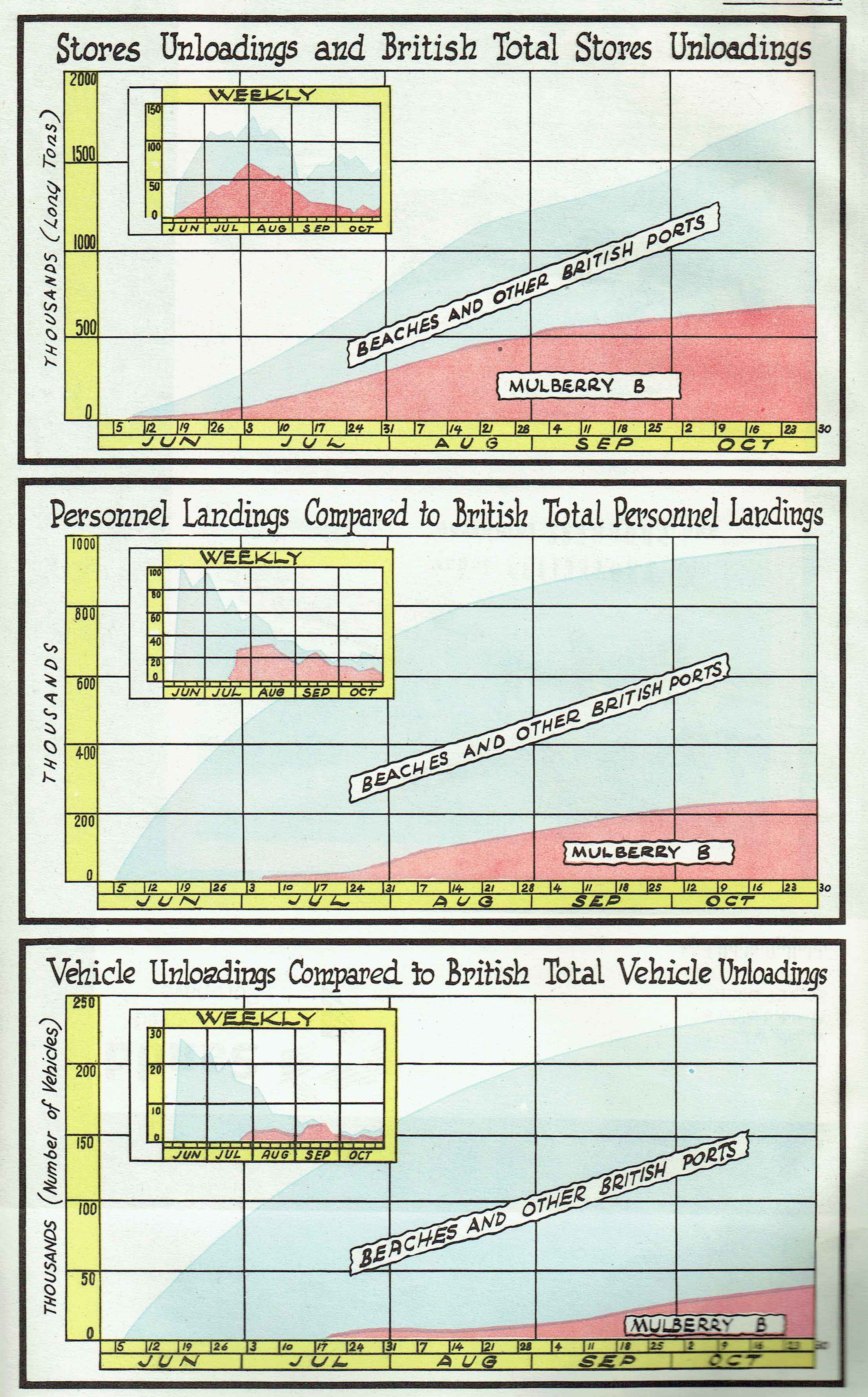
Small coasters were unloaded in PORT-EN-BESSIN and preloaded barges discharged there and at COURSEULLES. OUISTREHAM and CAEN could not be developed until cleared of the enemy and out of range of gunfire.
For some time after the capture of CAEN, the coastal defences at CABOURG continued to dominate the approaches to OUISTREHAM. The port of CAEN is reached by the OUISTREHAM-CAEN canal. The domination of OUISTREHAM therefore delayed the opening of CAEN.
The IWT organisation which did yeoman service with its tugs, PBRs and Rhinos loaded with MT, was faced with great difficulties during the stormy weather which prevailed during most of the first three weeks of the operation. IWT workshops were quickly set up and repairs put in hand, but the fact is that during bad weather the Rhinos were not really suitable for their task, being under-powered. They functioned more satisfactorily during the better weather later, but generally proved a continuous source of trouble.
The railway personnel were phased in after the ports and IWT personnel, but apart from reconstructing minor lines, repairing wagons and developing one or two rail served depots, it was impossible to do much during this phase. The railway signals branch of Tn began to function during this period, but their work can better be discussed later.
By the end of this phase, 16,000 tons of Tn stores had been landed and two Transportation Stores Depots set up.
In addition a number of small stores dumps were established at important centres of Tn activity. Without going into details of all the various types of equipment used in this operation by Tn, it can be stated that generally the equipment provided was found to be adequate in spite of the difficulties of weather which were encountered. It should be borne in mind, however, that every combined operation must be regarded as an individual problem and treated as such, and no hard and fast conclusion as to the suitability of equipment for all combined operations can be drawn from the experience gained in OVERLORD.
Postal
Postal
Prior to the operation formations had assumed a closed address “APO ENGLAND” and the Home Postal Centre NOTTINGHAM was carrying out the functions of Concentration Office for the force.
In addition the Postal branch of CANADIAN Section GHQ l Echelon 21 Army Group had joined the Postal Directorate of HQ 21 Army Group. In view of the fact that the distance to UK was so short and casualties were being evacuated direct to UK from the outset, it was decided not to establish a Postal Tracing Section for units other than CANADIAN.
Instructions were there fore sent out to units to return to the Army Post Office for return to senders all correspondence addressed to individuals who were deceased or missing, or whose address was not known or who had been evacuated to hospital and in respect of whom no redirection card had been received within fourteen days. The usual safeguards to prevent premature return of such correspondence in the case of deceased or missing personnel were applied.
The first postal personnel to land in the theatre were those of 6 Airborne Division who landed by parachute and glider well before H-hour. The postal personnel of 1 and 4 Special Service Brigades followed about an hour after the sea assault began, just prior to the arrival of the beach group detachments personnel.
The next to arrive were the personnel of 50 Division, 1 and 30 Corps postal units, who established their “D” (divisional) and “HT” (corps) offices and future “S” (static) offices. Second Army Postal Unit followed and established an “S” office which also acted as a cross post centre for the formations ashore.
DADAPS (Deputy Assistant Director Army Postal Services) 1 and 30 Corps were in sole charge of the postal services in their own sectors until D+5 when Second Army took over.
Locations Control (21 Army Group) was established on the Continent on D+ 6. HQ L of C with a staff increment from 21 Army Group took over the Base and L of C Area on 13 July and HQ 21 Army Group Advance Section took over from them on 29 July.
Arrangements had been made for the delivery of mail to assault units on D+l. In fact deliveries did not commence until D+2 due to shipping difficulties, but the placing of mail was found to have been generally satisfactory.
In the case of follow-up formations cut-offs of unit mail in the UK had worked well and all formations found their mail awaiting them on arrival in the theatre.
The first despatch from the theatre was made by Beach Group APO S688 on 8 June.
On 20 June all despatches to UK were taken over by 8 Base Army Post office at CREPON, which had the CANADIAN Base Post Office adjoining it.
On 6 July a two way airlift of first class letter mail only, was established between the theatre and UK, leaving parcel mail to be convoyed as before by surface routes. The first day’s lift to the theatre consisted of 8,100 lbs. of BRITISH mail and 1,600 lbs. of CANADIAN mail, while the first despatch by air from the theatre amounted to 7,000 lbs. of mail.
This resulted in an immediate improvement in the service to the troops, but the service to the UK continued to be unsatisfactory, and many complaints were voiced both by the troops and in the Press. It had been thought that shipping delays were responsible but when the introduction of the airlift failed to improve the homeward service, further investigations were carried out and the cause of the trouble was discovered to be dislocation of the civil postal services in LONDON as a result of damage from flying bombs.
The maximum amount possible of correspondence was immediately diverted to provincial distribution centres and an instant improvement was noted.
The establishment of firm and efficient surface links had proved to be more difficult than expected. Loading in the UK was delayed by the failure of lighters to find the correct coasters, while on the theatre side it was held up by the inability of the authorities on shore to locate the ships containing mail until thirty-six to forty-eight hours after they had anchored. An officer was given the full time job of patrolling the anchorages in an amphibious jeep to locate the mail ships, and thus hasten unloading which was normally carried out with DUKWS. This resulted in an improvement in the service.
During this first phase the force changed its address three times. At the outset it was “APO ENGLAND”; on 22- June this was altered to “British Western European Forces (BWEF)”; and finally on 14 July as a result of a high level political decision, the address was again changed to “British Liberation Army (BLA)”, which title was retained throughout the campaign.
Supply and Transport
Supply and Transport
In the early stages of the campaign a considerable proportion of the stores which had to be imported into the beach-head consisted of supplies and petrol.The Directorate of Supply and Transport was faced with the problem not only of providing them on a very large scale but of transporting them from coasters to beach dumps and later to roadheads, the distance to which increased as the campaign progressed. Provision of the commodities was carried out without any great departure from normal principles but careful planning was necessary in order to solve the difficulties of their conveyance across beaches in proper quantities and sequence.
SUPPLIES
Each man in the force landed with two twenty-four hour packs which were for consumption during the first forty-eight hours ashore. Apart from these the only rations employed for a considerable time were “fourteen-man Compo packs”, which proved to be very successful.
Airborne supplies for the two parachute brigades of 8 Airborne Division were carried initially by packing normal first-line scales on the man and in containers, in addition to which all spare space in the aircraft and gliders was used to stow such stores as supplies and ammunition.
Supply maintenance through BMAs was carried out according to plan and two DIDs were allotted to each beach sub area, while 33 and 38 Port Detachments and another DID were established in 4 L of C Sub Area.
The sites chosen in 101 and 102 beach sub areas were suitable but those for Nos. 2 and 5 DIDs at CREPON were cramped and unsatisfactory. Depot sites in 101 Beach Sub-Area were moved three times, having sustained shell fire, and the majority of the stocks landed into the DIDs in that area were destroyed.
Morale was good from the outset and casualties were light but it was found that there was insufficient labour at all depots. As no Corps FMCs were yet open rations were drawn by first or second line transport direct from BMAs’.
By D+6 approximately two day’s reserve of Compo had been built up by means of a planned rate of one third of a day’s reserve per day from D-day onwards.
An extra fifty tons of shipping space was allotted to S & T on the express coaster which sailed on D+5 and this was used for shipping urgent additional requirements.
The express coaster service was also used for shipping bread for hospital patients daily after D+13.
Owing to the operational situation the supply depots in No. 1 Army roadhead were formed in the area of LA DELIVRANDE by the amalgamation of depots in 101 and 102 BMAs. This was not a satisfactory location but no alteration in site was possible before the capture of CAEN.
No.2 Army roadhead however, formed from 104 BMA was located NORTH, EAST and SOUTH of BAYEUX and proved to be an excellent site for supplies with plenty of room, good natural cover and a suitable traffic circuit.
Base Supply Depots, from which formations were maintained, were established in both roadheads.
By the end of this phase the Field Service Ration had been introduced but it was wholly a preserved ration except for bread which was available in limited quantities from the beginning of July. It had not proved possible to provide frozen meat during this period although steps were taken to provide cold storage at ARROMANCHES in anticipation of it becoming available.
The storm which lasted from 19 to 22 June caused a virtual cessation of unloading but fortunately substantial reserves had already been built up and 8,200,000 rations, representing approximately fifteen days reserves for the force ashore, were in depots in addition to formation holdings on 19 June against the planned figure of 7,200,000.
COAL
Since it was impossible to estimate the precise uses for which coal would be required and in order to have as few different qualities as possible, it was decided to select a coal suitable for several purposes called “GP” or general purpose coal. To facilitate handling all solid fuel was packed in 70 lb. bags.
About 20,000 tons of coal had been packed in the UK and moved to various ports in ENGLAND and WALES ready to be shipped as required and during the period 6 June—25 July approximately 8,000 tons were shipped to the BRITISH sector and taken on charge by 67 and 73 DIDs. As all cargoes shipped were mixed commodities no vessels were loaded with solid fuel only. These DIDs had been given instructions handling coal prior to D-day by working for a period with civilian coal merchants.
TRANSPORT
The planned phasing in of MT units was based on certain known factors such as the minimum tonnage and mileage required to support the assault and the maximum planned capacity of the beaches. There were, in addition, certain forecast factors which were not as certain, such as the build-up of reserves, the progressive build-up of personnel and the forecast of dates for the progress of the operation. In planning these forecasts were treated as firm facts from which the amount of transport required and the dates of landing were calculated.
For the many other imponderables, such as rate of depreciation of MT coys by vehicle casualty, the amount of bridging to be undertaken or the requirements for troop carrying at different stages etc., only estimates could be made. Planning proceeded on that basis and Second Army were to be responsible up to D+17 for the phasing in of such units as they thought necessary for normal Base and L of O transport work, beach work, medical etc. in addition to their own requirements. For tasks which were not a Second Army responsibility e.g. construction at PORT EN BESSIN and motor craft for Tn HQ 21 Army Group nominated a few units for phasing in by Second Army. On completion of Second Army planning HQ 21 Army Group phased in all remaining transport units up to D+60.
The most interesting feature concerning transport was undoubtedly the operation of the 2 1/2 ton amphibious truck known as DUKW. Eleven General Transport Companies were equipped with DUKWS, ten of which were employed exclusively in transportation of stores from coasters and other craft lying off the beaches or from MULBERRY B to dumps ashore.
Part of the remaining company was used to evacuate casualties from the beaches to LSTs while the rest of it was used to bring stores ashore. The companies were an outstanding success and contributed greatly to the maintenance of the forces over the beaches.
During the 24 hours ending 1800 hours D+5 the quantity of stores carried over the three beaches, SWORD, JUNO and GOLD, by amphibians exceeded 10,850 tons. Thirty-six DUKWs were in need of replacement due to damage: of these, about 60 per cent were damaged by mines, 30 per cent by shell fire and 10 per cent by the torpedoing of an LST.
Drivers of amphibious vehicles had great difficulty in recognising and locating ships in the smoke but managed to achieve five turn-rounds between 0500 hours and 2300 hours daily, which was at times more than shore arrangements could handle. DUKW tyres sustained heavy wear and the need for replacements became acute. Otherwise the spares situation was generally good due to the fact that parts that were urgently required were despatched by air.
The work of the DUKW companies and of the Tn units, who were already engaged in the construction of MULBERRY B was considerably assisted by two motor boat companies which arrived during the first two days. One equipped with fast launches was employed in the control of DUKWs while the other, equipped with harbour launches, was employed chiefIy in the ferrying of Tn personnel. The motor boat companies had a very low incidence of casualties losing only one launch in the operation.
In addition to stores landed by DUKWs RASC transport was employed both to clear beached craft after they had dried out and, to a lesser extent, the stores brought ashore by Rhino ferries. These were taken to sector stores dumps which were sited just off the beaches and later, to BMA depots when they opened on D+2.
When roadheads were formed the distance from the beaches to depots was too great for DUKWs and it became necessary to establish transhipment areas into which DUKWs delivered their loads. Those units which were to constitute the basic army transport of Second Army remained under control of army and were allocated to lift stores forward from transhipment areas to roadheads. The remaining general transport was placed under HQ L of C who became responsible for movement of stores in rear of the army roadheads.
From the transport point of view this period was characterised by the long hours of the drivers and the bad road conditions which were to have their effect on the vehicles at a later stage.
After D+9 the transport situation changed considerably and there tended to be a surplus of transport for the immediate task, but this reserve was essential in case of a break through. As casualties had been very much lighter than expected the two Ambulance Car Companies in the theatre were only 25 per cent employed during this phase. However, such units as Tipper Companies employed mainly on RE tasks were in great demand and distinguished themselves by their hard work.
POL
It was planned to maintain the forces on the Continent up to D+18 by fuel products packed in UK. The total tonnage involved amounted to 63,000 tons which included the requirements of the RAF. From D+ 18 onwards although the maximum quantity of packed POL would continue to be imported so that the largest number of containers would be available in the theatre, it was proposed to concentrate on importing increased quantities of bulk petrol.
To make the plan effective, small depots were landed in the early stages to receive packed products and to issue them subsequently as required. By D+ 1 there were two Petrol Depots type “C” in each of the beach sub areas. The heavy demand for ammunition as early as D+1 caused a reduction in POL tonnage but even though imports were considerably decreased and 100,000 gallons of petrol and derv were lost by enemy action on D+2 a reserve of POL was rapidly built up because the consumption in the small bridgehead was one third of the planned figure.
By D+6 1,000,000 gallons of POL were stacked in the depots representing a reserve of approximately 2 1/2 days for each vehicle ashore.
While these stocks were accumulating a reconnaissance party had confirmed that PORT EN BESSIN, the small port planned to be used for bulk petrol storage, would be excellent for the purpose.
By D+6 the construction of Tombolas, which were pipelines running some hundreds of yards from the water edge to permit deep draught tankers to discharge off-shore, was put in hand. In spite of bad weather and high seas which retarded the construction work the first tombola was working by 24 June and the first load of bulk petrol was discharged from ship to storage at the pumping rate of 80 tons per hour on 30 June.
By the end of July storage tanks capable of holding 9,800 tons of MT80 and 2,000 tons of aviation spirit had been completed on shore by the Engineers assisted by Pioneers.
When the army roadheads were functioning the packed petrol imports were divided between them most, however, going to No. 2 Army roadhead at BAYEUX as this was to be the first part of the RMA to be developed.
By 5 July, although bulk petrol was beginning to flow steadily into the theatre, packed products were also arriving in large quantities and in order to deal with this tonnage extra petrol units were landed so that by this time there was one petrol depot type “A”, nine type “B” and nineteen type “C” working within the beach-head.
Units to handle bulk fuel were also necessary and the first Mobile Petrol Filling Centre arrived on 30 June and the first Bulk Petrol Transport Company on 5 July.
It was confirmed on 20 June that work in UK on PLUTO which was a scheme for laying cross channel oil pipelines on the ocean bed was so far advanced that the project could be launched on the capture of CHERBOURG, where the first lines were to be connected. In the meantime work had proceeded in laying the pipelines in the RMA.
Printing and Stationery
Printing and Stationery
The Order of Battle of P & SS on D-day was as follows :—
BRITISH
1..GHQ Printing Press
1..Mobile Printing Section
2.. Mobile Duplicating Sections
2.. Publications Depots
1.. Stationery Depot
2.. Advanced Stationery Depots
CANADIAN
1.. Mobile Printing Section
1.. Advanced Stationery Depot
One mobile duplicating section was allotted to HQ 21 Army Group and one to HQ Second Army.
The two BRITISH advanced stationery depots served Second Army and L of C while the CANADIAN advanced stationery depot served First Canadian Army and CANADIAN units on L of C. The remaining units worked as GHQ installations except for the CANADIAN mobile printing section which accompanied HQ First Canadian Army.
Demands for P & SS stores, the first of which emanated from the theatre on 11 June, were met by express coaster consignments until the advanced stationery depot for Second Army began to function on 7 July.
By 16 July the depot was functioning to capacity but the unprecedented rate of consumption of certain items especially those used in the production of fire plans necessitated the shipment of a considerable quantity of stores by express coaster after that date.
On 20 July the depot which was to serve L of C arrived but the CANADIAN advanced stationery depot was delayed some weeks.
Considering the size and nature of the operation, the number of typewriters lost or damaged beyond repair during the assault, or by subsequent enemy action, was surprisingly small.
The only printing unit in the theatre during the period under review was the mobile duplicating section attached to HQ Second Army.
It arrived on 2 July and started functioning at VAUX-SUR-SEULLES on 6 July when it produced the first issue of “Second Army Troops News” which was produced daily thereafter.
All other printing required by the force was produced in UK and all military publications, including the weekly 21 Army Group General Routine Orders, C-in-C’s messages of 6 and 10 June and 11 July etc., were distributed from UK.
Ordnance
Ordnance
MAINTENANCE
For the first four weeks the force was maintained from special packs of stores known as “Landing Reserves” each one comprising approximately 8,000 cases calculated to maintain a brigade group or equivalent formation in ordnance stores for thirty days.
For planning purposes and to allow for losses, delays in off-loading and to ensure adequate reserves to meet possible heavy demands, it was assumed that one of these sets would maintain a brigade for fifteen days only.
The quantity and nature of the stores in each set was based upon experience gained during previous operations and included special sets to maintain such equipment as AVsRE and flails.
From D+26 the force was maintained from Beach Maintenance Packs, similar to LRs, but containing a more comprehensive range of stores sufficient to maintain a division or equivalent formation for thirty days, plus some special packs for the maintenance of particular equipments. One BMP for a division weighed approximately 500 tons and contained some 12,000 cases.
From approximately D+100 onwards, maintenance was to be carried out in the form of Standard Maintenance Packs which included spare parts for heavy artillery, signal and wireless stores, clothing and general stores, sufficient to cover the needs of the force apart from fourth line repairs of vehicles and equipments which were not in any case carried out in the theatre.
The residue of stores from one period of maintenance was used in succeeding periods.
In addition to the stores held by OBDs, all formations ashore were supported by the Ordnance Field Parks who landed complete with spare parts and complete equipments such as guns, small arms, Wireless sets etc. and vehicles for issue to units of their formation. The OFPs were mobile and sited well forward in order that their stocks would be readily accessible to units. Replenishment of stocks of the OFPs was made from the BMA and RMA depots.
Maintenance of the force in ordnance stores was based on the fact that UK would remain the base and that only advanced depots holding a limited range of stores would be located in the theatre of operations. It was realised therefore that not all of the stores required by units would be available from theatre reserves, either because stocks were temporarily depleted or because they did not come within the range of LRs, BMRs or other phased programmes.
To meet such demands a special arrangements was made with UK depots whereby the indents were sent by fast boat or air to an Indent Clearing Centre in UK, whence they were sent to the depots in UK holding the type of stores concerned.
Priority was given by these depots to the despatch of such stores, which were sent to a transit depot in UK for coordination and shipment to this theatre in a small coaster known as the “Ord Ship”. Such stores were handled by a Stores Transit Sub Depot in the AOD who assembled all stores for a formation and arranged direct delivery. In the case of operationally urgent stores fast coaster or aircraft were used to bring the stores over.
ORDNANCE BUILD-UP
The first ordnance units to land on D-day were six OBDs capable of handling all types of ordnance stores, two Independent Ammunition Companies to assist the ammunition sections of the OBDs, two Port Ammunition Detachments and one Port Ordnance Detachment for supervising the unloading of ammunition and stores from the ships.
These units had the task of maintaining the assault troops with stores from the LRs. In the first place however, dumps were established just off the beaches on D-day and D+1, comprised mainly of ammunition, survivors’ kits, blankets and stretchers.
By D+1 reconnaissances were being made of the sites for BMA dumps to be established a few miles inland to hold the LR-s and ammunition.
Throughout the campaign all units in the theatre had left in the UK some of their unit equipment not immediately required, thus ensuring full mobility on landing. This remaining equipment was shipped separately as “unaccompanied G1098” which was assembled in ordnance depots on arrival in the theatre and issued to the units concerned.
On D+2 and D+3 detachments of 17 BAD, 17 Vehicle Company of 17 AOD and two Ordnance Maintenance Companies landed to recce sites for permanent depots in what was to become the RMA. Unfortunately the recce party of 17 AOD was torpedoed and almost completely lost but another was organised and landed with the advance party on D+7. The three Stores Companies of 16 AOD also landed with 17 AOD and were merged and operated with the latter.
The site chosen for 17 AOD near VAUX-SUR-AURE proved satisfactory but initial difficulties were experienced because that area was occupied at the same time by two divisions and a tank transporter column. It opened however, for issues on D+26 from BMPs and LRs, the latter having been diverted from OBDs from D+7 onwards. The stormy weather at this period seriously delayed the build-up of ordnance reserves to the extent that by D+23 only 19,139 tons out of the planned 39,240 tons of stores had been landed. Arrangements were made to open OBD stocks in the BMA to OFP and for Ordnance Sub Parks to commence demanding on the AOD.
Final disbandment of the OBDs was carried out at a much later date and the personnel then became available for other duties such as tank kitting sections for corps, staffing Officers’ Shops etc. On the closing down of the OBDs all stocks of their controlled stores were transferred to No. 1 Ordnance Maintenance Company to form an initial army reserve of two days wastage of stores for Second Army. The other ord maint coy (No. 1 Canadian Ord Maint Coy) subsequently became the army roadhead depot for First Canadian Army.
17 Veh Coy brought in their first reserve vehicles on D+7 and set up a vehicle park in the vicinity of 17 AOD. Another vehicle company landed on D+18 with the first of the phased programme vehicles, the drivers then returning to UK to bring over more vehicles.
The first Mobile Laundry and Bath Units landed on D+12. The bath sections of these units operated with forward units, often under shell and mortar fire, providing a change of clothing and baths for the troops. The laundry sections in the early stages of the campaign concentrated on providing clean linen and clothing for hospitals until relieved by base hospital laundries. One MLBU is capable of providing clean underclothing and a bath for every man in a division once per week.
An Army Industrial Gas Unit landed on D+ 18 to produce oxygen and acetylene for workshops, RE Services and medical Units, which helped the shipping problem by reducing the back-loading of empty cylinders to UK for refilling.
On D+22 the recce party of 14 AOD which was to be the main ordnance depot in the RMA landed; it was planned to open the depot in the CAEN area but as this was still in enemy hands and it was necessary to press ahead with the preparation of the depot, it was sited at AUDRIEUX. An immense amount of work was necessary to transform the open countryside into a semi-permanent depot. It was necessary to drain the whole area and then erect 200 steel framed canvas huts. Roads were made and railway spurs run into the depot from the adjacent main line.
During the time 14 AOD was building up its depot and preparing to issue stores from standard maintenance packs, 17 AOD continued to maintain the force from BMPS and the residue of LRS.
AMMUNITION
Ammunition requirements for the force were phased in at special assault rates to replace estimated expenditure until D+3, with reserves calculated at 21 Army Group rates of wastage. Then, both replacement of expenditure and reserves were phased in at 21 Army Group rates until after D+31 when FFC intense rates were used. Initially ammunition was received by the ammunition sections of the OBDs assisted by the ammunition companies under the direction of corps acting through the beach sub areas.
HQ 17 BAD landed on D+5 to co-ordinate the activities of all ammunition depots ashore under the direction of HQ Second Army who assumed administrative responsibility for all stores depots and ammunition depots in the theatre on that day. On D+12, 15 BAD took over the ammunition dump in 104 Beach Sub Area, thus forming the ammunition dump for No. 2 L of C Terminal (No. 2 Army roadhead) leaving 17 BAD free to take over the two ammunition dumps in 101 and 102 Beach Sub Areas, thereby forming the ammunition dump for No. 1 L of C Terminal (No. 1 Army roadhead). 12 BAD landed on D+18 and was sited adjacent to 15 BAD but did not open for issues until D+32 owing to the fact that operational troops were located within the BAD area.
All ammunition dumps in the bridgehead were laid out in accordance with the “User Type Principle” which was found to be most satisfactory, and speeded up the handover of ammunition to formations and units when collecting ammunition. Briefiy this principle involved dividing dumps into areas each capable of holding ten to twenty thousand tons. These areas were then subdivided into the following groups :-
Group 1 - AA ammunition
Group 2 - Fd arty ammunition
Group 3 - Tk and A.tk ammunition
Group 4 - Med and hy arty ammunition
Group 5 - Inf ammunition
Group 6 - Demolitions and associated RE stores.
Very little ammunition was lost due to enemy action except for a total of about 400 tons in the 101 Sub Area dump hit by shell fire during June.
Very heavy tonnages were handled by all ammunition units in the bridgehead. On D-day alone, 6,500 tons were landed and during the first ten days over 80,000 tons were landed to say nothing of heavy issues being handled at the same time. The average daily tonnage handled by the two BADs during the first two months of the campaign was 8,230, the peak day being 16,600, in comparison with the figure of 2,000 tons per day normally expected to be handled by a BAD. The maximum tonnage held at any one time during this period was 125,765 tons. Extensive use was made of pioneer companies in handling this enormous tonnage.
REME
REME
The first REME elements ashore were the beach armoured recovery vehicles of the beach recovery sections which landed immediately after the assault to be closely followed by D-8 crawler tractors and wheeled recovery vehicles. These beach recovery vehicles worked extremely hard under most adverse conditions as in places they were under shell fire and at night recovery work was made even more difficult by the presence of mines and explosive charges secured to under-water obstacles, to say nothing of the nightly visits from enemy aircraft.
“Drowned” vehicle parks were established near the beaches for the repair of drowned tanks, guns and “B” vehicles. In actual fact less than five per cent of the vehicles landed were drowned and even these were due not so much to faulty waterproofing but to a tendency for the craft carrying them to be beached in more than four feet of water. It was conclusively proved that well trained unit drivers are fully capable of waterproofing their own vehicles.
Under command of 1 Corps for the assault were eleven 2nd line workshops and four 3rd line workshops in addition to three beach recovery sections and one recovery company, consisting of three light and one heavy sections.
Armoured brigade workshops were given first priority in the phasing in, followed by corps troops workshops scaled for gun repair work. By D+3 seventy-five per cent of these workshops had landed and on the afternoon of D+1 three complete workshops, on assault scales, were already functioning.
30 Corps controlled units consisting of three beach recovery sections, one light recovery section and two composite workshops which were responsible for all repair and recovery in the BMA leaving the LADs and brigade workshops free to follow up their own units and formations. The composite workshops including attached specialist personnel for dealing with such equipment as AVsRE and flails accompanied by the light recovery sections landed on the first and second tides of D-day.
Between D+2 and D+11 669 vehicles were brought into the workshops of 30 Corps, 509 were repaired and returned to units and 130 classified as beyond local repair, the remainder being written off.
During the relatively static period after the initial assault the build-up of REME continued and the layout of its units in the RMA was planned in detail.
1 Corps were fortunate in that they had a suitable area of hard ground of which they made the best use by forming a “REME 'Workshop Area” which contained the corps troops workshop, two brigade workshops, four 3rd line workshops, a recovery company and a corps back-loading point.
It was found that the constant moves of divisions during this period from one sector to another considerably reduced output as they took their 3rd line workshops with them. It was therefore arranged that as a general rule 3rd line Workshops would not move from one corps to another but that each would have under command two armoured troops workshops and two infantry troops workshops whatever formations happened to be under command.
Due to lack of MT and gun spares it was necessary to cannibalise to a considerable extent and as a result 2nd and 3rd line workshops carried out work in excess of that laid down in permissive repair schedules. However, cannibalisation was essential in view of the urgent necessity of getting fighting equipment back into action and more than justified itself by the results obtained by the LADs of 6 Airborne Division, who, working under heavy shell and mortar fire to the EAST of the River ORNE, got equipment back to the division which could never have been repaired in time had spares been awaited.
The scrap section of 1 Corps’ back-loading point was called a “Help Yourself” park at first and was extremely useful to unit fitters who obtained many spares direct from the park. It was estimated that twenty per cent of all spares used in the early stages were obtained from this source which continued to prove invaluable when properly controlled for the use of REME and RASC only. In the main, however, spares were obtained from BMPs which functioned well except that identification was slow.
AFV Servicing Units whose task it was to service reserve “A” vehicles before being passed forward to the Armoured Replacement Group were not functioning until D+20. They were due to land on D+12 but bad weather conditions and alterations in the build-up delayed their arrival. In consequence a considerable number of reserve tanks awaiting servicing had accumulated and this back-log was never caught up.
The 8 Corps armoured thrust during this period involved about one thousand tanks operating on a narrow front.
There were twelve bridge crossings over the River ORNE and CAEN canal necessitating much recovery work and most of the recovery company was sited near the bridges. During the battle which followed most of the work of this company had to be carried out under very difficult conditions.
21 Advance Base Workshop which landed complete over the beaches on D+40 was working within four days of landing. This unit, although nominally 4th line heavy repair workshops and under normal conditions static, was in fact made fully mobile with all heavy machinery mounted on trailers.
Two special projects undertaken at this time are of interest. The AMERICANS were successfully using heavy fork-like attachments on the front of Sherman tanks for clearing hedgerows and undergrowth from the path of the tanks in the heavily wooded Bocage country. REME were asked to produce twenty-four samples for trial with BRITISH units. These twenty-four were made in three days from steel girders forming part of GERMAN underwater obstacles.
The second unusual task was a demand for the manufacture of one hundred and fifty penicillin sprays. These were made in fourteen days although no drawings were available. A sample sent from UK was used as a guide. Over one hundred more were manufactured at a later date.
Claims and Hirings
Claims and Hirings
The Directorate of Claims and Hirings was responsible for the disposal of all claims other than those arising out of contract or war damage and for the requisitioning and or hiring of land and buildings within 21 Army Group area. During June and July a total of 1,185 claims were received and 728 disposed of. In the same period 1,291 requisitions of real estate were recorded.
The first Claims and Hirings District Office was opened at BAYEUX on 16 June with sub offices at ARROMANCHES, COURSEULLES, PORT EN BESSIN, LUC-SUR-MER and CREPON.
Subsequently it was found that the existence of the sub offices involved complications, particularly in the matter of records and finance, and from the middle of July onwards these offices were gradually closed and the personnel absorbed by the district ofices as the bridgehead was expanded.
The Claims and Hirings detachment for Second Army reported to Rear HQ at RANVILLE on 2 July and officers were attached to Adm HQ First Canadian Army from 22 July. Elements were also attached to the various corps HQ. The presence of these officers with army and corps HQ proved to be of considerable assistance in regard to quartering, and their presence in the forward areas enabled them to dispose of certain claims which, had they remained outstanding, might have caused some ill-feeling between the inhabitants and the operational troops.
Intelligence summaries were also prepared from reconnaissance made of recently captured towns and villages with. a view to ascertaining the proportion of loss attributable to GERMAN or civilian looting or to war damage. These reports proved of considerable assistance when claims were subsequently made under more static conditions.
In this phase the technical policy regarding both Claims and Hirings remained as it had been developed in ENGLAND and laid down in the Claims and Hirings manuals issued to all the officers of the Directorate.
It was based on the assumption that FRENCH local administration would be found to be considerably disrupted, but this was not the case and it was decided that it would be able to function with reasonable efficiency within a short time.
Discussions were begun with representatives of the FRENCH Intendence with a view to the Directorate confirming itself to the service of requisition demands on the local authorities leaving the FRENCH Government to carry out all subsequent regularisation including the assessment and payment of compensation for the occupations in accordance with the normal Intendence practice. These discussions were satisfactorily concluded in August.
Labour
Labour
The policy for the employment of labour was to retain as great a proportion as possible on a pool basis. The only exceptions to this rule were fixed allotments of :—
• Ten companies to airfield construction
• Fourteen companies to Tn
• Four companies to Smoke Control
• Four companies for pipeline construction.
On D-day thirteen pioneer companies landed on the beaches on the first tide and ten more on the second. By the end of D+2, the finish of the initial assault, three Pioneer Group HQs and forty-two companies had landed and by D+5 the total had increased to ten groups and sixty-three companies.
The role of one assault company is typical of the rest. The men were divided into serials each with a particular task and on separate landing craft. The first serial was made up of one officer and seventeen men who landed at H+20 minutes to clear mines and to dig the command post in readiness for the beach group commander and his staff.
Eight serials, each with one corporal and 6 men landed with REs at H+45 minutes to establish eight exits from the beaches to a lateral road by laying down Sommerfeld track. Three serials, each commanded by an officer, landed at H+100 minutes to reconnoitre two miles inland for a place to establish and dig in the beach sub area HQ.
Other companies which landed later on D-day, unloaded and assembled bridging equipment and assisted in the preparation of bridge approaches. Some felled timber to construct corduroy roads while others demolished road blocks. Three companies specially trained in first aid and stretcher bearing were allotted to the beach sub areas and other companies off-loaded assault craft and began the build-up of beach stores depots.
All anticipated commitments for the initial stages had been covered in the plan but the ways in which labour would have to be used in the first few days could not be entirely foreseen and therefore an Assistant Director of Labour was appointed to each of the two corps to act as labour adviser and to coordinate the work of Group HQ.
As these were phased in they quickly took over operational command of their companies and brought back into the general labour pool those which had been married to a particular service for the assault.
By 25 July all but ten companies of the entire Pioneer Corps Order of Battle comprising thirty-five groups, two hundred and fifteen companies and twenty Administrative Units (Civil Labour) totalling 63,000 officers and men, had been phased into the bridgehead.
During the build-up ten companies were employed on making tactical air landing strips and one group and four companies were used on constructing the landward extension of PLUTO.
Casualty Clearing Stations and hospitals received an allotment of Pioneers for general duty work and stretcher bearing. Four companies were used initially for unloading ships at MULBERRY B and others were employed unloading ammunition, petrol and supplies in the transhipment area, the army roadheads and corps FMCs.
At one time twenty companies were employed repairing roads in the beach-head and constructing new by-passes.
Other companies were attached to divisional REs for forward road work and bridging, and REME employed sections for repairing and salvaging landing craft and tanks.
When First Canadian Army arrived in the bridgehead it assumed command of all pioneer companies employed with Canadian Army formations and roadheads.
For the assault seven groups and thirty-seven companies out of L of C pioneer resources were placed under command of Second Army, all of which were to be returned when control of the RMA became a L of C responsibility. Some of these units, however, had been necessarily committed to tasks of a forward operational nature. Thus, when L of C installations were phased in they had in some cases to employ units which were unaccustomed to their particular stores, habits and organisation.
It had always been the plan to supplement military labour by some form of civil labour and for this purpose AUCLs were formed and were responsible for employing and paying all available civil labour required by the employing Services in liberated territory.
As NORMANDY was largely agricultural with a small population, only 756 civilians were employed by D+30 but also working within the bridgehead at the same time were two mobile labour groups employing 500 civilians recruited from those who had been bombed out or who were ready to leave their homes.
During this phase the multiplicity of commitments which could not be foreseen in planning and which the Labour Directorate was called on to fulfil at short notice, was met by phasing forward units from UK before the L of C installations they had been planned to work with were required in the beach-head.
Veterinary and Remount
Veterinary and Remount
There were no V and R units included in the Order of Battle of 21 Army Group at this stage except a HQ staff consisting of a lieutenant colonel, major and three clerks.
As there were no veterinary officers on the staff of Civil Affairs the V and R staff was sometimes called upon for technical advice concerning civilian owned stock.
In July V and R 21 Army Group assumed veterinary responsibility for all dogs on the strength of units in the Order of Battle. As far as possible all dogs had been inoculated against rabies before despatch to BLA.
In order to cope with the large number of horses which it was expected would be captured, mobilisation of a Veterinary and Remount Conducting Section was requested, to serve as a war dogs hospital in addition to its normal functions.
No animals were held by any units except war dogs which were employed by certain CMP(VP) companies and by special RE dog platoons for mine detection. Approximately 400 RUSSIAN and POLISH ponies were captured but not being suitable for employment with the BRITISH Army were handed over to FRENCH farmers. Release of a supply of drugs and instruments to the FRENCH was arranged from army veterinary stores in UK.
Salvage
Salvage
Until the arrival of a Field Salvage Unit and a Salvage Collecting Centre Unit on D+8 small dumps along the beaches were manned by beach group personnel under the direction of the AD Salvage, Second Army and an Area Salvage Officer with HQ, L of C. By D+23 there were six dumps in operation including those at No. 1 roadhead and No. 2 roadhead and the latter had handled over 1,000 tons of material.
Large quantities of airborne equipment were sorted at the dump at OUISTREHAM and shipped to the UK before the end of June. The recovery of parachutes was not good however, as many of them were retained by troops and civilians for the silk.
Early in the operation it was decided that ammunition empties would be returned through salvage channels. Extra pioneer labour was permanently allotted to FMCs and roadheads for this commitment which continued throughout the campaign.
The first Base Salvage Depot was opened at CANCAGNY in the RMA on 24 July. The total tonnage of serviceable stores returned to Ordnance during this period was 7,328 tons.
Fire
Fire
Fire protection on land during the assault was provided by six Fire Fighting Companies, each consisting of a HQ and two first Class Fire Brigades. One company was responsible for each of the three beach sub areas, two companies for MULBERRY B, the RMA and No. 2 Army roadhead while the sixth was responsible for the defence of PORT EN BESSIN and the bulk petrol installations.
The plan for sea fire defence provided for one Fire Boat Company of nineteen fire boat sections to operate as follows :—
• PORT EN BESSIN - three sections
• MULBERRY B - four sections
• GOLD SECTOR - four sections
• JUNO SECTOR - four sections
• SWORD SECTOR - four sections.
This plan was not implemented in full owing to the fact that fire boats were not completed by contractors in time and during the early stages of the campaign there were not more than six army fire boats operating at MULBERRY B, PORT EN BESSIN and off the beaches. The company HQ was located at MULBERRY B.
During the dry weather in June the main problem was the provision of adequate water supply in the vicinity of dumps and depots. This was solved by the use of static tanks and basins among the depots in the RMA and by filling shell holes and bomb craters in No. 2 Army roadhead.
A water pipe line was run from ARROMANCHES harbour to feed static basins in the transhipment area and a similar line from PORT EN BESSIN provided the water necessary for the protection of the petrol storage tanks in that area. In No. 1 Army roadhead it was necessary to depend almost entirely on the water carried in fire tenders.
Control centres for the receipt of fire calls and despatch of AFS units were established at PORT EN BESSIN, BAYEUX, ARROMANCHES, COURSEULLES, OUISTREHAM and DOUVRES-LA-DELIVRANDE.
The total number of fires attended by Army Fire Service during this phase was 109 of which 44 were caused by enemy action : six of these were major fires. During the critical weather period in June sections of MULBERRY B were kept afloat by continual pumping from fire boats which also carried out much salvage work among shipping.
NAAFI/EFI
NAAFI/EFI
(Navy, Army and Air Force Institute/Expeditionary Force Institutes)
The first EFI personnel were landed on D+17 and on the following day they established the first Base Canteen Depot (BCD) under canvas at SULLY.
Within six days the BOD was being supplied direct from MULBERRY and arrangements made with RASC for the handling of EFI stores.
To supply troops who arrived up to D+30 issues of NAAFI/EFI special packs were made. These packs were designed to provide cigarettes, matches, stationery, razor blades, soap etc for thirty men for twenty-one days and were in addition to 17,500,000 cigarettes and 3,140 lbs of tobacco issued free during the early stages of the campaign.
On 13 July eight Bulk Issue Stores were opened and the first two mobile canteens started operating while on 20 July the first “Nobby Bar” opened in CAEN, and a further eighteen mobile canteens were on the road.
Reinforcements
Reinforcements
As foreseen, it proved impossible in the early stages to submit formal demands for reinforcements by arms of Services and trades and it was not until D+28 that GHQ 2nd Echelon was able to render the first full return to the War Office. Subsequently these demands were made at intervals of fourteen days.
Reinforcements supplied by the War office were despatched to four reinforcements groups which, although in UK, operated under the control of 21 Army Group. Personnel drafts were called forward from these groups to the Continent as required.
From D-day until D+8 reinforcements were despatched from UK to Corps Reception Camps located in the BMAs and then distributed to units in the corps. In order to help the control and documentation of reinforcement personnel, a small clerical staff from GHQ 2nd Echelon (BRITISH) was attached to each CRC, while a representative of GHQ 2nd Echelon (CANADIAN) was attached to 1 Corps Reception Camp to control the postings of CANADIAN personnel.
When HQ Second Army arrived in the theatre the Advance Reinforcement Sections of GHQ 2nd Echelon (BRITISH) and GHQ 2nd Echelon (CANADIAN) also established themselves in the beach head. These arrivals made adjustments to the predetermined planned drafts possible and also provided machinery for demanding personnel that were urgently required.
HQ 21 Army Group arranged facilities for the despatch of such reinforcements at twelve hours notice from the UK. On D+8 101 Rft Gp which previously had been allotted to Second Army landed on the Continent and set up in the area of BAYEUX. From that day reinforcements were despatched from the beaches to 101 Rft Gp and therefore came under control of HQ Second Army who authorised their postings to units.
For the period D to D+17 drafts of reinforcements had been prepared in accordance with the planning demands of divisions.
In addition, 101 Rft Gp was scheduled to land with 6,000 officers and men by D+8. For the first few days the build-up of reinforcements proceeded according to this plan but on D+8 there were sufficient reserves in the beach-head to warrant the postponement of the scheduled landings for two days.
From D-day to 26 July, 44,563 BRITISH and 13,323 CANADIAN reinforcements were despatched from UK to the Continent for 21 Army Group. These totals fell far short of the planned figures as, owing to the casualties being lighter than was expected, the wastage during the first month was reduced by fifty per cent of the estimate.
101 Rft Gp experienced great difficulty at the start as it had been allotted only three platoons of transport to convey reinforcements to units in different parts of the beach-head. Furthermore some drafts from UK arrived badly kitted and no stocks existed in the holding units at this time to make up any deficiencies.
Discipline
Discipline
POLICY
While the units and formations of 21 Army Group were stationed in the UK the responsibility for the detailed administration of discipline was placed on the Home Commands but all matters of policy affecting them were the responsibility of HQ 21 Army Group.
The Commander-in-Chief received from His Majesty a warrant to convene General Courts Martial and to confirm findings and sentences in the field. Delegated warrants were issued to the Commanders of First Canadian Army, Second Army, and to Corps Commanders and Commander L of C.
It was the policy of 21 Army Group to retain in the theatre any soldiers who were convicted of a military offence and sentenced to detention, imprisonment or penal servitude and to hold them in 21 Army Group penal establishments. It was considered essential, however, that up to the time these penal establishments arrived in the theatre, soldiers under sentence should be evacuated, and by the middle of July the following numbers had been despatched under escort to the UK :—
• Sentenced to penal servitude - 48
• Sentenced to imprisonment of over one year - 19
• Sentenced to punishment other than the above - 38
The escorts were provided from the theatre and the soldiers were handed over to Garrison HQ SOUTHAMPTON who became responsible for their disposal.
A certain number of troops absented themselves from their units prior to D-day. The policy of HQ 21 Army Group in dealing with these absentees was to despatch them when they were apprehended to a Reinforcement Holding Unit and to ensure that they were sent overseas with their unit or with an early reinforcement draft.
MILITARY PRISONS
One Military Prison large enough to hold 500 soldiers under sentence and five Field-Punishment Camps each to hold 150 were allocated to 21 Army Group. First Canadian Army was to establish its own field punishment camp but was not to have a military prison as all soldiers sentenced to one year’s detention or more were to be evacuated from the theatre. No. 5 Field Punishment Camp arrived on the Continent on 2-3 June, opened on 18 July and held forty-six soldiers under detention on 26 July.
COURTS MARTIAL
HQ 21 Army Group had planned to have two Court Martial Centres at its disposal.
The objects of these centres were :—
• To relieve units in the line of the responsibility of paper work in connection with trials.
• To hasten the disposal of cases.
• To hold courts which would sit permanently and be presided over by a permanent president.
• To relieve units of the responsibility of guarding soldiers awaiting trial, promulgation or committal.
A centre accommodated 150 soldiers and was designed to try 100 cases a week. fifteen permanent presidents of FGCsM (Field General Court-Martial) were allocated to 21 Army Group.
It was decided to utilise permanent presidents for the following reasons.-
• To relieve fighting units of the responsibility of providing a senior officer as president of FGCsH.
• To ensure that similar sentences were awarded in all formations for similar offences.
• To endeavour to prevent technical errors in procedure which often lead to the quashing of convictions.
Permanent presidents landed with the assault corps and were required to preside at FGCsM almost immediately.
Some of the officers chosen for this responsibility were proved to be too old or of a too low medical category to conduct trials under the battle conditions which prevailed during the early days, and were consequently relieved of their appointments.
Prisoners of War
Prisoners of War
In order to relieve the fighting troops of the administrative task of looking after prisoners of war, it was decided that in the initial stages, until PW camps were established, all prisoners would be evacuated to the UK as they accumulated day by day.
Escorts provided by the War Office from D+1 were based on SOUTHAMPTON and crossed to the beach-head in specified LSTs to collect prisoners.
The arrangement did not always work smoothly. This was due to the LSTs being unable to wait off-shore long enough to allow the escorts to land and locate their prisoners, and also to the fact that owing to the irregular arrival of LSTs, prisoners were not always ready to be embarked when required. In the early stages no documentation was carried out until the prisoners reached UK.
Six PW camps, each scheduled to accommodate 200 officers and 2,000 ORs were put at the disposal of 21 Army Group.
The first of these arrived on the beaches on D+1 and was employed under command of Second Army as a collection and transit centre.
Another arrived on D+5 and set up a transit cage at ARROMANCHES. When these‘ camps were established documentation was carried out on the Continent for those PW who were to be retained in the theatre for labour. The policy of evacuating prisoners to the UK continued.
Plans had been made to handle PW in the initial stages on the following scale :—
D to D+9 at 500 per day - 5,000
D+l0 to D+29 at 1,000 per day - 20,000
Total of 25,000
This estimate however, far exceeded the total number of captured, which by 26 July amounted to only 12,153.
One unexpected problem arose when it was discovered that many prisoners were in possession of large sums of FRENCH currency, some having as much as 15,000 francs in their possession.
PW are usually allowed to retain all their property until they reach the base camps and are registered. It was undesirable to allow them to retain these large amounts because the money was a potential aid to escape and also tempted soldiers to trade with prisoners at exorbitant prices.
The bulk of this money was therefore withdrawn at army PW cages and handed to the field cashier for retention on behalf of the prisoner concerned.
The prisoners taken during this period were amenable to control, assisted in making their own cages, and made few attempts to escape. They included persons of nationalities other than GERMAN, with RUSSIANS and POLES predominating.
Chaplains
Chaplains
Two DACsG and forty to fifty other chaplains landed during the first 24 hours. The work of spiritual ministration to troops was carried on in the forward areas with good effect on morale.
During the whole of this first period it was noticeable that units were punctilious about burying their own dead, but unwilling to dispose of fatal casualties of other units, even though the bodies were within the unit area. This had an adverse a ect on the morale of those in the area.
Medical
Medical
MEDICAL BUILD-UP
In the assault stage of the operation Field Ambulances landed with brigades and battalions as planned, and each beach group landed on D-day with a self-contained medical organisation comprising two Field Dressing Stations, two Field Surgical Units and a Field Transfusion Unit supplemented by small surgical teams.
With the exception of the right flank where the landings met opposition at LE HAMEL, field dressing stations were working and surgeons were performing operations in all the beach groups by H+90.
By D+2 it was possible to concentrate the Casualty Clearing Stations and the hospitals which began to arrive at the beach-head into three principal medical areas, HERMANVILLE, REVIERS and RYES.
By D+6 it was necessary to close down the area at HERMANVILLE to make way for the expansion of a neighbouring ammunition depot, and a new medical site was chosen at LA DELIVRANDE.
In the latter part of June a fourth area was developed near BAYEUX. The field dressing stations within the corps were situated near the casualty clearing stations and attended to the lightly wounded, exhaustion cases and sick, leaving the CCS clear to handle major casualties.
The hospitals in the rear medical areas received casualties from the corps CCS.
Early in July BAYEUX developed into the main L of C hospital area, and when HQ L of C took over administrative command of the bridgehead on 13 July it also took over the REVIERS concentration of hospitals.
The RYES area was closed down, and when, in the meantime, First Canadian Army assumed responsibility for the LA DELIVRANDE group, there remained two main hospital areas.
For most of July the Second Army hospitals remained static and in the latter part of the month closed in readiness to move forward.
EVACUATION BY SEA AND AIR
Casualty Evacuation Posts were established on each of the three beach sectors on D-day but enemy shelling caused the CEP (Casualty Evacuation Point) on SWORD sector to close down after the first few days, and all its casualties for evacuation were sent to the CEP on MIKE beach. Later the evacuation of casualties was further simplified by concentrating the casualties in JIG and MIKE beaches. This central CEP at COURSEULLES was enlarged and formed out of two FDS, two FSU and one FTU. It had accommodation for 1,500 casualties and held cases until shipping and weather permitted evacuation.
Evacuation to UK was carried out by means of LSTs modified to carry stretcher cases, hospital carriers and medically manned LSTs for walking wounded. These were loaded initially off-shore by DUKWS specially allotted for medical purposes.
On D-day and D+1 the rough sea made evacuation difficult and if a decision had not been taken to beach the LSTs, the evacuation of casualties would have ceased and the CEPs would have been overcrowded.
The policy of using medically adapted LSTs, and setting aside DUKWS for medical purposes worked extremely satisfactorily; there were, however, misunderstandings and difficulties concerning the arrival of hospital carriers. Eventually it became routine for an officer of the CEP to meet the carriers in a DUKW and guide them to the proper anchorage.
By 26 July 38,581 casualties (including sick) had been evacuated to UK by sea.
Evacuation by air began on 13 June which was a week. earlier than had been anticipated in planning.
Air evacuation was more uncertain than sea evacuation because the airfields on which suitable aircraft arrived changed constantly and there was always uncertainty as to the number of aircraft available. The problem was also complicated because no facilities existed on the air strip for holding casualties. Consequently no preparations could be made for evacuation until the aircraft had landed, and in a congested beachhead it was not always possible to deliver casualties at the air strip on time.
The necessity for dual documentation was another factor which caused a heavy strain on fighting units.
On 18 June ,however, the whole evacuation scheme was centralised under 11 L of C.
A Medical Air Liaison officer was attached to 83 Group RAF, 81 General Hospital, and later, 77 General Hospital at REVIERS was made the principal collecting centre for casualties to be evacuated by air, and a single air strip was selected for evacuation purposes.
RAF Casualty Air Evacuation Units began to arrive at this time and assisted in holding casualties on the airfield until aircraft were available. The holding capacity of these units was not large enough to deal with the numbers to be evacuated and on several occasions a FDS or CCS was sited to help out in this task. The number evacuated by air up to 26 July was 7,719.
MEDICAL STORES
There was no shortage of medical stores in the assault period and only minor losses of equipment occurred.
The system of supply over the beaches depended on the daily delivery of Medical Beach Maintenance Blocks, each composed of two half blocks weighing 25 cwts. and containing items of medical equipment designed to meet all reasonable demands until Advance Depots Medical Stores were established.
Two of these were sent over in split loads of five and ten tons between D+3 and D+10. This was considered necessary in view of possible sinkings. In addition six tons of medical equipment were preloaded on RASC transport to augment the medical maintenance blocks.
BLOOD TRANSFUSION
To meet the expected demands for transfusion fluids in the early days of the operation, the following arrangements were made :—
• Special issues of blood were made to the assault forces.
• Transfusion fluids were included in the maintenance blocks.
• FTUs landed with an estimated supply to last two days.
• Two Advance Blood Banks were landed on D+3 and allocated to each of the corps fronts.
• Supplies of whole blood were sent initially from UK by naval despatch launch and later from D+16 by air.
In a later stage of the campaign the two blood banks which had been allocated to the assault corps were put at the disposal of First Canadian and Second British Armies. These were supplied with blood from No. 1 Blood Transfusion Unit which landed on D+16 and set up at BAYEUX.
The supply to corps and divisional medical units was maintained by a daily service of trucks carrying blood from the army advanced blood bank. Penicillin was also distributed through the agency of the Blood Transfusion Service.
During this phase the following quantities of blood, plasma and penicillin were used : -
Blood . . . 18,000 pints
Plasma . . . 15,000 pints
Penicillin . . 2,400 mega units
EXHAUSTION
The incidence of cases of exhaustion rose steeply from the beginning of July (2.5 per 1000 per week) to the week ending 22 July (5.63 per 1000).
Enemy mortar fire was stated to be the main cause of the collapse of these psychiatric cases.
To deal with them Divisional Exhaustion Centres were opened, where casualties who could be quickly cured were admitted for four or five days. Corps Exhaustion Centres admitted casualties evacuated from divisional level for seven days’ treatment.
Beyond these at the Army Centres and at the Second Army Rest Camp men were treated and then given a period of convalescence.
Over 65 per cent of exhaustion casualties were returned to duty in the theatre. Of these 50 per cent returned to full duty, and the other 15 per cent to duty in a reduced medical category.
DENTAL
The employment of Mobile Dental Units at a distance of two or three miles in the rear of troops engaged in battle was fully justified, for the dentists were able to give treatment in the battle zone and retain the services of men of operational units, who would otherwise have been evacuated to the rear areas.
HYGIENE
The solution of hygiene questions did not present any serious difficulties. The water supply was not tampered with by the enemy, but required strict supervision. flies began to appear in large numbers and anti—fly precautions were improvised until fly-proofing materials arrived.
FEMALE NURSING
Nursing sisters began to arrive in the theatre from D+10 onwards. Their arrival was much appreciated because they improved the standard of post-operation treatment tremendously.
Pay
Pay
Throughout the early days of the operation the work of Imprest holders in operational units, the supply of funds, and the accounting for expenditure, worked smoothly and on simple lines, because the changeover to the Active Service System of accounting had taken place as soon as units entered the concentration areas.
All the difficulties which the change entailed had been met and overcome before the operation began. Each officer landed with an advance of pay book and every Imprest holder had previous contact with the appropriate cashier, and was familiar with the procedure for drawing and accounting for Imprest funds in the field.
As there was a possibility that the enemy in retreat would destroy large quantities of FRENCH currency notes, supplemental FRENCH francs were specially printed in AMERICA to meet the emergency.
Of the total number printed the share allotted to 21 Army Group was 2,899,500,000 francs.
By agreement with the FRENCH Provisional Government the rate of exchange was fixed at 200 francs to the pound sterling.
Immediately prior to embarkation all ranks were paid 200 francs. Corps and divisional Field Cashiers embarked with a set of seven boxes of currency specially prepared in suitable note denominations and waterproofed. The value of each set was 4,750,000 francs which was estimated to cover the formations expenditure for two weeks.
On 21 June the Base Cashier disembarked at MULBERRY with 5 1/2 tons of preloaded currency to the total value of 335,440,000 FRENCH francs. This bulk supply was safeguarded in the cellars of the Chateau de COURSEULLES which had been specially reinforced by concrete. Further supplies of preloaded currency were landed during the period 29 June to 17 July. In all a total of 65% tons of francs, amounting to a sterling equivalent of $321,750,000 was despatched to FRANCE without the loss of a single franc.
Corps and divisional Field Cash offices landed with their formation HQ.
Between D+2 and D+12 eleven Field and one Area Cash Office arrived and commenced to operate. No. 3 Forward Base Pay ofifice, which disembarked on D+13, took over the buildings of a bank in BAYEUX for the purposes of distributing funds to forward cashiers and payment of military bills.
Later this unit moved to DOUVRES and made the underground passages of the radar station there into vault accommodation for the bulk supply of currency. During the period D+18 to D+24, a further seven field cash offices arrived in the beach-head together with an advance detachment of No. 9 Command Pay offices.
Provost
Provost
ORGANISATION
Elements of all three wings of the Corps of Military Police were planned to land with the assault forces on the first and second tides of D-day, They comprised :—
• Three Divisional Provost Companies (each of HQ and six sections) whose task was to regulate and control traffic of the assault and follow-up brigades,
• Six Beach Provost companies (each of HQ and four sections) and several traffic Control Sections, which were responsible for control of traffic and signing of routes in the beach transit and assembly areas.
• Ten sections of CMP (VP) who were responsible for guarding PW, detaining suspect civilians and Constructing cages.
• Two Corps Provost Companies who were deployed to control the area between the beaches and the forward divisions.
During the build-up the provost strength in the beach-head increased by the addition of :—
• A provost company for each division phased in after the assault.
• Four provost companies, four TC companies and one VP company for each of the armies.
• Seven provost, seven TC and three VP companies for L of C areas. L of C Provost were phased in earlier than planned, to assist in the main problem of organising traffic.
With the exception of beach provost companies who had more work than four sections could adequately handle, the allotment would have been sufficient had it landed according to plan, but owing to the failure of the Rhinos and the rough sea conditions, only divisional and corps provost companies arrived on time.
The result was that there was no proper supervision of assembly areas on the morning of D+1 and the narrow exits from the beaches were inadequately controlled.
On the afternoon of D+1, when the LSTS were beached and a flood of delayed traffic was released, there was considerable congestion on the beaches and far too few Provost to control it.
By D+2, however, more Provost had landed and the situation was greatly improved.
By D+3, although the volume of traffic was steadily increasing the forward and return routes in the BMA were working satisfactorily. With minor alterations the original‘ traffic circuits were found to be successful.
TRAFFIC
During the subsequent build-up the problem of 'maintaining an easy flow of traffic was complicated because a modern rnechanised army was attempting to manoeuvre on a system of narrow and badly maintained roads which had been designed to carry the slight traffic of an agricultural area. Within a few weeks of landing, the beach-head, which at that time measured only a little more than twenty miles broad and ten miles deep, contained 115,000 vehicles.
At one check post 18,836 vehicles passed by in one day, giving an hourly average of 785 vehicles, or nearly one vehicle every four seconds of the night and day. The policy at this time was to accept any vehicle on the road at any time, and the general object of all concerned was to keep traffic moving at all costs. Despite every effort the towns of COURSEULLES, BERNIERES, LA DELIVRANDE and BAYEUX quickly became bottlenecks.
The problem was eventually partially solved by :—
• Building tank tracks, lateral cross country roads and by-passes.
• Instituting a system of movement control. In the absence of a firm plan for traffic control, movement tended to take place during the hours of daylight, leaving the roads relatively free at night, but after the institution of movement control all operational traffic was timed to take place during the hours of darkness, when administrative traffic was less heavy.
SIGNING
Although each provost company carried into the beach-head a reserve of signs and signing material, so that there would be little delay in laying out routes, the task was so tremendous that each company had to resort to improvisation at an early stage.
During the build-up period the congestion of formations, depots and installations in the beach-head produced a confusing multiplicity of signs. To make the system of signing uniform, Provost became responsible for co-ordinating all route signing. Each company set up a sign factory operated in the initial stages by its own personnel but later by Pioneers, civilian carpenters and sign writers.
COMMUNICATIONS
Each corps and army was allotted a CMP (TC) signal section which proved to be invaluable, for by operating their own network of signal communications the police were greatly assisted in their problem of controlling traffic.
CRIME
There was little crime recorded during this phase, but it is dificult to say how far this was due to the fact that everyone was busily occupied and how far to the fact that the time and attention of the Provost was almost entirely taken up with traffic control.
One Special Investigation Section was allotted to Second Army and during the build-up was fully occupied in investigating cases of looting and illegal disposal of WD stores.
Education
Education
The main function of the Education Service during the early stages of the operation was to stimulate and maintain morale by the early dissemination of news. Each formation issued a daily broadsheet compiled by the Staff officer Education, based on the BBC broadcasts and close liaison with the General Staff of their HQ.
The first of these to be published on the Continent was that of 3 British Infantry Division on D+3 and the aim was to get the broadsheets containing the previous day’s news to the front line troops early each morning.
Quite early on there arose a demand for classes in FRENCH and, to a lesser extent, in GERMAN.
The chief diificulty about this was the lack of text books as the entire stock of the FRENCH and GERMAN series allotted to 21 Army Group was destroyed in LONDON by enemy action. Classes were held, however, and glossaries of the more common words and phrases required in daily contact with the FRENCH people were published. In the case of several formations lists of GERMAN technical terms were produced for the benefit of technical units dealing with captured enemy material.
At least two Study Centres were established, one at the Second Army rest camp near ARROMANCHES and the other at OUISTREHAM which functioned in spite of enemy shelling from across the river. In addition to the libraries contained in these study centres, boxes of fifty books, eighty per cent fiction and twenty per cent of a more serious type, were distributed to units on demand and ten thousand Penguin editions were allocated within 21 Army Group.
Graves
Graves
At the outset the scale of graves units in the beach-head was as follows :—
• With First Canadian Army
- two Graves Registration units (GRU)
- one Graves Concentration unit (GCU)
• With Second Army
- five Graves Registration units.
The first BRITISH GRUs landed on D+3 and by 20 July 44 the number of graves registered was 8,000 out of a total of 12,500 burials reported by formations.
It is considered that these figures would have been improved if GRUs had been allotted territorially instead of, as in Second Army, one GRU per corps and one for Second Army Troops, since it was found that formations and units would often report burials to their original GRU after changing from one corps to another, even though the original GRU was not in a position to register their graves in the new area.
The only other difficulty experienced at this stage was due to the failure of the manufacturers to complete on time their contract for delivery of ten thousand prefabricated metal crosses. As a result graves units had to improvise with small wooden crosses, assisted whenever possible by crosses made from RE sources.
Welfare
Welfare
Welfare stores, including sports equipment, were issued before D-day. Sports equipment was specially packed in “composite” cases, as for example, the football “composite”, which contained cases, bladders, laces, repair outfits, inflators, lacing-awls and dubbin. In addition, there were soccer and rugger match packs, each pack containing a complete outfit of clothing, including boots. 1,000,000 cigarettes and a supply of pipe tobacco, the gift of members and friends of the Oversea League, were shipped to the theatre each week.
Arrangements were made through the War Office with the Newspapers Association for the provision of BRITISH daily newspapers on a scale of one per ten men. Papers were packed in standard packs by a military unit and were despatched to the Continent, first by sea and later by air.
The first despatch was on D-day, but owing to cancellations in sailing, boats going to the wrong beach etc., arrivals of newspapers in NORMANDY were irregular for the first week, but some forward units did receive their newspapers on D+2.
The total number supplied on D-day was 56,000 which was stepped up a month later to 96,000. The cost of provision of the newspapers was borne by NAAFI.
Five “Stars-in-Battledress” parties, phased in with corps troops, landed on the beaches on D+8. They gave programmes within a mile of the front line, on a stage which was usually a 3-ton lorry with the sides down. Six ENSA mobile parties arrived on D+5.
Towards the end of July, the first mobile canteens arrived, and they began at once to operate among the forward troops.
Between D-day and 26 July, 5,500 wireless sets were issued.
Five Army Kinema Service sections, each consisting of two dual 35 mm and eight 16 mm cinemas landed in the bridgehead between 15 June and 26 July, and cinema shows were successfully given for eight hours each day to large audiences.
Civil Affairs
Civil Affairs
Although as previously stated it is not intended to discuss the organisation or activities of Civil Affairs in detail in this history, mention must be made of the very considerable assistance that was rendered by them during this phase.
The thirty detachments comprising one Civil Affairs Group placed under command of Second Army were deployed either with divisions or on specific tasks of civilian importance.
They coped with the refugee problem and thereby removed any anxiety on that score from the fighting staffs, although the problem proved smaller than had been anticipated. In addition the information that they gleaned from civil sources was invaluable in discovering the limitations of live and dummy minefields.
The siting of the depots in the RMA was in many instances greatly facilitated by the co-operation they achieved with the FRENCH farmers in ensuring an early cutting and harvesting of their crops and fields.
The above are only examples of ways in which the progress of the armies was directly assisted by the work of Civil Affairs.
Abbreviations
To see more abbreviations click here