6 June 1944 - 25 July 1944
The main task which devolved on the Transportation Service was to discharge and clear in conjunction with S & T the planned tonnage of 900,796 tons of stores in addition to hundreds of vehicles over the beaches or through ports, during the months of June and July.
As stated elsewhere, due to bad weather and difficulties in establishing the Ferry Craft Control, this figure was not quite reached. As it was, over 750,000 tons were brought ashore without the aid of a proper port.
Unlike other Services, Transportation normally controls all Tn troops on the ground direct from HQ 21 Army Group. This course was not possible at the beginning of operation OVERLORD. During this first phase, therefore, all Tn activities were controlled by an advanced HQ of Tn 21 Army Group which was placed first under command of HQ 11 L of C Area and then under command of HQ L of C until the arrival of HQ 21 Army Group in the theatre.
It may be said that from a Tn point of view, this operation was largely successful, but the complexities of the problems and all the technical planning and execution by the Tn Service, in conjunction with the Movements Staff of HQ 21 Army Group are too great to enable a complete picture to be given in the brief space available.
During the first few days the responsibility for discharging ships was that of the beach group commanders who were assisted by their port operating staffs. In addition the craft ferry service run by the Navy and the DUKW ferries organised by the RASC were controlled through the same channels.
Initial difficulties was experienced in evolving a proper ferry organisation and cases of serious delays to ships occurred. As the weeks passed the anchorages became more centralised, control became easier and a definite split in functions was made so that MT was passed over GOLD beaches and stores were centred on JUNO.
As the operation proceeded, the Port Operating Groups took over complete responsibility for the discharge of ships and for controlling the unloading of craft when beached. An improved turn round of ferry craft was already being obtained in the first week of July by centralising control of ferry services. The phasing in of Port Operating Companies kept pace with the tasks that they were set.
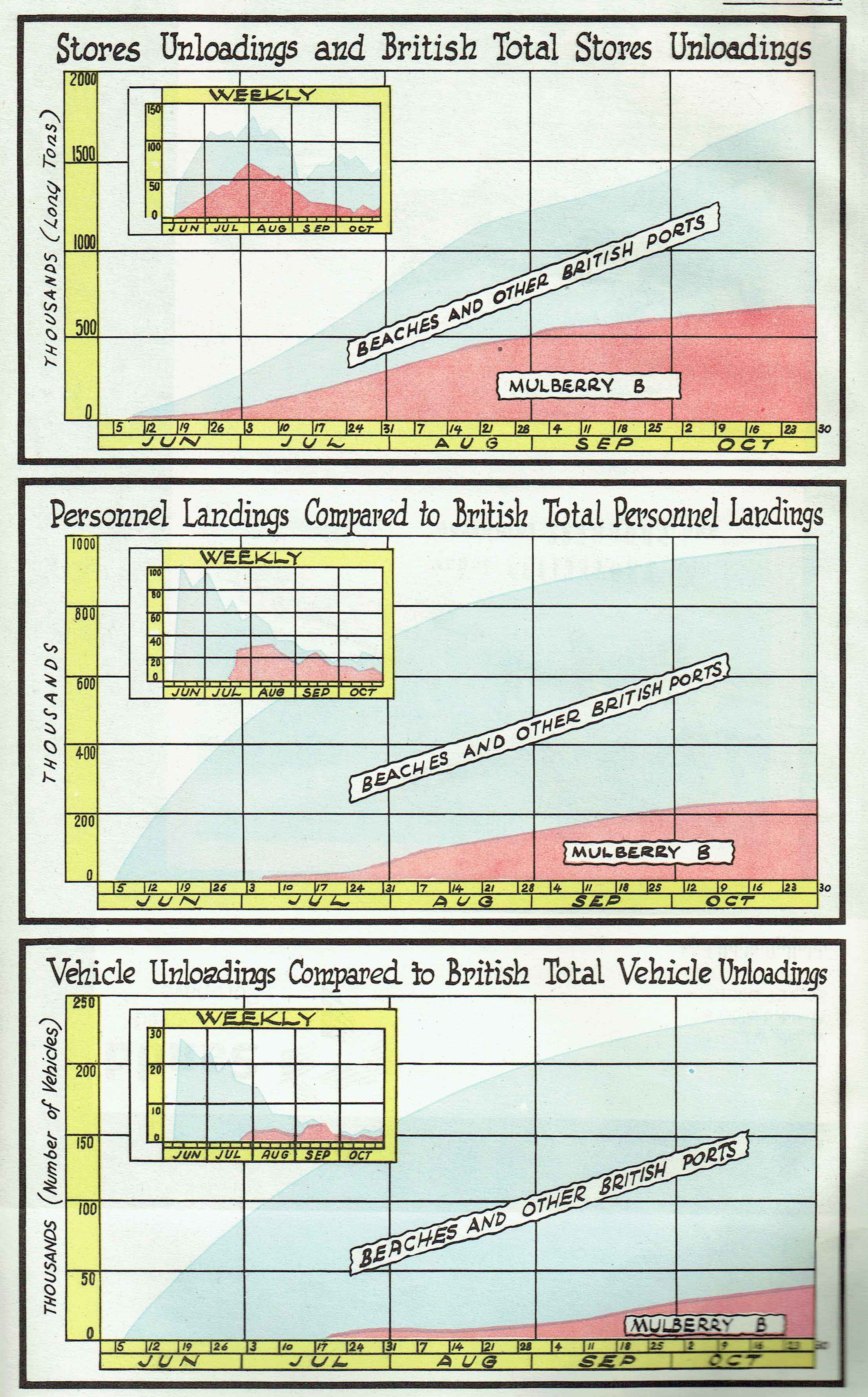
Port Construction and Repair units were landed at the same time as port operating units to repair the small ports of PORT-EN-BESSIN, COURSEULLES and OUISTREHAM. A special port construction task force was also landed at the same time to carry out the construction of MULBERRY B. An account of this will be found at this image”.
Small coasters were unloaded in PORT-EN-BESSIN and preloaded barges discharged there and at COURSEULLES. OUISTREHAM and CAEN could not be developed until cleared of the enemy and out of range of gunfire.
For some time after the capture of CAEN, the coastal defences at CABOURG continued to dominate the approaches to OUISTREHAM. The port of CAEN is reached by the OUISTREHAM-CAEN canal. The domination of OUISTREHAM therefore delayed the opening of CAEN.
The IWT organisation which did yeoman service with its tugs, PBRs and Rhinos loaded with MT, was faced with great difficulties during the stormy weather which prevailed during most of the first three weeks of the operation. IWT workshops were quickly set up and repairs put in hand, but the fact is that during bad weather the Rhinos were not really suitable for their task, being under-powered. They functioned more satisfactorily during the better weather later, but generally proved a continuous source of trouble.
The railway personnel were phased in after the ports and IWT personnel, but apart from reconstructing minor lines, repairing wagons and developing one or two rail served depots, it was impossible to do much during this phase. The railway signals branch of Tn began to function during this period, but their work can better be discussed later.
By the end of this phase, 16,000 tons of Tn stores had been landed and two Transportation Stores Depots set up.
In addition a number of small stores dumps were established at important centres of Tn activity. Without going into details of all the various types of equipment used in this operation by Tn, it can be stated that generally the equipment provided was found to be adequate in spite of the difficulties of weather which were encountered. It should be borne in mind, however, that every combined operation must be regarded as an individual problem and treated as such, and no hard and fast conclusion as to the suitability of equipment for all combined operations can be drawn from the experience gained in OVERLORD.
26 July-26 September
Until the middle of August there was no great change in the activities of the Tn Service as unloading continued across the beaches and through MULBERRY and the small ports in the beach head in preparation for the expected advance NORTH.
But when the break-through to the SEINE took place, followed by the advance through FRANCE and BELGIUM into HOLLAND, Tn were faced with two big problems.
- Firstly, a long rail L of C from the RMA across the SEINE forward into HOLLAND had to be organised, and
- Secondly, in order to shorten the L of C and bring supplies by a shorter route through ports that would be able to operate right through the Winter, the Channel ports had to be opened.By the end of September both these tasks had been successfully tackled and a rail L of C existed from the RMA right through to EINDHOVEN.
The port of DIEPPE was open and the ports of OSTEND, BOULOGNE and ANTWERP were being made ready to accept shipping, although the use of ANTWERP depended on clearing the SCHELDT estuary of hostile elements.
The development of the rail L of C focused from the very start on the development of CAEN which had to become the main traffic and locomotive centre in spite of the damage that had been sustained there.
Energetic action had to be taken to repair yards, sidings, workshops and locomotive sheds, communications and signals. This was followed by the opening of the railway line to SERQUIGNY and to the SEINE and later railway construction troops were spread out all along the line to SERQUEUX and forward into BELGIUM. For this four railway construction and maintenance groups and fourteen railway construction companies had been brought over into the beach-head in readiness.
Throughout North-East FRANCE bomb damage at rail centres had been extensive and had been combined with serious demolition SOUTH of the SEINE, although NORTH of the river the demolitions were less widespread. A large number of bridges were down in the BRITISH zone in FRANCE and damage to installations and track was heavy.
The problem, from a 21 Army Group point of view, was a dual one. In the first place the most profitable route for repair had to be selected and in the second place the actual work of repair had to be organised utilising BRITISH resources and manpower and whatever assistance could be obtained from the FRENCH and BELGIANS.
The first part of the problem involved the use of a very wide range reconnaissance which was found extremely difficult to control and coordinate owing to the extremely bad communications and also to the acute shortage of transport.
It was decided, owing to the destruction of all bridges across the SEINE, to establish railheads SOUTH of the river with a road link across the river and rail tails somewhere NORTH of the river. This system was a makeshift to close the gap until the SEINE bridge at LE MANOIR was constructed on 22 September.
This bridge although 520 ft long was successfully completed in fourteen days. Two main bridges were also down across the SOMME, but it was found possible to bypass this damage by a diversion at DOULLENS.
Apart from this it was possible to get the L of C completed right through to BRUSSELS with the exception of a major bridge at HAL which was reconstructed by the BELGIANS.
In spite of the efforts of the railway operating organisation it was not until the end of September that the railways of FRANCE and BELGIUM began to show signs of settling down to provide any kind of reliable service. Communications were bad, particularly in the AMIENS arrondissement but after very close collaboration with the SNCF and the SNCB, the main trunk links and control circuits were nearly completed by the railway signals staff by the end of September.
The operating service was short of stock and locomotives due to an inadequate allocation of the engines being imported on allied account through CHERBOURG, but this problem had been gradually solved by the end of September.
The opening of the DIEPPE train ferry on 29 September finally overcame the problem of locomotive shortage, since locomotives for BRITISH use could thereafter be delivered direct to the BRITISH sector in accordance with a prearranged programme.
Amongst the most awkward of problems was that of coal, all of which was being imported from the UK principally via CAEN and CHERBOURG, and the coal traffic required for moving trains NORTH of the SEINE was taking up paths across the SEINE which could ill be spared.
Every effort was being made towards the end of September to arrange for coal to be provided from FRENCH sources in the mining area of the NORTH.
To tackle the problem of organising a rail L of C which was operated entirely by BRITISH troops in some sectors, by FRENCH and BRITISH in another and entirely by FRENCH and BELGIAN personnel elsewhere, great flexibility of organisation was essential.
It was found necessary by mid-September to drop the standard railway operating group and railway unit organisation in the area SOUTH of the SEINE and to set up a divisional superintendent’s office at CAEN.
At the same time the head of the railway branch left BAYEUX, where HQ 21 Army Group Rear remained, and went forward to ROUEN Where it could maintain some contact with TRANCO.
ROUEN had been selected as the base from which to send out the necessary railway construction reconnaissances and it was also suitable for the central control of railway operating.
Nevertheless it was soon found that it was necessary to have a railway operating headquarters further forward and a group HQ moved to AMIENS. As soon as BRUSSELS fell a railway staff was set up alongside the SNCB in that city.
In the area SOUTH of the SEINE the actual operating itself was complicated and difficult as it was a very bad section of line to work, so that at times it was not possible to attain the agreed programme.
The following are some of the particular difficulties encountered;
- first, a spate of rail breaks between CAEN and MEZIDON which was due to the effects of shelling
- second, accentuation of traffic-working difficulties by engine failures and hot axle boxes, particularly on the US double-headed through trains
- third, there was congestion in the CAEN yard and in the RMA area due to limited siding capacity, loading points and depots
- fourth, there was a shortage of engine power due particularly to insufficient numbers of BRITISH locomotives and insufficient shed facilities to handle the locomotives at CAEN.
NORTH of the SEINE, however, apart from the problems of water supply and repair of lines, the greatest difficulty encountered was that of re-organising the railway operating service in collaboration with the FRENCH and later with the BELGIANS.
Though the railway operating units could be used for this type of work they had been designed to operate railways rather than to assist others to do so, and their organisation was not altogether suitable for the latter task.
The second half of the problem on the Tn side was to develop the Channel ports as quickly as possible and thus relieve the strain on the L of C. It was not possible to open up CAEN as a port until the end of August, but other facilities were found to be adequate and, as a precaution, work continued on the winterisation of MULBERRY.
Preparations were made well in advance for opening each of the ports as they were captured. Reconnaissance parties were sent forward together with Royal Naval parties, the port commandant and sub-area representatives. They took with them a basic key plan to work from and were ordered to produce a final plan for the complete development of each port. For this Work the port construction and repair groups and port operating groups were utilised.
Representatives of 21 Army Group kept in closest contact with them in order to make the maximum possible use of facilities and resources at the disposal of 21 Army Group and to ensure that the planning of shipping and the shipping of stores could be modified to conform to the actual situation in each of the ports as they were captured.
The port of DIEPPE was captured on 2 September, by 7 September ships were being discharged there and by the end of the month a maximum of 7,200 tons in one day was being discharged and cleared by rail and road. The capture of BOULOGNE and OSTEND did not however provide two additional ports immediately as they were both in a very damaged state. All three ports were heavily demolished, blocked and mined, but in many cases demolitions were inexpertly and incompletely executed.
The factors which were most important in preventing these ports from opening quickly were mine clearance and the removal of block ships in the entrance. ANTWERP was taken by the end of the month but could not be operated because the SCHELDT was heavily mined and the GERMANS still occupied the river approaches.
The shortage of MT experienced by all in this phase had a very direct bearing on the administration and functioning of Tn units. With the advance most of the units had to change their location at least once if not twice and the movement of all these units with their impedimenta produced problems of the greatest complexity.
Not one of the Tn units was fully mobile and about 550 lorry and 100 transporter lifts additional to unit transport were required to move Tn units and equipment to the places where they were required to work.
Tn units could not, therefore, be moved with complete flexibility from place to place and in some cases were not able to get down to their Work as quickly as was desirable.
With the extension of the L of C from ARROMANCHES to EINDHOVEN the Tn Service became extremely difficult to control largely due to difficulties of communication.
On the move of HQ, 21 Army Group to BRUSSELS the DDTn (Ports) became directly responsible for the development of OSTEND and ANTWERP and through HQ 11 L of C Area for DIEPPE, LE TREPORT, BOULOGNE and CALAIS while MULBERRY B, PORT EN BESSIN, CAEN and OUISTREHAM continued to be developed under the supervision of HQ 12 L of C area.
The railways and stores organisations also moved to BRUSSELS leaving a divisional area organisation at AMIENS and a railway operating group at CAEN. The Tn Service was thus suitably disposed to prepare the build-up during the winter for the attack on GERMANY.
27 September 1944—14 January 1945
By the end of September it was apparent that the size and strength of the Transportation Directorate was inadequate to deal with all the complex railway problems of organisation which arose in FRANCE and BELGIUM. The Directorate of Transportation was therefore divided into two sub-directorates, Ports (including MULBERRY) and Railways, each headed by a brigadier.
The main railway activities centred around the restoration of the SNCB which was vital for the efficient development of the advance base.
At the same time the main rail L of C from the RMA to EINDHOVEN was further developed as the Channel ports were opened up, and progress was also made on re-opening DUTCH railways and canals. Apart from restoring the railway system and constructing sidings and depots, a great deal of equipment and stores was handed to the BELGIANS and DUTCH to assist them in essential development.
In addition many WD locomotives were brought into the theatre to relieve the shortage. The BELGIANS took over the responsibility of operating the railways, although Tn personnel continued to assist with the maintenance of locomotives.
In December the shortage of coal threatened to curtail rail movement, but by diversion of coal from non-essential consumers this danger was averted.
During October railway construction was in progress at widely scattered locations from SOUTH of the SEINE to the MAAS but the general movement of units continued eastwards.
At this time a railway construction and maintenance group was allotted to work in each of the areas controlled by First Canadian and Second British Armies but the groups "remained under the direct control of Tn Directorate for major tasks.
The maintenance of the L of C from the RMA to northern FRANCE was a considerable problem and consequently a complete railway construction and maintenance group was allocated for the purpose. The hastily repaired routes required heavy maintenance especially as the approaches to the SEINE were via secondary lines.
A fourth group was responsible for all other work in NE FRANCE from the SEINE to the FRENCH-BELGIAN frontier and undertook the necessary repairs in the ports of CALAIS and BOULOGNE.
The damage at ANTWERP was comparatively light, but considerable work had to be carried out before heavy traffic could be handled.
However, the extensive marshalling yards built for operating the modern NORTH docks were damaged by mortar and shell fire, and the enemy had lifted and removed thirty-five miles of track and over two hundred points and crossings from the rail layout in the port area.
Extensive railway construction however, was not found to be necessary for the development of ANTWERP as a base. Two transportation stores depots were established in the advance base one at HAL near BRUSSELS for bridging materials and the other at ANTWERP for miscellaneous stores.
In addition an advanced transportation stores dump was established at ACHT near EINDHOVEN.
Practically all railway bridges in HOLLAND had been destroyed by the enemy. The majority were over canals, and replacement spans rarely less than one hundred feet were required. Consequently at this stage of the campaign the demand for railway construction units reached its maximum.
Towards the end of November, the additional labour working with the units included eighteen pioneer companies, two docks operating companies, two railway operating companies and aport maintenance company. During November nineteen bridges, of which six were double line, were re-opened for traffic and work was in progress on twenty-two others : 4,000 linear feet of standard bridging were used during the month.
In November and December, the water level of the SEINE rose higher than for any corresponding period since 1910.
Nevertheless the bridge at LE MANOIR stood up to these conditions, a remarkable tribute to the value of “camels feet” foundations. The river flowing at a speed of 10 knots rose almost to rail level, and the bridge had to be kept under constant load.
By the end of the year the L of C was open to the River MAAS at RAVENSTEIN and MILL and railheads were available within ten miles of the forward positions of the armies. The main routes out of ANTWERP were open and repairs in the NORTH marshalling yards were completed; further WEST it had been possible to hand over the majority of the heavy maintenance commitment to the US Army and the SNCF but one railway construction and maintenance group remained in NE FRANCE and the Channel ports.
During the first six months of the campaign seventy-five railway bridges consisting of 202 separate spans had been wholly or partly reconstructed by BRITISH railway construction and ancillary units. Twenty—eight of these bridges carried two or more lines. These works had absorbed over 8,000 linear feet of new standard bridging material in addition to 1,640 linear feet of locally produced spans, while in the same period 2,500 linear feet of original spans had been repaired.
The HQ of the Tn Stores organisation which had moved to BRUSSELS was controlling two Tn stores depots and one Tn spares depot in the RHA, and two Tn stores depots with one Tn spares depot in BELGIUM. In October, however, one Tn stores depot in the REA was closed, and the personnel were moved to BELGIUM, where they opened a new depot at ECKEREN near ANTWERP.
In November approval was given for the formation of three type “A” and three type “B” Tn stores port detachments. At the same time recommendation was made for the formation of a machinery spare parts section RE for providing spares for locomotives and IWT craft.
On 12 September a port construction and repair company arrived in ANTWERP. Although the port itself was not badly damaged major repairs necessary to the KRUISSCHANS lock were not completed till December.
Quay sides were cleared of concrete obstructions, scrap steel etc., with the assistance of mechanical equipment sections and civilian labour. In view of the fact that it was a large port, special organisations were set up. The port superintendent was relieved of all port operating group administrative matters, and a group commander known as the deputy port superintendent, was made responsible for all the port operating and port maintenance companies. The port was then divided into five sectors, each under the direction of a dock superintendent and all Tn activities in the port Were co-ordinated by a Colonel Tn.
Apart from discharging MT and petrol ships, port operating personnel were used primarily in a supervisory capacity. The discharge of most of the other ships was carried out by civilian labour who were employed under contract on a tonnage basis. During the attacks on ANTWERP with flying bombs and rockets certain port installations were severely damaged and repairs were carried out by civilians under the supervision of PC and R personnel.
The Tn service was responsible for dredging the port and dredgers manned by Tn personnel improved the berthing facilities and also dredged the River SCHELDT. Subsequently an organisation was set up called tht “SCHELDT Dredging Control” which co-ordinated all such military requirements with the long term civilian policy.
Between 2 November and the end of January a total of 1,031,000 cubic yards had been dredged.
The port of GHENT was opened in December as an alternative to ANTWERP in the event of the latter port becoming totally or partially denied to us, and provisional arrangements were made for the discharge of up to 12,500 tons per day should it be necessary on a joint BRITISH and US account. The administration of this port was similar to that at ANTWERP. GHENT is reached through the TERNEUZEN/GHENT Canal.
The main sea looks at TERNEUZEN were seriously damaged. A hasty repair was made which enabled assault craft to get into the SCHELDT for the attack on WALCHEREN, the clearance of which opened the port of ANTWERP. DUTCH engineers estimated that permanent repairs would take six months.
A PC and R Coy was therefore deployed and completed a difficult engineering job in under two months. By 1 December the canal was clear for shipping and the first ship commenced discharge on 19 December. A new type retractable Bailey was built over the main locks to replace the demolished Bascule bridge.
Once ANTWERP was open, the port of BRUSSELS was developed exclusively for the discharge of barge traffic and by the end of January a daily average tonnage discharge of 2,376 tons was reached on BRITISH account.
At DIEPPE PC and R personnel concentrated on improving the general working efficiency of the port and although the tonnage handled was satisfactory it decreased rapidly soon after the opening of ANTWERP.
Damage to the port at LE TREPORT was slight and only a small number of PC and R personnel were employed for minor clearance and repair work. This port was only intended as an overflow to DIEPPE and consequently was only used to a small extent for discharging and loading vehicles on LSTs.
At BOULOGNE the port was extensively damaged and the only repair work carried out was to enable the required port capacity to be attained. It was not until 12 October that the first ships arrived and a daily average of 2,205 tons was reached during the month of November. finally, with the opening of CALAIS, the port was handed back to the FRENCH in January.
At CALAIS LST hards were constructed and completed by the end of November but it was not until January that stores were discharged at a daily average rate of 337 tons. This port was earmarked mainly for personnel and leave traffic.
A considerable amount of demolition had been affected by the enemy prior to the capture of OSTEND and the main entrance from the Channel was obstructed by at least eleven sunken ships. Reconstruction work commenced in September, and by mid-October the main tasks of clearance and repairs to quays, removal of wreckage and construction of LST ramps were completed.
After opening on 26 September it became the principal port for discharging coasters and bulk petrol.
During the month of January the average daily tonnage discharge rose progressively to 3,443 tons.
Little use was made of OUISTREHAM but the port of CAEN proved extremely useful for importing coal and stores into the RMA and latterly for exporting stores to the advance base and unwanted stocks to UK. Dredging operations at the entrance to the OUISTREHAM canal were started at the end of September and completed by the end of November.
In order to minimise the chances of flooding in that area, bridges and debris were cleared from the River ORNE by the end of November. This port attained a daily average tonnage of 1,232 tons during January.
In order that the important canal systems of FRANCE, BELGIUM and HOLLAND should be exploited to the full the Ports and Waterways Engineering Sections of the Tn Directorate of 21 Army Group were grouped in one branch so that the maximum use of engineering resources between ports and waterways could be made. The responsibility for IWT supervision of the reinstating of canals was taken over by the Canal Clearance and Repair Section of the ports and waterway engineering branch.
Concurrently with the clearance of the canals, the IWT operating branch began to re-establish the BELGIAN and DUTCH IWT operating organisations. The BELGIAN Government under Tn direction formed a centralized IWT organisation known as ORNI (Office Regulateur de Navigation de l’Interieur). Personnel of two IWT operating companies were deployed throughout BELGIUM, organising and controlling craft movement.
When ANTWERP was opened more and more resources were deployed on the canals at the expense of the Channel ports. A Port Mechanical branch was formed to control all mechanical units and to ensure that the mechanical engineering services required for the operation and maintenance of port and waterway equipment were put to the best advantage.
The main problem of Tn IWT was to re-establish the BELGIAN waterway organisation, as it was evident that IWT operating on military account would become one of the major methods of port clearance, particularly in the case of ANTWERP.
By the end of October the whole system of canals in BELGIUM was in satisfactory order, with the exception of the ALBERT canal. Clearance of this canal was started in October by BELGIAN contractors under the general supervision of the BRITISH and US IWT organisation and eventually opened to 600-ton craft by 15 December.
By the end of December, 207,800 tons had been moved throughout BELGIUM by IWT and clearance ex ANTWERP by IWT had reached approximately 3,000 tons per day.
Tn also undertook the clearance of the DUTCH canals and a start was made on the ZUID WILLEMS canal in HOLLAND. The main waterways in northern FRANCE were comparatively undamaged, the principal obstructions being demolished bridges which the FRENCH authorities, under our direction, were able to reinstate themselves.
15 January 1945 - 8 May 1945
Poms
During this period the policy was to make the maximum use of civilian resources in order to free BRITISH troops for the time when we advanced into GERMANY.
More and more of the routine work of daily operating of ports was therefore handed over to civilians, under Tn control. At ANTWERP for instance civilian stevedores were employed inconsiderable numbers along side Tn personnel and worked excellently despite the attacks by “V” weapons.
The handing over of CAEN, BOULOGNE and DIEPPE to the FRENCH released more port operating units in readiness for employment in GERMANY.
Port construction and rehabilitation continued in CALAIS, OSTEND, ANTWERP and CAEN and heavy work was undertaken at FLUSHING. However, dilution with civil labour inthese ports achieved the release of some sixty per cent of port construction and repair units under the direction of the Chief Engineer, for employment on the construction of permanent road bridges across the RHINE later in the phase.
IWT
Following the same principle the working of traffic on the BELGIAN canals was handed over to civilians, under the direction of Q(illov), on 2 March. This released units for work on the RHINE and also for preparing the IWT movement required by the relief operation into HOLLAND which was then being mounted.
When the crossing of the RHINE took place IWT assisted in the construction of the floating road bridges, and other personnel moved to ZWOLLE in readiness to take food to AMSTERDAM across the ZUIDER ZEE.
Other Tn units moved forward to take control of craft on the RHINE and on the various GERMAN waterways. However, the scale of destruction on the GERMAN waterways was found to be so great that opening them for traffic was clearly a long term task.
The IWT units were therefore employed to safeguard essential Tn installations.
Some port construction and repair units were brought in on the task of canal clearance in GERMANY as well as continuing the clearance of waterways in HOLLAND to which they were already committed.
RAILWAYS
The primary object of the Railways branch throughout the winter was to assist the BELGIANS and the DUTCH to make the best use of their railways. The urgent needs for locomotive and wagon repairs and the provision of bridging and signal materials were met so far as was possible and the stores handed over to the civilian railway authorities.
In the case of the NETHERLANDS railways Transportation assisted largely in the actual repair work on locomotives and rolling stock and in the distribution of stores. The HQ of the NETHERLANDS State Railways is normally at UTRECHT which was in the GERMAN occupied zone and few senior DUTCH officials able to revive their railway organisation were in the liberated parts of HOLLAND.
However, the signal communications for the main L of C SOUTH of the RHINE in HOLLAND were completely re-installed and a large amount of railway reconstruction undertaken from military resources.
The very cold weather in January and February combined with a shortage of coal, food and clothing, and the “go slow” policy so successfully employed during the GERMAN occupation combined to reduce the standard of operating on the railways.
When the weather conditions improved, however, wagon turnround was accelerated and in February the pool of wagons in ANTWERP awaiting loading had been reduced to seven hundred as compared with eighteen hundred in December. This was the equivalent of only one-and-a-half days’ requirements and was attributable also to improvements in our own technique in the use of wagons on these railways.
By March it could be said that the problems in BELGIUM and in the liberated parts of HOLLAND were becoming easier, so that it was possible to withdraw more personnel in preparation for the move across the RHINE.
The build-up for VERITABLE involved the re-construction and redevelopment of two L of C: HERENTHALS-NEERPELT—EINDHOVEN and WEERT, and ROOSENDAAL—BREDA—TILBURG—’s HERTOGENBOSCH—RAVENSTEIN—NIJMEGEN.
Much reconstruction work was required and in particular a large bridging job was necessary at RAVENSTEIN. The build-up for PLUNDER necessitated a carefully planned combination of reconstruction work and railway operating. That this was achieved is shown by the fact that thirty-five trains per day were being run each way over this L of C operating to a large number of railheads.
Eleven of these railheads were established in the NIJMEGEN-GENNEP-CLEVE triangle despite the fact that the railway lines WEST of the RHINE had been badly destroyed by bombing, demolition and destruction and would present a continuous problem for a long period in the future.
For operation PLUNDER itself there was no real effective railway L of C in the BRITISH area. The main railway route over the WESEL bridge to MUNSTER, OSNABRUCK and HANNOVER was in the AMERICAN area and there was no site between WESEL and NIJMEGEN that had ever been bridged before.
On the WEST side of the RHINE the only lines available were single track. When work was begun on the line EMMERICH—BOCHOLT—RHEINE with the intention of inaugurating a L of C working from railtails EAST of the RHINE, it was found that it had been heavily damaged by bombing and practically all the larger and medium road bridges had been destroyed. The construction of a railway bridge was therefore put in hand at SPYCK and it was planned then to run the rail L of C forward over new bridges across the EMS canal and the EMS river to BREMEN. This L of C was operating satisfactorily by 10 May.
The bridge at SPYCK consisted of 24 spans, 27 piled piers and 6 trestle piers and was 2,680 ft in length of which 1,900 ft was of water gap.
In order to ensure that adequate information was got back quickly so that a correct appreciation of the railway situation EAST of the RHINE could be arrived at, an advance railway HQ was organised and attached to 5 Railway Construction and Maintenance Group which had a Railway Survey Company close to it.
The advance railway HQ consisted of fifteen officers with interpreters, twenty other ranks and approximately twenty vehicles. Despite the fact that it was only able to assemble one week in advance of the operation the organisation proved quite successful.
To control and operate railways on the L of C an area railway HQ was left in BRUSSELS for BELGIUM and FRANCE and a second area HQ was formed and moved into GERMANY after the RHINE crossing for the L of C in HOLLAND and GERMANY. It was hoped to take over control of the GERMAN divisional organisation but owing to evacuation and bombing and shortage of BRITISH officers and NCOs it was not possible to do this to any appreciable degree until after the surrender.
However, by 8 May sufficient preparatory work had been accomplished to operate with GERMAN coal, locomotives, wagons and a high percentage of GERMAN personnel, all the railways in GERMANY that could physically be opened.
BRITISH materials had been imported only for railway construction, signals communications and plant for the line between EMMERICH and RHEINE.
STORES
The Tn stores organisation played a large part in ensuring that the necessary railway construction work in HOLLAND and GERMANY could be properly carried out. To achieve this, 107 Tn Stores Depot at ANTWERP was gradually expanded early in 1945.
Thirty-two sidings were renovated and put into use, 1,450,000 square feet of stacking space was available and a workshop for repairing all Tn plant was established.
When the army moved into GERMANY, stores were sent to selected sub depots in the country and in addition work was commenced on discovering and utilising captured stores to meet Tn needs.
Abbreviations