
OUTLINE OPERATIONAL PLAN FOR THE ASSAULT
6. The initial plan for Operation OVERLORD provided for an assault on the NORMANDY coast from immediately NORTH of the CARENTAN estuary to the River ORNE with the object of securing as a base for further operations a lodgement area which included airfield sites and the port of CHERBOURG. See sketch map at this image.
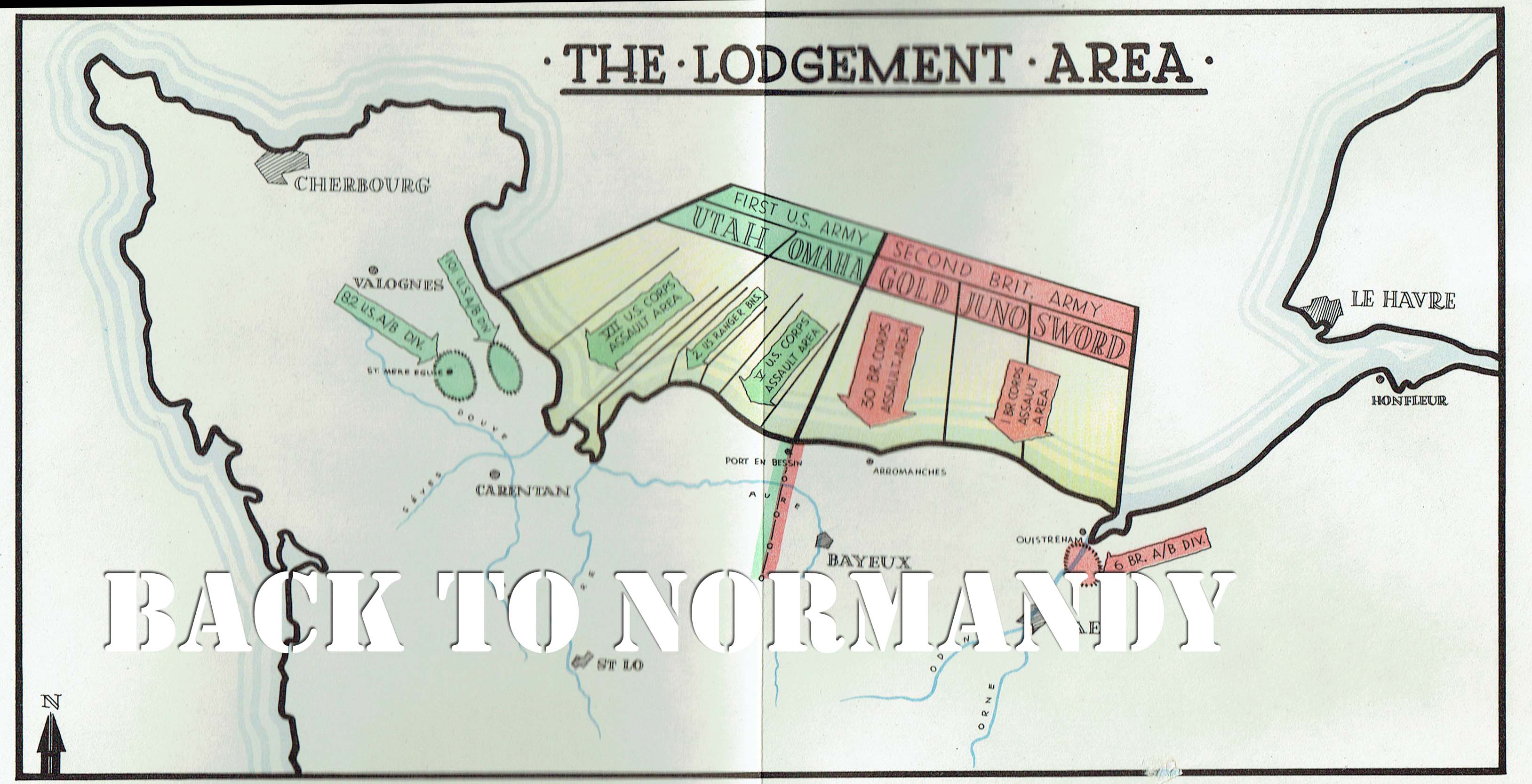
7. The operation was a combined BRITISH, CANADIAN and UNITED STATES undertaking by all Services of the three nations. The Naval forces involved were under command of the Allied Naval Commander Expeditionary Force (ANCXF). HQ Allied Expeditionary Air Force (AEAF) commanded all Air Forces taking part in the operation while all the land forces participating were initially placed under command of HQ. 21 Army Group.
8. The Naval Forces operating in the assault were divided into two separate task forces:
- Eastern Task Force in support of the BRITISH Forces.
- Western Task Force in support of the AMERICAN Forces.
Their tasks were as follows :—
- Provision of protection from enemy naval forces.
- Clearance of enemy mines and minefields.
- Bombarding enemy defences.
- Supporting the assault by fire as necessary.
9. The RAF and US Air Forces were responsible for:
- The strategic bombing of enemy lines of communication before and during the assault.
- In conjunction with ADGB the air defence of the bases and troop concentrations in the UK and protection of coastal convoys, warships and shipping.
- The tactical bombing of enemy troop concentrations, reinforcements, strong points and other targets in the vicinity of the assault.
- Establishing complete air superiority and thus protecting the ground forces.
10. The general plan for the Army’s part in the operation was:
- To carry out airborne landings on the night D—1/D with the object of protecting the flanks of the area in which the assault was to take place.
- To assault on the NORMANDY coast between VARREVILLE and OUISTREHAM on a five divisional front from landing ships and landing craft with two BRITISH, one CANADIAN and two UNITED STATES divisions.
- To land the follow-up divisions, one BRITISH and one UNITED STATES on the second tide on D-day and on D+1.
- There after to build up our forces in divisions as follows :—
BRITISH AMERICAN
By D+ 4 to . . 61/3 81/3
By D+12 to . . 9 9
By D+20 to . . 15 9
By D+35 to . . 15 15
- The initial objectives were the towns of CAEN, BAYEUX, ISIGNY, CARENTAN, and airfields in the vicinity.
- Second Army was to protect the left flank of UNITED STATES First Army, while the latter captured CHERBOURG, ANGERS, NANTES and the BRITTANY ports.
The Order of Battle of 21 Army Group for the assault is shown at this image not yet ready”
26 July-26 September
Outline of Operations
The operational picture during this phase (from 26 July to 26 September) can be divided into four stages:
- Firstly the combined BRITISH, CANADIAN and AMERICAN operations in the area of FALAISE leading up to the crossing of the SEINE,
- Secondly the pursuit of the enemy through FRANCE and BELGIUM by Second Army,
- Thirdly the operations of First Canadian Army up the coast of FRANCE and BELGIUM, and
- Fourthly the operations to extend EAST and NORTH in BELGIUM and HOLLAND culminating in the combined US and BRITISH airborne operation in the neighbourhood of NIJMEGEN and ARNHEM.
25 July saw the beginning of the break-out from the bridgehead as the AMERICAN attack between PERRIERS and ST LO, which had been co-ordinated with an attack by 2 Canadian Corps across the road CAEN - FALAISE and another thrust SOUTH by 12 Corps, developed with great momentum and by 30 July the advance into BRITTANY had begun.
On that day Second Army began a drive from the CAUMONT area SOUTH and EAST towards the River ORNE with 8 Corps on the right, 30 Corps in the centre, and 12 Corps acting as a pivot on the left.
By 19 August, despite heavy enemy resistance, this attack had progressed as far as the road PUTANGES—FALAISE.
On 1 August 12 US Army Group had become operational with first and Third US Armies under its command but all US land forces remained under the overall command of the C~in-C 21 Army Group. First Canadian Army launched a heavy attack towards FALAISE supported by one thousand heavy bombers on 7 August and was only halted some four miles NORTH of FALAISE.
On 12 August a junction was made between the CANADIANS and 12 Corps who had successfully crossed the River ORNE.
FALAISE was entered on 16 August but in the meantime the GERMANS launched a heavy counter attack against the first US Army in the vicinity of MORTAIN. First US Army held this attack and so Third US Army continued its drive on LAVAL and LE MANS from which it was ordered to turn NORTH and help Second Army trap the GERMAN forces.
On 19 August they met the CANADIANS and the FALAISE “pocket” was closed.
Amongst the equipment that was subsequently checked were 571 guns, 358 tanks and SP guns and 4,715 vehicles of various natures.
As Second Army advanced into the “pocket” first US Army was ordered to attack NORTH-EAST to capture ELBEUF on the SEINE about ten miles SOUTH of ROUEN. They reached this town on 25 August, by which date Second British and First Canadian Armies were closing on to the SEINE and the mopping up of the FALAISE pocket was completed.
On 26 August orders were issued for 21 Army Group to advance NORTH with the intention of eventually capturing ANTWERP.
30 Corps crossed the SEINE on the right of the BRITISH line in the vicinity of VERNON (R47) with 12 Corps on the left forcing a crossing between LES ANDELYS (R39) and LOUVIERS (R28).
The bridgeheads over the SEINE were quickly established and by 31 August 30 Corps were crossing the SOMME at AMIENS and had elements across the road ALBERT (3/I36)—AMIENS after an advance of eighty miles.
12 Corps began their advance on 30 August and by the next day had reached POIX (M84).
During the next four days the advance continued rapidly and BRUSSELS was captured by Guards Armoured Division on 3 September, while 11 Armoured Division by an advance of sixty miles on the same day was in the area of ALOST.
On 4 September 11 Armoured Division captured ANTWERP but the northern suburbs close to the docks still remained to be cleared.
Meanwhile, 2 Canadian Corps crossed the SEINE on 26 August near ELBEUF.
On 30 August ROUEN and FLEURY were captured.
By 1 September DIEPPE was liberated and the port rapidly put into limited operation.
On 4 September the area of BOULOGNE was reached and by 10 September OSTEND and NIEUPORT had been occupied after DUNKIRK had been by-passed on 8 September.
BRUGES was cleared by 11 September and in conjunction with the Polish Armoured Division the GHENT—BRUGES canal was crossed after which an advance was made up to the LEOPOLD canal and the area up to the SCHELDT estuary between ANTWERP and TERNEUZEN (D21) was cleared.
1 Corps had meanwhile crossed the SEINE and were engaged with the enemy outpost positions near LE HAVRE. The main defences of this port were contacted on 6 September.
After a heavy naval and air bombardment the attack on LE HAVRE began on the evening of 10 September and was ended by the surrender of the garrison on the morning of 12 September.
3 Canadian Infantry Division had the task of clearing both BOULOGN E and CALAIS.
The former was attacked on 17 September but all resistance in the town was not finally crushed until the 22nd. This was followed by the attack on CALAIS which commenced on 25 September.
The town was entered on 28 September and after an armistice for the evacuation of civilians all organised resistance ceased on 30 September.
CAP GRIS NEZ area was captured at the same time and so cross-channel shelling of the BRITISH coast was over, while bases for the enemy V-weapons were pushed back into HOLLAND.
The Supreme Commander assumed direct command of the Allied Expeditionary Force on September and 12 US Army Group was placed under command of SHAEF.
Operating on the right flank of 21 Army Group it was directed on the ARDENNES and the inter Army Group boundary was an approximate line BEAUVAIS (11/I90)—DOUAI (H60)—ATH (J23)—HASSELT (K36).
On 8 September the Guards Armoured Division secured a bridgehead over the ALBERT canal and advanced rapidly up to BOURG LEOPOLD.
On 11 September a bridgehead over the MEUSE—ESCAUT canal was established in conjunction with 11 Armoured Division, while further WEST another bridgehead over that canal was secured at AART on 14 September by 15 Infantry Division. It seemed that a great opportunity now presented itself of out-flanking the GERMAN defence line and advancing EAST provided bridgeheads could be secured over the MAAS and the RHINE.
On 10 September it was decided that Second Army assisted by an airborne corps should attempt to advance to the ZUIDERZEE and there after swing EAST into GERMANY.
The operations entitled MARKET GARDEN commenced on 17 September.
101 US Airborne Division achieved complete surprise in their landings and occupied SON, ST OEDENRODE and VEGHEL. They captured and held intact all bridges in their area except that over the WILHELMINA canal which had been previously blown.
82 US Airborne Division also landed successfully and seized intact the bridge over the MAAS at GRAVE and the bridge over the MAAS—WAAL canal at HEUMEN.
1 British Airborne Division made a generally successful landing and captured the NORTH end of the road bridge across the NEDERRHINE at ARNHEM.
Meanwhile the attack by Second Army began with 30 Corps advancing to six miles short of EINDHOVEN, with 8 Corps on the right and 12 Corps on the left exploiting their bridgeheads across the canal with a view to bridging it.
101 US Airborne Division captured EINDHOVEN and together with Guards Armoured Division pushed on to the southern bank of the WILHELMINA canal while 82 US Airborne Division continued to drive for the bridges at NIJMEGEN.
Unfortunately, at the crucial moment the weather turned against the allied forces and the operational situation which at the beginning seemed so rosy began to deteriorate. Enemy resistance was rapidly stiffening and the flying in of reinforcements and supplies for the hard-pressed airborne troops near ARNHEM got progressively more and more difficult as the weather grew worse.
After four days of very gallant fighting 1 Airborne Division had to relinquish its hold on the road bridge at ARNHEM and despite heroic advances by Guards Armoured Division and 43 Division Contact was never firmly made between 1 Airborne Division and 30 Corps.
On September 43 Division reached the RHINE and made contact with the Polish Para Brigade but owing to the strenuous reaction of the enemy and the steep banks of the river at that point, only a very small quantity of stores could be ferried over.
By 25 September 8 Corps had captured HELMOND and GEHERT and had made contact with 30 Corps near ST ANTONIS, while on the left 12 Corps had cleared the area between the road EINDHOVEN—TURNHOUT and the road EINDHOVEN—’sHERTOGENBOSCH.
During the night 25/26 September 43 Division managed to evacuate over two thousand men of 1 Airborne Division and the operation came to a halt.
Although it had not been one hundred per cent successful a deep thrust of some sixty miles had been made into country occupied and stubbornly defended by the enemy and the capture of the bridge at GRAVE and of NIJMEGEN with its road bridge intact proved invaluable in later operations.
27 September 1944—14 January 1945
The most vital of the operations that took place during the period 27 September 44 to early January 45 were those to open the port of ANTWERP as the entire administrative build-up for the force depended upon their successful and early conclusion. The plan to open ANTWERP fell into three parts: first the isthmus leading to SOUTH BEVELAND had to be cleared at the same time as the “island” formed by the SAVOJAARDS PLAAT (D 2008), the LEOPOLD canal and the sea; secondly, SOUTH BEVELAND itself had to be secured, and thirdly, WALCHEREN island guarding the outer approaches to the port had to be captured.
While these operations were in progress the right wing of First Canadian Army was to be directed to advance from the ANTWERP—TURNHOUT canal across the general line of the road TILBURG—BREDA—ROOSENDAAL—BERGEN OP ZOOM to the MAAS. This latter task was given to 1 Corps which had been brought up on the right of the CANADIAN sector from LE HAVRE, while 2 Canadian Corps was made responsible for clearing the SCHELDT.
On 1 October the operation to seal off SOUTH BEVELAND began when 2 Canadian Infantry Division passed through the 1 Corps bridgehead over the LEOPOLD canal about five miles WEST of TURNHOUT. The northern outskirts of ANTWERP up to the DUTCH frontier were quickly cleared.
Despite very heavy opposition from paratroops and frequent counter attacks with infantry and tanks in the WOENSDRECHT (D62) area the isthmus was virtually sealed by 20 October and 2 Canadian Infantry Division were ready to advance WEST.
Meanwhile the operations for the clearing the SOUTH bank of the SCHELDT started on 6 October with a bitterly opposed assault across the LEOPOLD Canal NORTH of MALDEGEM (J09) by 3 Canadian Infantry Division. It was four days before the bridgehead could be sufficiently extended to enable bridges to be completed.
On 9 October, after sailing up the GHENT—TERNEUZEN canal an assault group of two battalions and a tac brigade HQ sailed into the SCHELDT and landed on beaches at the eastern tip of the “island” obtaining complete surprise and quickly establishing a bridgehead.
On 19 October after fierce fighting a junction was made with troops from the LEOPOLD canal bridgehead near ST KRUIS (D00), and BRESKENS was cleared on 22 October.
After the fall of BRESKENS the enemy opposition began to crack and by 3 November the canal areas between ZEEBRUGGE, SLUIS and BRUGES were cleared of all enemy and 12,500 prisoners had been taken.
Meanwhile, on 24 October, 2 Canadian Infantry Division advanced into SOUTH BEVELAND. Despite considerable opposition they reached the BEVELAND canal on 27 October and proceeded to bridge it.
The previous day 156 Brigade of 52 Division, newly arrived from UK, sailed in LVTs from TERNEUZEN and landed successfully near BAARLAND (D3219).
A link-up with 2 Canadian Infantry Division was made on 29 October.
On 30 October the combined advance was halted at the eastern end of the causeway leading to WALCHEREN island but the following day some troops of 5 Canadian Infantry Brigade passed along the causeway and actually reached to within one hundred yards of the western end of it where they were stopped by heavy mortar and machine gun fire from the WALCHEREN dykes.
1 November was set as the date for the assaults on WALCHEREN Island. The main preliminary operation was the bombing by the RAF of the WESTKAPELLE and other sea dykes whereby the island was flooded by four breachings.
Three assaults were to be made on the island : by 2 Canadian Infantry Division and 52 Division from SOUTH BEVELAND, by No. 4 Commando on FLUSHING (Vlissingen) and by Nos. 41, 47, 48 and 10 Commandos near WESTKAPELLE.
The assault from the EAST was unsuccessful, the CANADIAN battalion eventually being forced back after it had made four hundred yards progress at the causeway. The attack on FLUSHING was successful and the build-up proceeded satisfactorily during the day.
The force attacking WESTKAPELLE was supported by the fire of HMS Warspite and two monitors and a close support squadron of twenty-five vessels. This squadron was heavily engaged by the nine hostile batteries between WESTKAPELLE and FLUSHING.
The weather unfortunately severely restricted flying operations from UK but Typhoons from 2 TAF on the Continent pressed home a determined attack as the assault troops were about to land.
The fact that despite heavy losses the landing of the Commandos proved successful was due in no small measure to this attack and to the action of the close support naval squadron who drew to themselves, sometimes at point blank range, the fire of the enemy batteries.
On 2 November a junction was made with the force at FLUSHING and on 6 November the GERMAN commander was captured at MIDDELBURG after an attack in LVTs across the inundations. By 8 November some eight thousand prisoners had been captured on WALCHEREN Island and the operations had been successfully concluded.
During this time 30 Corps was concerned with expanding the NIJMEGEN bridgehead and keeping open the corridor while 8 Corps and 12 Corps came up on its right and left respectively.
30 Corps gradually expanded WEST and SOUTH—WEST towards s’HERTOGENBOSCH to link up with 12 Corps while further WEST l Corps under First Canadian Army was moving towards the line TILBURG~BERGEN-OP-ZOOM. s’HERTOGENBOSCH was cleared on 27 October by 12 Corps and on the following day TILBURG was secured.
BREDA was captured by Polish Armoured Division under command 1 Corps on 29 October and within twenty-four hours BERGEN-OP—ZOOM, ROOSENDAAL, and OUDGASTEL (D73) had been cleared. 104 US Infantry Division who had come under command 1 Corps, joined in the sweep up to the MAAS and by 8 November all the territory SOUTH of the MAAS including the island of THOLEN and the SAINT PHILIPSLAND peninsula (D54) was completely in our hands.
Meanwhile, on the right of the BRITISH sector operations were proceeding to clear all the enemy WEST of the MAAS and to establish bridgeheads across that river. During October, 8 Corps with 7 US Armoured Division under command, captured VENRAIJ (E72) and reached the MAAS northwards from BOXMEER (E74).
In November, 12 Corps came in on their right followed shortly afterwards by 30 Corps who had been relieved at NIJMEGEN by 2 Canadian Corps.
While 8 Corps steadily pushed the enemy across the DEURNE canal near MEIJEL (E70) towards VENLO (E90), 12 Corps attacked on 14 November from EAST of WEERT towards ROERMOND (K79).
On 19 November, 30 Corps with 84 US Infantry Division under command, attacked towards GEILEN- KIRCHEN (K86). Some very stiff fighting took place in most difficult country and under bad weather conditions, but by early December, the enemy had been cleared from the WEST bank of the MAAS as far SOUTH as a few miles below MAESEYCK (K67) whence our line crossed the river and ran just NORTH of SITTARD to inclusive GEILENKIRCHEN.
On 13 December, regrouping started for the second stage. This operation was to be carried out initially by 30 Corps who were to attack South-East from the NIJMEGEN area. 12 Corps took over in the SOUTH and HQ 30 Corps moved to BOXTEL (E33).
However, on 16 December, the enemy launched his ARDENNES offensive against first US Army and on 20 December, the US Ninth and first Armies came under operational control of the HQ 21 Army Group.
30 Corps was concentrated in the general area LOUVAIN—HASSELT, and operated with first US Army on the northern and western flanks of the ARDENNES salient, capturing some seven hundred prisoners.
As the salient was gradually eliminated, 30 Corps was pinched out, and on 14 January, Corps HQ proceeded to BOXTEL to resume preparations for its original operation.
15 January 1945 - 8 May 1945
Before the final assault into inner GERMANY across the RHINE could take place it was necessary to clear the area between the MAAS and the RHINE.
This process was achieved by three operations entitled BLACKCOCK, VERITABLE and GRENADE.
Operation BLACKCOCK commenced on 16 January with an attack NORTH from the road GEILENKIRCHEN—SITTARD by 12 Corps.
It was carried out under conditions of hard frosts, sudden thaws and thick fog but in spite of the weather the area SOUTH of the ROER was completely cleared in ten days except for a small bridgehead SW of ROERMOND.
Meanwhile preparations for operation VERITABLE were being carried out by First Canadian Army under whose command 30 Corps had been placed.
The latter corps had been built up to a strength of seven divisions, three independent armoured brigades, eleven regiments of 79 Armoured Division grouped under a brigade headquarters and five AGsRA.
The attack was to be carried out initially by 30 Corps but subsequently 2 Canadian Corps would take over the left sector and the attack would continue on a two-corps front.
1 Corps to the WEST would continue to hold its 125 mile front along the MAAS.
The attack began on 8 February after excellent artillery support although the weather interfered with the programme for air support.
By midnight all objectives for the first day had been attained. The SIEGFRIED defences were pierced on 9 February and the outskirts of CLEVE entered.
NORTH of the road CLEVE—NIJMEGEN 3 Canadian Division was successfully carrying out amphibious operations.
The floods, however, were rapidly becoming a serious handicap to the operation.
An attempt to lessen their effects was made by blowing certain dykes NE of NIJMEGEN but the GERMANS in turn blew other dykes which let in about the same quantity of water as was being drained away.
As the valley of the ROER was also flooded it was clear that the AMERICAN attack, (operation GRENADE), would have to be postponed.
By 13 February, however, the SIEGFRIED line had been completely breached and the REICHSWALD was cleared.
The right flank of 30 Corps had reached the MAAS, three miles SOUTH of GENNEP and the construction of the bridge had begun.
On the left flank the CANADIANS had come opposite to EMMERICH.
During the next nine days with the extension of the front SOUTH and EAST of the REICHSWALD, GOCH was captured and operations developed against CALCAR.
On 23 February Ninth US Army, which still formed part of 21 Army Group although First US Army had reverted to under command 12 US Army Group on 18 January, launched operation GRENADE across the ROER towards DUSSELDORF and MUNCHEN GLADBACH.
By early morning 24 February six class 40 treadway bridges and other infantry bridges had been erected.
Within three days a bridge-head sixteen miles wide and six to eight miles deep had been established.
Meanwhile regrouping was being carried out in the BRITISH sector preparatory to an assault by 2 Canadian Corps to break through theenemy defences between UDEM and CALCAR and exploit to XANTEN.
That operation began on 26 February and met desperate resistance and appalling conditions underfoot.
By the night of 27 February however, a gap had been made between the HOCHWALD and BALBERGER forests near the railway line at A 0441.
Co-incident with this attack, opposition on 30 Corps front showed signs of lessening. WELL E82, WEEZE E93 and KEVELAER E93 were captured and a link-up was effected at GELDERN with Ninth US Army.
The AMERICAN advance had been rapid and by 2 March MUNCHEN GLADBACH, NEUSS, ROERMOND and VENLO had been secured.
The US forces continued to advance along the Westbank of the RHINE through KREFELD A10 and ORSOY A22 while 2 Canadian Corps cleared the XANTEN area.
By 10 March the enemy still in the bend SW of WESEL was finally mopped up and 2l Army Group was now ranged along the WEST bank of the RHINE from DUSSELDORF to ARNHEM.
The assault across the RHINE was to be by means of two operations, PLUNDER to be carried out by the ground troops, and VARSITY which was the airborne drop across the RHINE. D-day was to be 24 March for both these operations but a postponement of up to five days would be accepted if weather delayed the airborne operation.
The intention was to establish a bridgehead over the RHINE, isolate the RUHR from the rest of GERMANY in conjunction with First US Army and break into the NORTH GERMAN plain.
Briefly, Ninth US Army was to assault across the RHINE near RHINEBERG, Second British Army was to assault in the area of XANTEN and REES while First Canadian Army was to carry out feints along the RHINE on the left flank of Second Army.
The role of 18 US Airborne Corps consisting of 17 US Airborne Division and 6 British Airborne Division was to seize the high ground and certain bridges about five miles NORTH of WESEL, to speed the capture of WESEL, and assist the RHINE crossings.
Force U of the Royal Navy consisting of forty-five LCM and forty-five LCVP brought overland on transporters was to support the crossings of Second Army.
The weather, both for the operation and the days immediately preceding it, was ideal and by D-day for the operation 24,983 tons of bombs had been dropped by Bomber Command while Eight and Ninth US AAFs had dropped 24,500 tons of bombs.
After intense artillery preparation the assault began at 2100 hours on 23 Marsh by four battalions of 51 Division.
Seven minutes later a report was received that the first wave was across.
Good progress was made during the night and the outskirts of REES were reached.
By 0300 hours 1 Commando Brigade was well established in the town of WESEL.
Ninth US Army assaulted near OSSENBURG and despite strong resistance bridging operations were soon under way.
At 1000 hours on 24 March the airborne operation began with over 1,700 aircraft and 1,300 gliders being employed ; 14,000 troops were delivered with the loss of under four per cent of the gliders. All the airborne troops’ objectives were taken by nightfall with the exception of the heavily wooded high ground NORTH of DIERSFORDT which was captured during the night.
Five bridges over the River IJSSELwere seized intact.
Ground troops progressed rapidly and in the AMERICAN sector the general line of the road DINSLAKEN—WESEL was reached. Elements crossed the LIPPE-SEITEN canal near LIPPENDORF A2388 and class 40 bridges were opened.
HAFFEN and MEHR A1248 were captured by 15 Division who also made contact with 6 British Airborne Division.
Opposition at REES from paratroops, who held out until early on 26 March, was very stubborn but the exploitation of the bridgehead and the build-up proceeded well.
By 28 March US troops had captured GLADBACH, GAHLEN and DORSTEN while17 US Airborne Division with 6 Guards Armoured Brigade and 1 Commando Brigade captured HALTERN A64.
12 Corps reached BORKEN A36 and RHEDE A26 on the same day while 30 Corps secured the line HALDERN A15—ISSELBURG A16—ANHOLT and 2 Canadian Corps had almost cleared EMMERICH.
The break-out could be said to have started on this date and 18 US Airborne Corps, 8 Corps and 12 Corps advanced rapidly meeting the first organised resistance on the line of the DORTMUND-EMS canal where fighting went on from 31 March to 6 April.
Meanwhile elements of the Ninth US Army reached the River WESER South East of MINDEN on 3 April on which date Ninth US Army reverted to under command 12 US Army group.
The advance of 30 Corps was held up at LINGEN until 6 April but 8 Corps crossed the WESER on 7 April and four days later was attacking CELLE.
This place was taken the next day and the advance continued to UELZEN where four days hard fighting took place.
LUNEBURG was captured on 18 April and six days later 8 Corps had cleared the WEST bank of the River ELBE in this sector.
Meanwhile 12 Corps having cleared RHEINE crossed the WESER against opposition in the HOYA area and eventually captured SOLTAU on 24 April.
After turning NORTH towards HAMBURG they reached their sector of the ELBE on 26 April.
30 Corps was meanwhile being stubbornly opposed by desperate SS troops but despite this and many inundations they captured BREMEN by 28 April thereafter continuing NORTH and NW to clear the peninsula to CUXHAVEN.
Meanwhile 2 Canadian Corps reverted to under command First Canadian Army after the capture of EMMERICH.
It then advanced rapidly NORTH to the outskirts of DOESBURG and ZUTPHEN while1 Canadian Corps attacked from the NIJMEGEN bridgehead to clear the area up to the NEDERRIJN. This was completed by 5 April.
2 Canadian Corps advanced towards OLDENBURG and secured bridgeheads across the EMS but after the capture of ZUTPHEN and DEVENTER 1 Canadian Division had turned WEST on 11 April to assault across the River IJSSEL towards APELDOORN.
In conjunction with this attack ARNHEM was cleared by 1 Canadian Corps on 15 April and the ZUIDERZEE was reached on 18 April. 2 Canadian Corps’ advance continued from OLDENBURG to GRONINGEN and LEEUWARDEN reaching the SOUTH bank of the EMS estuary opposite EMDEN.
By 26 April with the exception of a small strip of coast on the EMS estuary the whole of NE HOLLAND had been cleared.
Having captured OLDENBURG 2 Canadian Corps moved towards WILHELMSHAVEN and EMDEN while SOUTH of the ZUIDERZEE 1 Canadian Corps progressed WEST towards HILVERSUM and UTRECHT.
While 30 Corps was completing the clearance of the CUXHAVEN peninsula the final stage of the operation on the remainder of the Second Army front began with attacks across the ELBE by 8 Corps on 29 April and 18 US Airborne Corps on 30 April, in both of which rapid progress was made.
18 US Airborne Corps secured the line DOMITZ-LUDWIGSLUST-SCHWERIN and 6 British Airborne Division on their left advanced forty miles to make contact with the RUSSIANS on the BALTIC coast at WISMAR.
On 2 May, 11 Armoured Division of 8 Corps entered LUBECK and the advance continued NORTH towards KIEL and the KIEL canal.
On the next day 12 Corps entered HAMBURG which surrendered without a fight.
At 1820 hours on 4 Way plenipotentiaries of the GERMAN High Command surrendered to the Commander-in-Chief 21 Army Group at LUNEBURG HEATH and the order to cease fire became effective at 0800 hours on 5 May 1945.
Outline of administrative planning
Preface
It will be noted that both in this outline administrative planning and in each of the four phases the problems and achievements of the “Q” Staff and Services are dealt with prior to those of the “A” Staff and Services.
This change in accepted staff procedure does not in any way mean that the activities of the “A” Staff and Services are any less important than those of the “Q" Staff and its associated Services but is made deliberately because the work of the latter follows on more naturally and in a more logical sequence from the outline of operations than would be the case if the Work of "A” and the "A” Services was described first.
Staff Responsibilities
On the HQ 21 Army Group Administrative Staff which carried out the planning for Operation OVERLORD were three senior appointments responsible to the MGA as follows :—
(a) DQMG who co-ordinated the work of Q(Plans), Q(Maint) and Q(AE) and under whose direction the “Q” Services functioned.
(b) DQMG (Mov & Tn) who was responsible for all movement planning, the movement of personnel vehicles and stores by air, sea and land, and for the co-ordination of the work of the Movements Staff and the Transportation Service.
(c) DAG who was responsible for all “A” Planning and Organisation, "A" Personal Services and activities of the “A” Services.
The detailed organisation of the administrative staff is set out at this image “C not yet ready”.
Second Army was charged with all planning from D-day to D+14 (subsequently extended to D+17) under the general direction of HQ 21 Army Group. This involved the assessment of the requirements of administrative units and stores from D to D+41 and the phasing in of daily maintenance requirements and administrative personnel for the period D to D+17 including the requirements of the Royal Navy and the Royal Air Force. HQ 21 Army Group took over these responsibilities from Second Army from D+18 onwards.
Although AMERICAN forces were being employed alongside BRITISH forces, in view of the inherent differences in BRITISH and AMERICAN administrative procedure the US forces were made responsible for their own maintenance and build-up subject to the over-riding approval of the C-in-C 21 Army Group.
Control of Movement
During the planning period an organisation was set up for the control by the Royal Navy of both a ferry service to land personnel and stores from vessels at anchor off the beaches and a cross-channel shuttle service of ships and other craft.
The control of this was to be assisted by Movements officers both ashore and afloat. In the initial stages control on the far shore was to be de-centralised to Beach Sub Areas with their appropriate naval increment but as soon as possible the control of shipping in the whole BRITISH assault area was to be exercised by FOBAA (Flag Officer British Assault Area) in conjunction with Q(Mov) Shipping, 21 Army Group.
To implement the policies laid down by HQ 21 Army Group, ANCXF and AEAF in regard to alterations in the build-up, an organisation entitled BUCO (Build Up Control Organisation) was established in UK to control the movement of ships and craft from the UK and of personnel and vehicles into them from the concentration and marshalling areas.
This organisation was also responsible on the BRITISH side for the post D-day concentration plan and for ensuring that all units were ready in time to move to marshalling areas for embarkation, although the actual mounting of the operation was the responsibility of the 'War Office acting through the Home Commands.
The BUCO staff contained representatives from HQ 21 Army Group, ANCXF, AEAF, War Office Q(Mov), Ministry of War Transport, Second Army, First Canadian Army, 2 Tactical Air Force and representatives of the US “users” who acted as liaison links with HQ ETOUSA which controlled the US concentration and build up. ‘While BUCO was concerned with the movement of personnel and vehicles, HQ 21 Army Group controlled directly, in conjunction with War Office, all alterations or additions required in the stores shipment programme.
Outline Maintenance Plan
The BRITISH Forces were to be maintained over the beaches until such time as sufficient ports were captured and developed on the assumption that beach maintenance could cease on the opening of the SEINE ports. As the BRITISH sector contained only four small ports, PORT EN BESSIN, COURSEULLES, CAEN and OUISTREHAM, the capacity of which, even if captured intact, would not be sufficient for dealing with the tonnage requirements of the BRITISH Forces, it was decided to construct an artificial port at ARROMANCHES.
This artificial and prefabricated port was known by the codeword "MULBERRY B” and its object was to reduce the degree of dependence on maintenance over open beaches in the early stages of the operation. A similar artificial port “MULBERRY A” was to be constructed in the AMERICAN sector. In addition, small havens of sheltered water for the discharge and protection of the ferry craft were to be formed by sinking chains of ships off the coast prior to the develop- ment of the MULBERRY and the codeword “GOOSEBERRY” was given to them.
Second Army was to be maintained for the first few days from Beach Maintenance Areas and subsequently from two Army Roadheads one of which would ultimately be handed over to First Canadian Army.
As soon as possible a Rear Maintenance Area Was to be established. It was not intended that the beach maintenance areas should develop into the Rear Maintenance Area but they were either to close down or be retained as Stores Transit Areas on the opening of the RMA.
As well as the planning, the administrative responsibility for the early stages of the operation devolved upon Second Army. An important point to notice is that no reliance was placed on any railways being available for at least the first three months of the operation and so the L of C was planned to be entirely road operated. Whilst the development of the administrative organisation was planned to fall into three main phases, the dates of each phase could only be approximate as they were dependent on the tactical situation.
Stage I - D to D+4
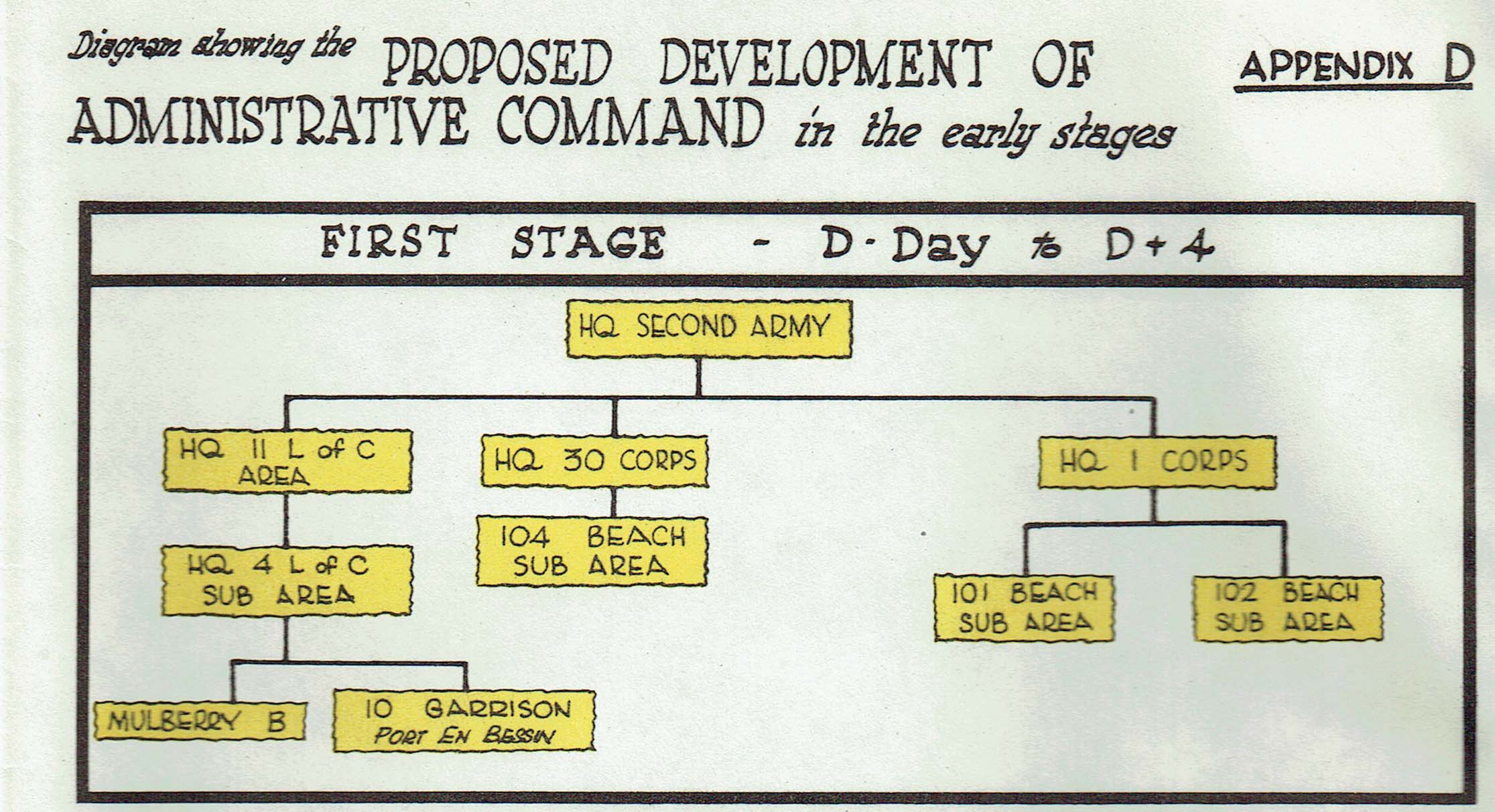
During this stage maintenance was to be entirely over the beaches except for the possibility of a small tonnage being discharged through MULBERRY B on D+4. It was not anticipated that any appreciable tonnage would be unloaded at the MULBERRY until D+9. The beaches were organised into three sectors each controlled by a HQ Sub Area and each containing a beach maintenance area. A total of eight Beach Groups (two as reserve formations) were placed under command of the Beach Sub Areas which in turn were placed under command as follows:-
101 and 102 Beach Sub Areas - 1 Corps
104 Beach Sub Area - 30 Corps.
HQ. 4 L of C Sub Area was responsible for the area of ARROMANCHES where MULBERRY B was to be constructed as soon as the tactical situation permitted. It was planned to use PORT EN BESSIN for the reception, storage and distribution of bulk petrol and HQ 10 Garrison was made responsible for its local administration under the direction of HQ 4 L of C Sub Area. HQ 11 L of C Area was given the overall responsibility for the developing of MULBERRY B and PORT EN BESSIN through the agencies of 4 L of C Sub Area and 10 Garrison respectively and were placed under command Second Army. The proposed administrative layout during this stage is shown at this image.
Stage II — D+5 to D+17
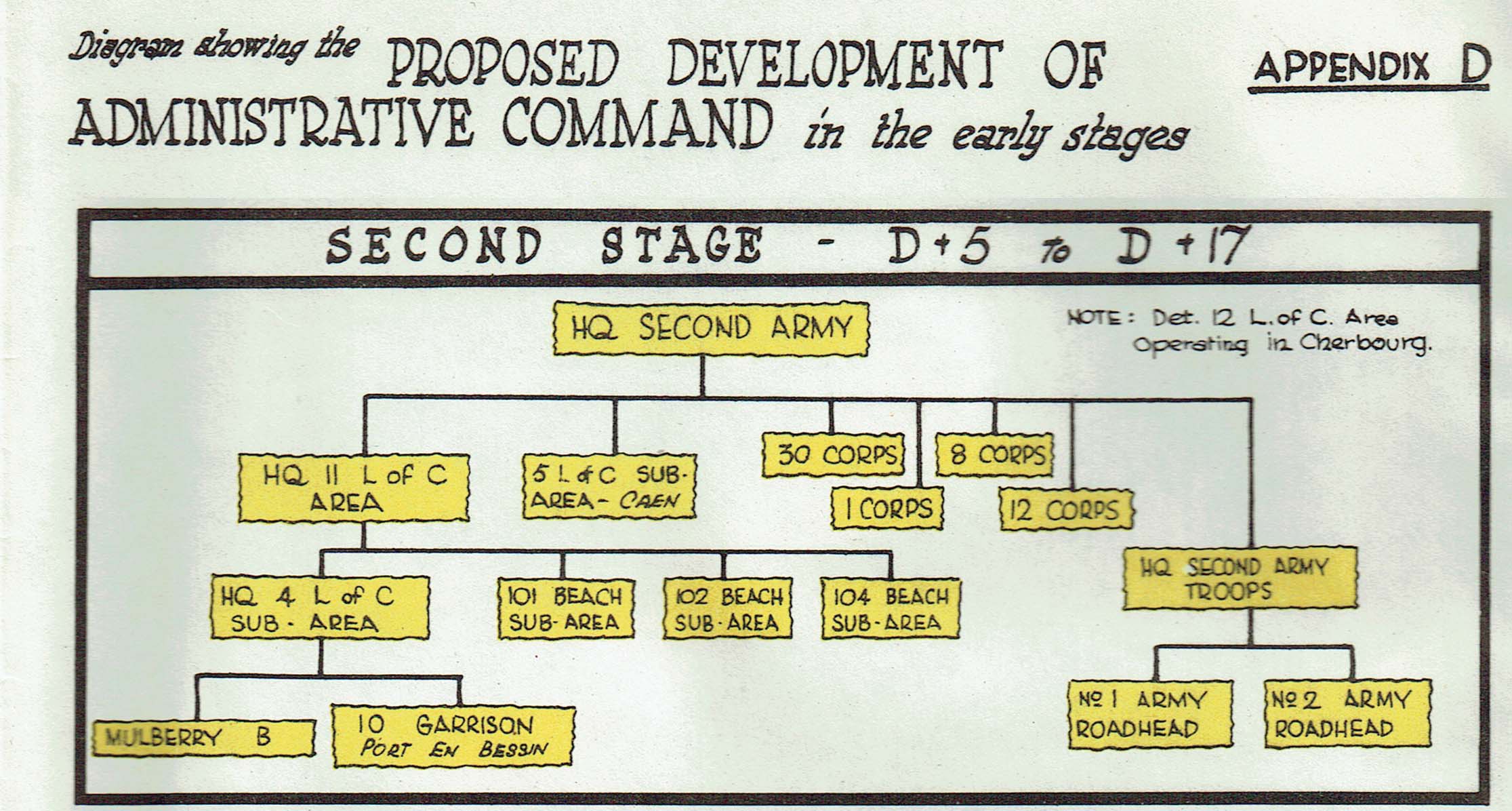
With effect from D+5 Second Army through HQ 11 L of C Area were to take over from Corps the responsibility and control of the beaches and beach maintenance areas. HQ 11 L of C Area would then be responsible through the HQ of the beach sub areas for the clearance of all beaches in the BRITISH Sector and, as above, through 4 L of C Sub Area for the operation and local administration of MULBERRY B and PORT EN BESSIN.
Two army roadheads were planned during this period of which No. 1 in the area of CAEN was to be prepared to start issues on D+5 whilst No. 2 in the area of BAYEUX was to open on D+7.
Second Army was to be responsible for the operation and control of both roadheads until No. 1 was handed over to First Canadian Army. It was anticipated that CHERBOURG would be captured by the US forces on D+8. As it was improbable that certain awkward loads for the BRITISH forces could be brought across the beaches it was planned in agreement with the US to unload them at CHERBOURG, and HQ 12 L of C Area was detailed to provide a detachment under command of First US Army to represent BRITISH interests and operate a transit area for BRITISH stores. The administrative layout during this stage is shown at this image
Stage III — D+18 to the capture of the SEINE ports
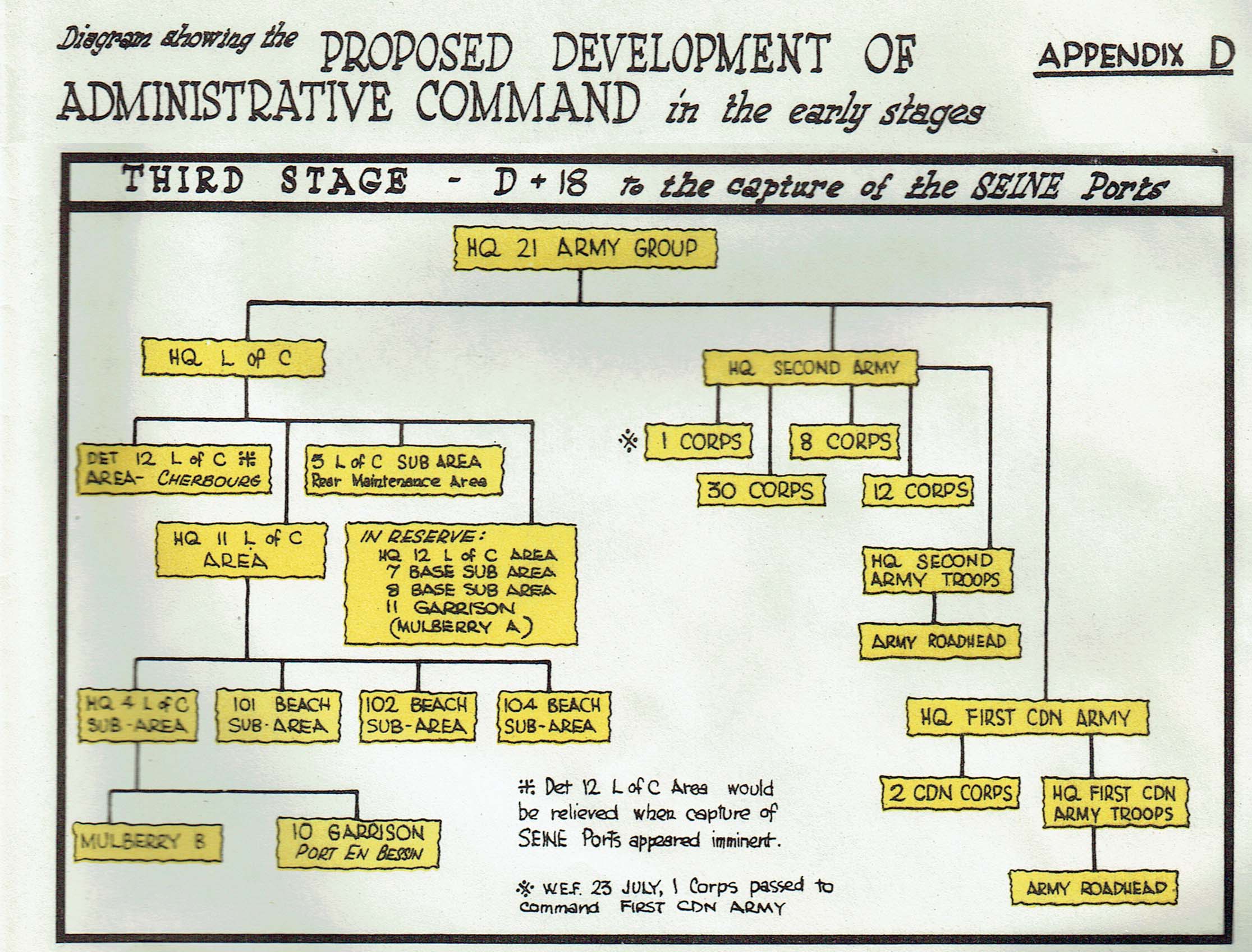
The majority of Second Army units were planned to have disembarked by D+17 and on that date the remainder of First Canadian Army would commence their move to the Continent. The presence of the two armies would necessitate a co-ordinating and controlling headquarters. HQ L of C with an increment from HQ 21 Army Group would move to the Continent between D+17 and D+20 for this purpose until the arrival of the complete HQ of 21 Army Group which was not anticipated to take place before D+30.
11 L of C Area with its units under command would revert to under command HQ L of C from the date of the latter’s assumption of administrative control. HQ 5 L of C Sub Area under command HQ L of C would be responsible for developing the RMA while 7 and 8 Base Sub Areas were to move to the Continent so as to be readily available when the capture of the SEINE ports of LE HAVRE and ROUEN appeared imminent. The detachment of HQ 12 L of C Area operating at CHERBOURG '-'3-11d then be released and HQ 12 L of C would take over command of 7 and 8 Base Sub Areas.
In addition 11 Garrison was held in reserve to operate and administer MULBERRY A as it had been arranged that this artificial port would be transferred to 21 Army Group if CHERBOURG was captured more or less intact by the US forces. The administrative layout at this stage would thus be as shown at this image
Build up of Reserve Stocks
The rapid build-up of reserves was clearly a matter of paramount importance throughout the early stages if the fighting formations were to be afforded liberty of action in the event of a sudden crack in the enemy’s defences. The urgency was at its greatest in the initial few days when sufficient reserves would have to be landed not only to allow for a rapid advance but to be available for resisting the fierce and lengthy counter attacks which might be launched against the shallow bridgehead. In addition to normal maintenance, therefore, reserve stocks were to be landed at the following scales :—
(a) By midnight D+3
Ammunition — Four days expenditure at 21 Army Group rates for the forces ashore by D+5
POL — Fifty miles per vehicle ashore on D+5
Supplies —— Two days supplies for the forces ashore on D+5
Ordnance Stores (less ammunition)
Maintenance from D+1 to D+9 would be dependent on Landing Reserves. A specially scaled Landing Reserve Set would be landed as early as possible for each brigade group or equivalent formation ashore. From D+10 maintenance would be by Beach Maintenance Pack. Each pack was sealed for a division or an equivalent formation and contained first and second echelon spares plus equipment for thirty days at special wastage rates.
(b) By D+41
Fourteen days initial stocks of all commodities were to be held in the RMA.
(c) By D+90
Fourteen days initial stocks of all items plus working margins not exceeding seven days were to be held in the Advance Base depots.
The RAF reserves were to conform with the above.
In calculating the holdings the following scales were used :—
Ammunition — 21 Army Group Rates (See Appendix “P”, not yet ready)
POL — 50 miles per vehicle per day
Ordnance Stores —— Beach Maintenance Pack scales and controlled stores calculated at (less ammunition) FFC intense Rates.
Army and RAF Responsibilities
The basic principle that services of common usage in the Army and RAF should be provided by one ‘service for the use of both was to be followed. In order to ensure the most economical arrangements having regard to the respective scales of requirements, it was agreed that the majority of services of common use should be provided by the Army. Thus the Army agreed to provide supplies, petrol, oil and lubricants, ammunition and equipment common to both Services, labour and other services of a like nature.
Replacement of Vehicles
The General Staf" requirement for heavy ‘A’ vehicles was that twenty-five per cent of unit entitlement should be available behind the armoured formations at all times. This is greater than the Contact Rate of wastage for ‘A’ vehicles but until workshops were established and their output afforded a compensating reduction, the replacement demands from formations were higher than the Contact Wastage rate.
The requirement for light ‘A’ and ‘B’ vehicles was to produce in the beach-head between D-day and D+42 the calculated rate of wastage for that period, plus one month’s reserve to cover exceptional "losses in the assault and the creation of a repair pool.
There was considerable conflict in priorities between shipment of reserve vehicles and fighting formations in the build-up. The General Staff were, however, advised and agreed that reserve vehicles to maintain the force ashore should have priority in shipment over fighting formations where conflict between the two arose.
All vehicles due to be landed up to D+42 were to be waterproofed. As regards reserve vehicles this work was undertaken in War Office depots with the assistance of 21 Army Group Ordnance and REME personnel from units or reserves of low priority in the Order of Battle.
Replacement vehicles were to be shipped unaccompanied, Ordnance drivers meeting them on the beaches in order to clear them.
Reinforcements
For planning purposes it was assumed that normal reinforcements demands could not be expected from formations and units before D+18. To overcome this diificulty it was planned that reinforcements would be provided until then by means of predetermined drafts, based on an estimate of casualties, which would be despatched until D+9 direct to Corps Reception Camps and after that date to Second Army Reinforcement Group.
The policy governing the build up of reinforcements from D to D+2 Was to ensure:
(a) that there would be a reserve of personnel in each beach-head to replace casualties in the beach groups as quickly as possible in order that the important work of off-loading would not be impeded by lack of manpower. The policy was to be put into effect by sending out drafts numbering ten per cent of the Beach Group strength to land in FRANCE on D+l even before it was known Whether they were necessary or not.
(b) that there would be a- supply of specialist and vital personnel to replace such casualties in assault divisions.
It would not be possible to send any other reinforcements at this stage.
From D+3 to D+9 reinforcements were to consist of first line reinforcements of units which it was estimated would have suffered serious casualties and standard drafts for each arm of the Service. Arrangements were made to permit variations in the predetermined drafts at short notice in order to cover unexpected shortages of key tradesmen and specialists.
As soon as practicable after D+9 a reserve of reinforcements was to be built up on the Continent. These reserves were to be held in Reinforcement Holding Units for the BRITISH and in Reinforcement Holding Battalions for the CANADIANS and were to be supplied to units under the normal system.
Casualties
The estimates of casualties for the BRITISH and CANADIAN forces were based on the official War Oflice casualty rates known as the Evetts Rates. In determining the estimate of casualties which might be sustained in the operation the following categories were considered :—
(a) DROWNED It was estimated that sixty per cent of the personnel in any craft lost or damaged would become casualties.
(b) SICK AND NON-BATTLE CASUALTIES
For planning purposes it was estimated that the sick who would be evacuated to hospital would amount to 0.17 per cent per day of the total forces ashore.
(c) BATTLE CASUALTIES
The Evetts Rates are divided into three, the “Intense”, “Normal” and “Quiet” depending on the degree of fighting involved. It was thought, however, that the most severe of the above rates was not sufficiently high to represent the anticipated casualties of some assault formations and therefore a new rate “Double Intense” was applied. The estimated total of battle casualties at these rates was divided into :—
D-day and D+l
Killed, captured and missing — 30% of casualties
Wounded —— 70% of casualties
D+2 and thereafter
Killed, captured and missing — 25% of casualties
Wounded —— 75% of casualties
The numbers of wounded were further calculated to be:
Litter cases — 50%
Walking cases — 50%
Evacuation Policy
For D-day and until hospital accommodation was adequate for retention of casualties, the medical plan was based on:
- the evacuation to the UK of all casualties, except those whom it was dangerous to move
- the provision of life saving surgery by the medical units in the beach organisations.
As soon as hospital accommodation ashore was adequate, all cases requiring not more than seven days treatment were to be retained on the Continent. As the build-up of hospitals permitted, this period was to be extended to fifteen days, thirty days and ultimately to such longer periods as the Army Group Commander decided.
LSTs and hospital carriers were to be used for evacuation over the beaches and from artificial ports, and hospital ships were to be used for evacuation from major ports.
21. Basis for Administrative Plan
The entire administrative plan for this operation was based on the Joint Outline Maintenance Project for Operation OVERLORD and the detailed instructions on each specific subject were issued to formations in the form of Administrative Instructions.
Abbreviations
To see more abbreviations https://www.ww2history.eu/abbreviations