
Introduction
On 3 Sep 1939, the strength of the RE was 13,025 Regulars and 76,276 Territorial Army and Supplementary Reserve personnel, for a Corps total of 89,301. This increased substantially during the war, to a peak of 280,632. RE strength reduced somewhat during the war, but on 1 Jan 1945 the total was still 257,900.
Of these, 62% were in field, line of communications, or works roles; 33% in transportation; 1 ½% in survey units; 2 ½% in Movement Control, and 1% in postal duties.
The Corps was smaller than during the First World War. However, the variety of units raised far surpassed that of any earlier period.
The varied roles performed by RE squadrons and companies can be seen in the following list:
• Armoured Engineer Squadron
• Armoured Corps Field Survey Squadron
• Army Troops Company
• Artizan Works Company
• Armoured Engineer Squadron (ex Assault Squadron)
• Armoured Engineer Park Squadron
• Bomb Disposal Company
• Construction Company
• Dredging Company
• Electrical and Mechanical Company
• Field Camouflage Company
• Field Company
• Field Squadron
• Field Company (Airborne)
• Field Park Company
• Field Park Company (Airborne)
• Field Park Squadron
• Forestry Company
• Fortress Company
• Inland Waterways Transport Heavy Workshop Company
• Inland Waterways Transport Light Aid Workshop Company
• Inland Waterways Operating Company
• Map Supply Company
• Mechanical Equipment Company
• Mechanical Equipment (Transportation) Company
• Mechanical Equipment Park Company
• Movement Control Company
• Parachute Squadron
• Port Artizan Company
• Port Construction and Repair Company
• Port Maintenance Company
• Port Operating Company
• Quarrying Company
• Railway Bridging Company
• Railway Construction Company
• Railway Operating Company
• Railway Survey Company
• Railway Workshop Company
• Road Construction Company
• Survey Company
• Tunnelling Company
• Transportation Stores Company
• Workshop and Park Company
The sheer number and variety of units is staggering, and companies and squadrons could be renumbered or converted to other roles as well. @1
The variety of units is repeated in the variety of headquarters that can be found during the war. A completely new type of headquarters, the army group, RE (AGRE) appeared about 1943. This had no fixed organization, but could command a variety of other engineer units and headquarters. Unlike the First War, army troops RE (ATRE) was normally a fixed formation (three field companies and a field park company), and the numbers could but did not necessarily reflect the army to which they might be assigned. GHQ troops RE (GHQTRE) was a similar type of organization.
Corps troops RE (CTRE) numbers, as in the prior war, did reflect the corps to which they were assigned, although some CTRE were formed with designations other than a corps number. And there were many other types of headquarters as well. The Second, more so than the First, was truly a world war, and engineer support came from sources other than the Royal Engineers. A few examples may suffice. The many Indian divisions, of course, received their companies from the Indian Engineers. In addition, virtually all of the engineer units in the Far East were IE, as were almost all of those in Persia and Iraq. @2 Other IE units supported the campaign in Italy.
The South African Engineer Corps had GHQ units in East and North Africa, and provided a corps troops engineers for Italy. The Royal Canadian Engineers supported their divisions, and also provided army troops and corps troops engineers and other GHQ units for the UK, Italy, and NW Europe. Australia and New Zealand both provided engineers for North Africa and the Middle East in the early years of the war.
Given the complexity of unit types, the numbering was less clear-cut than had been the case in the First World War. Field squadrons were originally in one series, from 1 to 21. However, in 1943 and 1944 one squadron in each division added 600 to its number, giving them what had been vacant numbers in the series for companies. Field park squadrons were mostly numbered 141 to 149, again taking numbers from the company series. When assault (later armoured) engineer squadrons were formed, they simply kept whatever number they had (whether originally a field squadron or field company).
The units formed in Italy in 1944 and 1945 were given lettered designations. Parachute squadrons were originally numbered in their own series, but the last squadron formed kept its former number as a field company. The airborne field and field park companies kept their old numbers. In 1945 these became airborne and airborne park squadrons, with whatever number they had. With regard to the numbering of field companies, numbers 1-59 were Regular companies with a variety of roles (and a number of gaps). Numbers in the range 100-110 and 150-157 were Supplementary Reserve companies; those within the 200-299 range were TA companies.
The number range 300-469 was allocated to AA companies.3 Other number ranges contained a variety of types of unit. From 60 to 99 there was a mixture of war-formed chemical warfare and field companies. With several exclusions and exceptions, companies in the 111-140 and 158-199 range were mainly war-formed construction units. In the ranges 500-599 and 600-699 there was a mixture of second line TA units and war-formed companies of many types. In general the higher numbered ranges were : 700-899 war-formed construction, 900-999 port and inland waterway companies, 1000-1099 docks companies. There were also a few numbers higher than that.
@ 1 All identified units and available information on their assignments and changes during the war is given here. In some cases, information on the activation of war formed units is sketchy, and the dates when units were disbanded or placed in suspended animation is even more limited. In this section, disbanded “Sep 1945+” indicates a date of Sep 1945 or later (given the limited information, “disbanded” in this section can include units actually placed in suspended animation). Again, the authors wish to thank David A. Ryan for his assistance in providing additional information and corrections to a draft of this section, filling in a number of gaps.
@ 2 A list of engineer units in the Middle East from WO169, circa 1942, shows exactly two RE companies and 85 IE companies/squadrons.
6 June 1944 - 25 July 1944
GENERAL
All Works Services were initially placed directly under Chief Engineer, Second Army who was provided with a small increment from HQ 21 Army Group to assist him.
On 14 July HQ L of C took over the beaches and an area including BAYEUX directly under 21 Army Group.
Engineer stores dumps were established at
- TAILLEVILLE (No. 1 Army roadhead),
- BAYEUX (No. 2 Army roadhead),
- VER-SUR-MER and
- LUC-SUR-MER, while the Engineer Base Workshop were sited at
- LE BERGERIE
The Engineer Stores Base Depots were located one each at TAILLEVILLE and BAYEUX.
It had been expected that the major demands for RE stores would be for purposes of road making and repair, constructing airfields, building bridges and erecting bulk petroleum installations.
For these purposes some 42,000 tons of engineer stores had been phased in during the period under review in addition to nine thousand personnel.
In actual fact, due to the bad weather and operational factors, only some 22,000 tons of the above was landed while the number of personnel that were landed only amounted to 6,500.
The limited advances made compensated for this shortage of personnel and stores as less bridging materials were required, fewer airfields could be constructed in the space available, the initial establishment of the rear maintenance area had also to be deferred and several field units became available for work in the rear areas.
As against this, however, the slower rate of advance placed an enormous strain on the roads in that very restricted area of operations, consequently road repair and improvement became the major engineering problem of the day.
ROADS
The number and condition of the roads in the coastal sector was better than had been anticipated but even so, due to little or no maintenance having been carried out on them for some years, they soon commenced to break up badly under the continuous traffic.
The constant passage of heavy traffic also greatly impeded the progress of repair work but rough patching, widening and the filling of potholes was carried out whenever and wherever possible.
One of the first measures to relieve the congestion on the narrow and tortuous roads which, at any rate through the villages, were only suitable for one-way traffic, was the construction of many roundabouts and by-passes. These detours were made at the following places : CREPON- COURSEULLES- ST AUBIN-SUR-MER- DOUVRES- CRESSERONS- SOMMERVIEU- HERMANVILLE- AMBLIE- BRETTEVILLE- CREULLY- VASSIEUX and proved invaluable in speeding up the passage of traffic.
In addition to this many miles of track reserved entirely for tracked vehicles were constructed parallel to the main routes. This naturally greatly assisted in the prolongation of the life of the actual roads themselves.
Lastly, duplicate bridges were constructed to relieve the bottle-necks of GRAVE-SUR-MER and REVIERS.
Owing to the impossibility of constructing the full number of airfields mentioned above, airfield construction troops were diverted to work on the roads. Considerable improvement was made in the exits from the beaches and a comprehensive scheme initiated for improving those from MULBERRY B.
AIRFIELDS
The total force available for the construction of forward airfields was initially Five Airfield Construction Groups RE and one Airfield Construction Wing RAF.
By the end of June, excluding the emergency landing strip, ten airfields had actually been constructed in the beach-head area.
This number rose to seventeen by the end of July of which eight had tracked runways of square meshed steel (SMT) and one had bituminised hessian runways (PBS).
Thirteen airfields in the area were being operated by the RAF by 24 July.
A serious problem arose as a result of the dust on these airfields causing excessive wear on any aircraft engines not fitted with air-intake filters. This occurred even with the SMT and the PBS runways, but not to so marked a degree in the case of the latter.
Water was piped to three airfields in attempts to lay the dust and, rather more successfully, experiments were also made with the use of oil.
The general wet weather experienced in July, however, proved the most satisfactory means of solving the problem.
BULK PETROLEUM INSTALLATIONS
Very considerable construction work was carried out at PORT-EN-BESSIN, the petroleum port, through which 36,000 tons of bulk spirit were received and 27,500 tons issued during the period under review.
By 25 July the status of RE work at this port was approximately as follows :—
- Two ship-to-shore lines had been completed.
- Six tanker berths were in operation with pipe connections laid.
- Balance tank installations and LP pumps had been completed for MT and aviation spirit.
- Tankage had been erected for 9,800 tons of MT fuel and 2,000 tons of aviation spirit.
- Three 6” pipelines were laid to BLARY in No. 2 Army roadhead where 1,040 tons of storage had been erected, and another pipeline to ISIGNY was nearly finished while work was proceeding on storage and pumping stations. In addition one 6” aviation fuel pipeline had been completed to COULOMBS.
LOCAL RESOURCES
It was possible to reduce the phasing in of certain stores, particularly for airfield and road construction, as the area of the beach-head was found to contain quantities of limestone that was suitable for airfields if treated with bituminous material, and also gravel deposits and sand.
Small stocks of cement, timber and other stores were also found and made use of in addition to a few concrete mixers, excavators, road rollers, and one small factory which was adapted into a sawmill. The water situation proved to be generally satisfactory and about fifty water points were established supplied from rivers, streams or wells.
The BAYEUX water system which had a pumping station at BARBEVILLE was undamaged but its operation was partly dependent on the rehabilitation of the CAEN power station.
26 July-26 September
The transition from the semi-static period in the bridgehead to full mobility across FRANCE and BELGIUM produced many problems for the Works Directorate.
In addition to the continued responsibility for works services in the areas behind the rear army boundaries large quantities of bridging stores had to be moved through ports and depots ; airfields, roads and pipelines and to be planned and constructed, bridges lifted and forestry work begun.
GENERAL
Early in September HQ 11 L of C Area with 5 CE Works attached took over control of the area between the SEINE and rear army boundaries, while 12 L of C Area with 4 CE Works attached assumed responsibility for the whole BRITISH area SOUTH of the SEINE.
This re-organisation involved the moves of several units, some of which, such as airfield construction units, were not fully mobile, but all the moves were accomplished in time to meet their expanding commitments.
In August the import of engineer stores steadily increased to a total of 90,500 tons but as stated earlier in this phase imports during the following month were drastically cut.
The constantly changing tactical situation resulted in heavy demands for certain types of stores such as bridging and oil stores and these had to be imported at the expense of normal maintenance supplies. Some idea of the volume of work can be gathered from the fact that 5 ESBD (Engineer Stores Base Depot) handled 4,015 tons in one day in August.
Fortunately, a considerable quantity of enemy engineer stores was captured, especially in the BRUSSELS area and the majority of this booty consisted of constructional stores as well as a good supply of machinery and electrical apparatus.
With the opening of CAEN and DIEPPE in September and the abandonment to 21 Army Group by armies of engineer stores dumps in the rear areas that they evacuated, another ESBD was required to take over the stores transit depot at DIEPPE and to establish an ESBD in the area of BRUSSELS.
Despite the considerable difficulties of maintaining contact with the stores representatives of the armies, an even flow of bridging and other operational stores was maintained and no hold-ups or shortages were experienced during the advance.
ROADS AND BRIDGES
With the enlargement of the bridgehead and consequent reduction in density of traffic, road maintenance became very much easier to accomplish.
Work proceeded in accordance with the final plan for the RMA and a new class 70 bridge was erected over the River ORNE, but the progress of the armies, coupled with demolitions by the enemy created an immense demand for bridging material in the forward areas.
To meet this as many bridges as possible on the minor roads in the L of C were dismantled and subsequently re-issued to armies. In all, nearly three thousand tons of bridging was recovered by this means. It was also decided to maintain only two of the four main forward routes.
These were as follows:
Class 70 route BAYEUX-CAEN-LISIEUX-EVREUX-PACY-MANTES (with class 40 branches to ELBEUF-PONT DE L’ARCHE-LES ANDELYS and VERNON).
Class 40 route BAYEUX-DOUVRES-TROARN-PONT L’EVEQUE-ROUEN.
A class 70 road from NANTES-GASSICOURT which had a class 70 Bailey bridge on barges spanning the SEINE was continued via BEAUVAIS, AMIENS, ALBERT, ARRAS, DOUAI, TOURNAI, LEUZE and HAL to BRUSSELS.
The route via VALENCIENNES in the US area was used during the construction of the class 70 Bailey bridge at TOURNAI and the BRITISH army had right of way on this route. Across the SEINE class 40 bridges were completed and maintained at ROUEN, ELBEUF (two), PONT DE L’ARCHE, LES ANDELYS and VERNON (two).
With the exception of the bridge at ROUEN which used existing piers of a demolished bridge, all these were Bailey bridges on pontoons.
In September another class 40 dry Bailey bridge was erected at ROUEN. Altogether the number of bridges being maintained at the end of September on the L of O was 135 Bailey bridges and 21 of improvised types.
https://ww2history.eu/bridges.html
AIRFIELDS
The construction and maintenance of airfields became a serious problem during this phase. Army Groups RE moved forward with the armies and it was only by maintaining close liaison that it was possible to ensure that maintenance apparatus was moved up to the airfields in time to be of use.
In some cases airfields were constructed and occupied but were discovered almost at once to be of little operational value as the armies had advanced out of range of fighter aircraft.
On the whole it was found that repairing captured enemy airfields, even though they had cratered concrete runways, was more satisfactory than trying hastily to construct new airfields by laying surfacing materials on unused ground.
Dust continued to be a nuisance but by spraying a mixture of naval fuel oil and diesel oil it was largely abated.
By the end of August twenty-three airfields were in use, ten of which had runways made with SMT, two with PBS, two with repaired concrete and nine without any special runway material. Only one permanent airfield was required at CAPRICE.
Three more airfield construction wings RAF arrived in the theatre and it was decided not to bring in a fourth.
Some of the wings were temporarily employed on road construction work in addition to the maintenance and construction of airfields.
BULK PETROL INSTALLATIONS
In August and September a total of approximately 152,500 tons of bulk spirit was received and 110,900 tons issued.
The total distance of the pipeline laid was approximately 360 miles, carrying 7,500 tons within its length in addition to tankage capacity amounting to 53,000 tons.
By the end of September the following RE work had been completed:
PORT EN BESSIN
- Storage for 11,000 tons of MT fuel and 4,000 tons of aviation spirit.
- Eight inside berths were in operation and cross-connected.
- One six-inch pipeline was laid to CHERBOURG, a distance of sixty miles with intermediate pumping stations each with 1,200 tons storage at CHERBOURG, MONTESBOURG and ISIGNY.
- One six-inch pipeline was laid to COLOMBES (fifteen miles) in order to provide aviation spirit. Filling arrangements were completed at seven airfields.
MAIN PIPELINES
One of the three six-inch pipelines laid from PORT EN BESSIN to BLARY, a distance of nine miles, was extended to JURIGNY (Fred: could not find it on the map) (seven miles) where 4,800 tons of MT storage was installed with jerrican and road tanker filling points, and two were continued to DARNETAL near ROUEN a further 107 miles and across the SEINE. Here a 600 ton tank was installed and rail and road filling points completed. This was extended by one six-inch pipeline to FORGETTES (four miles) where 600 tons storage and a can filling point were provided.
At PETIT COURONNES, SOUTH of the SEINE, the system was connected into rehabilitated tanks of 10,000 tons capacity.
Intermediate storage tanks were established at:
- BRONAY 8,400 tons
- BILLY . 2,400 tons
- LISIEUX 2,400 tons
- BRIONNE 2,400 tons
Booster pumping stations were also installed at the last three places mentioned and at PETIT COURONNES.
QUARRIES
Until the end of August lack of equipment seriously hampered the work of the five quarrying companies.
Quarries were being operated at LE TRON QUAY, CAEN, FALAISE and LOUVIERS and all quarry operations came under direct control of the Director of Works.
An average of 7,000 cubic yards per day of road material was being produced at the end of this phase.
WATER
Water had to be supplied to all hospitals, PW camps, convalescent depots, NAAFI institutions and laundries etc.
Nine boreholes were successfully sunk yielding an aggregate of 36,000 gallons per hour.
14 AOD in the RMA was supplied from a civilian well.
The water for CAEN came from the springs at MOULINES, but extensive repairs had to be carried out to the main between BRETTEVILLE SUB L’AIZE and TILLY LE CAMPAGNE where the reservoir also had to be repaired.
A temporary supply of water for locomotives at CAEN railway station was provided from a well until the main system was repaired.
ELECTRICITY AND COLD STORAGE
In August it became clear that an organisation to repair and operate large power stations for military purposes in towns and ports was essential.
The establishment for this was approved on 16 September and known as 163 CRE (Power).
CAEN power station was brought into operation on 20 September and provided electricity for the operation of port cranes, capstans, industrial plants and depots in the RMA.
In addition to erecting fifteen ten-ton refrigerating plants at ARROMANCHES, the existing refrigeration plant at CAMBES, near CAEN, was utilised after a generating set and the necessary refrigerant and chemicals had been installed.
At OSTEND and ANTWERP cold storage facilities sufficient for 21 Army Group needs were found to be available and were hired, the supply of refrigerants and fuel etc. being a military commitment.
FORESTRY
HQ 8 Canadian Forestry District with five CANADIAN forestry companies and commanding two forestry companies RE was operating during this phase.
The CANADIAN companies were located in the forest of CERISY in the US zone and the RE companies in the areas SOUTH of BAYEUX and CAEN. 24,000 tons of sawn timber, piling, poles and pickets were made in addition to 15,000 tons of firewood.
WINTERISATION
At the end of July HQ 21 Army Group called for the requirements for winterisation of depots and roads in order to enable them to function throughout the winter.
The principles were as follows:-
- Essential hutting should be provided for storage.
- Minimum scales of hutting for living accommodation for personnel to be provided.
- Hutting should be provided for hospitals, depots, HQ and NAAFI’s. Messing arrangements etc. would be under canvas.
This produced the following requirements :-
- Hard standings - 1,109,000 sq ft
- Covered storage - 3,093,400 sq ft
- Hutting - 3,353,425 sq ft
- Roads within depots - 204 miles
By 22 August, however, it was seen that the advance was going so well that except for 14 AOD, winterisation would not be carried out as it was anticipated that the advance base would shortly be developed in the LE HAVRE—ROUEN area.
In mid-September a modified winterisation programme was approved. It was decided to winterise only two hospitals and such other essential installations as would remain in the RMA even after the establishment of the advance base which was now to be in the area of BRUSSELS.
To help in this the issue of one thousand Nissen huts was authorised and arrangements were made for the forestry companies to provide floors for them from local timber resources.
27 September 1944—14 January 1945
GENERAL
The development of the advance base was never hindered by delays to essential works, although at one time non-priority jobs had to be held over for two and a half to three months.
In view of the many projects for the development of the advance base the general policy was to place orders with civilian firms for the supply of huts, works services, etc., through the agency of the OMA. The shortage of coal, however, caused considerable delays to civilian production.
During this period 176 Workshop and Park Company took over the transit depot at DIEPPE from No. 6 ESBD which was subsequently established in BRUSSELS. No. 7 ESBD also moved into BRUSSELS area but left a small detachment in the RMA to operate the TAILLEVILLE depot. Port sections were established at BOULOGNE and OSTEND as well as DIEPPE.
On 16 December 169 CE Works (11 L of C Area) with an augmented staff, assumed control of the BRITISH sector of BELGIUM, in addition to those parts of HOLLAND on either side of the SCHELDT.
At the same time, the responsibility of 168 CE Works (12 L of C Area) in the RMA, was extended to cover the area to the BELGIAN frontier.
AIRFIELDS
Four RAF airfield construction wings, less one squadron which was placed under command of Second Army, were fully employed on the winter programme for the maintenance of airfields which included repairs to concrete runways, hangars and all types of accommodation as well as preparing 100,000 sq. yards of hard standing for unloading stores from transport planes to lorries.
About Christmas and early in the New Year adverse weather considerably hampered the work of airfield construction. A great amount of labour was employed in maintaining runways and tracks clear of snow and ice, and successful tests were carried out for de-icing runways with local rock salt.
The first FIDO equipment for dispersing fog was installed at CAMPRAI EPINOY. This consisted of piping laid along each side of the landing strips with petrol burners placed at intervals.
WATER SUPPLY
In this phase the water supply for installations in the RMA, including hospitals, was completed. The water supply in ANTWERP was found to be intact and generally there were no difficulties encountered throughout BELGIUM. Repairs, however, were carried out to the main pipeline from the mainland to WALCHEREN.
During the ARDENNES offensive there was danger that three-quarters of the water supply for BRUSSELS would fall into GERMAN hands. This would have occurred if the enemy had been successful in reaching the line of the River MEUSE between HUY and DINANT.
DRAINAGE
Electrical pumping apparatus which had been tested and forwarded from UK was received in this theatre at the end of the year for draining the large flooded areas in HOLLAND.
ELECTRICITY SUPPLY
The HT (High Tension) line from CAEN power station to BAYEUX was repaired in October and hospitals were equipped with lighting. The SCHELL and MERXEN (Merksem) power stations in the ANTWERP area were repaired and also operating by the end of October.
Arrangements were made for the construction of a power line from MERXEN to ROOSENDAAL to energise the HT gird in HOLLAND, owing to the complete destruction of the GEERTRUIDENBERG power plant.
In addition, two floating power stations of 27/28,000 KW capacity were despatched from USA to boost up the power supply.
Temporary lighting was supplied to all quays in the ANTWERP dock area in December.
BULK PETROL INSTALLATIONS
The following works services were completed :—
- The second four-inch line from OUISTREHAM to BRONAY was functioning.
- Eight three-inch HATS cable petrol lines (PLUTO) had been brought in through BOULOGNE, and connected to three 1,200-ton tanks. A manifold to form a header for all lines was also completed. Rail and road facilities were provided and in late December receipts averaged 1,000 tons daily.
- Three six-inch pipelines were laid from OSTEND to GHENT by 1 November and 7,200 tons of tank storage were constructed with road, barge and rail distribution facilities at both places. 3,600 tons of tank storage and twelve pumps were also constructed at an intermediate station at BEERNEM between OSTEND and GHENT,
- Four 1,200-ton tanks and one 600-ton tank were erected at CALAIS in November and three six-inch lines with pumps were laid from BOULOGNE to CALAIS.
- By the end of December the oil installations at HEMIXEM (Hemiksem) and HOBOKEN were interconnected and the pipeline ANTWERP-EINDHOVEN was operating. Plans were already in hand for the pipeline to be extended beyond EINDHOVEN.
CONSTRUCTION
SHAEF, having decided to allocate hutting from all sources, was notified that hutting for winter quarters was required for approximately 200,000 personnel altogether and 1,500,000 sq ft of covered accommodation was required for other purposes in the forward areas and base installations.
Work continued on hospitals, depots and installations in the RMA. The pressure of work, however, in the ANTWERP area necessitated the transfer of an extra CRE (Works) from the RMA.
Hospitals were being constructed at ANTWERP, LOUVAIN, OSTEND, BRUGES and DIEPPE, whilst large camps were also under construction for refugees and PW, amounting to approximately 100,000 personnel.
On the adoption of CALAIS as a leave port a transit camp was built for 2,600 with feeding facilities for 3,000.
Owing to the very large AA deployment in the area of ANTWERP, over 1,000 camps, varying from fully hutted mixed AA batteries down to single isolated searchlight sites, were constructed.
There were practically no other major building projects, but an immense amount of clearance of debris, repairs and alterations to buildings in addition to road repairs and hard standings were carried out.
Arrangements were made for the production by civilian contractors of approximately 1,000 Nissen huts in November and 5,000 per month afterwards.
Orders were also placed for a modified design of a hut known as the “Elite” after previous designs had failed to prove satisfactory.
The production of hutting was limited by the availability of timber which was mainly supplied by the forestry companies.
FORESTRY
Seven forestry companies out of the twelve operating in the theatre at this time were employed in the ARDENNES.
Timber was urgently required for bridging, hutting and construction of “corduroy” roads. Also the supplies of pitwood had fallen so far behind actual requirements for coal production that four forestry companies were specially employed from the latter part of December on this production.
The loss of soft wood supplies in the ARDENNES as a result of the GERMAN offensive was a serious handicap.
QUARRYING
The greatly extended lines of communication meant a very heavy road stone commitment for the Quarrying Group RE whose output increased in January to 170,000 tons. During the very cold weather which commenced on 27 December 44 and continued until the end of January, a maximum depth of frost of fifteen inches was reported. This placed a further drain on the limited transport available as the FRENCH and BELGIAN Ponts et Chaussees authorities had to be allotted military transport to assist in road gritting and snow clearance as well as the general maintenance of routes which by previous arrangement they had partly undertaken. A diagram showing the production or distribution of stone by the quarrying group is at Appendix “T”.
ROADS
The L of C responsibility for the maintenance of roads and bridges was considerably increased when its boundary was advanced to the line of the ALBERT canal. This burden was particularly heavy since the routes from the RMA had still to be maintained while at the same time preparations for the opening of ANTWERP absorbed very considerable engineer resources.
NAVIGABLE WATERWAYS
With the occupation of northern FRANCE, most of BELGIUM, and part of HOLLAND, it became imperative to open the canals which were normally the most important means of transport. One of the first steps was to substitute high level for low level bridges at various points.
BRIDGES
All floating bridges on the SEINE with the exception of one each at VERNON and ELBEUF were removed in order that barge traffic could be resumed. At the end of October military convoys were diverted via ROUEN, except class '70 traffic which was diverted through PARIS, in consequence of the removal of the class 70 bridge at MANTES GASSICOURT.
STORES
Altogether 16,500 tons of engineer stores were moved up by road and rail from the RMA and substantial lifts of stores were imported into ANTWERP while demands for 25,000 tons of material were placed on the OMA.
15 January 1945 - 8 May 1945
AIRFIELDS
Progress of work on airfields was slow and difficult during January because of the snow and ice conditions.
In addition to the normal maintenance new work was being carried out on fifteen airfields, and two airfields were being maintained in army areas by airfields construction personnel under the technical control of armies.
Airfield construction wings were spread out from AMIENS to EINDHOVEN and on three airfields, work, including in one case major repairs to a complete concrete air strip, was specially undertaken for the US forces.
During this phase six airfields were handed over to the BELGIANS and the DUTCH for maintenance under our technical control.
Five airfields in FRANCE, one of which Was under US technical control were now being maintained by the FRENCH.
BRIDGING
During the planning for the assault across the RHINE it was realised that the subsequent maintenance of the large number of long floating bridges required to support the operation would absorb many more engineer troops than could be spared.
It was therefore decided to build several high level semi-permanent bridges and the design, development and organisation for the bridges were entrusted to the Works Directorate.
Early in January the Engineer Staff was augmented by a Deputy Chief Engineer (Permanent Bridges) together with a small staff, whose function was to take over the technical side of this work.
Experiments and training with a specially designed Bailey cantilever rig for driving long timber piles was undertaken at a site near BRUSSELS. This method proved satisfactory and several sets of the apparatus were prepared.
By the end of March all experiments were completed, designs and instructions were issued in elaborate book form, and during the last week of the month vast quantities of bridging stores were moved forward.
This included an estimated requirement of three thousand sixty-foot piles, and as no suitable road transport was available, a design was prepared for a special vehicle, twenty-five of which were produced in army base workshops.
Initial requirements for semi-permanent bridges across the RHINE (including NEDERRIJN) were six one-way class 40 and two one-way class 70.
Owing to the speed of operations these were later reduced to three one-way class 40 (at XANTEN, REES and ARNHEM) and two one-way class 70 (at REES and ARNHEM).
One timber pile bridge was constructed at XANTEN, the remainder being steel piled jetty bridges.
In addition one-way class 40,and one-way class 70 timber piled bridges were constructed at ZUTPHEN over the River IJSSEL.
A number of PC and R units were taken off port repair work and used to assist in the construction of the bridges across the RHINE.
For the crossing of these rivers, a total length, including bridge approaches, of some 16,000 feet of class 40 and class 70 semi-permanent bridging was put over. Construction dates were:
| XANTEN (RHINE) | Timber pile bridge One-Way class 40 | Begun 1 April 45 | Opened 26 May 45 |
| REES (RHINE) | Steel piled jetty bridges One-way class 40 One-way class 70 | Begun 1 April 45 | Opened 23 May 45 |
| ARNHEM (NEDERRIJN) | Steel piled jetty bridges One-way class 40 One-way class 70 | Begun 20 April 45 | Opened 31 May 45 |
| ZUTPHEN (IJSSEL) | Timber piled bridges
One-way class 40 One-way class 70 | Begun 15 April 45 | Opened 25 May 45 |
In addition to these bridges, a total of sixteen class 9, 12, 15 and 40 floating bridges with an aggregate length of 19,000 feet, were built across these rivers within a few days of forcing each crossing.
In spite of the great speed of our advance up to and beyond the RHINE the GERMANS were still able to carry out practically 100 per cent demolitions. This meant a continued demand for Bailey bridging and a number of Bailey bridges had to be taken down on the L of C to make up for the temporary deficiency in army operational areas.
The necessity became evident for the early replacement of Bailey bridges by civilian bridges and a six months scheme for replacement was prepared and submitted to the BELGIAN Government for consideration.
Arrangements were made in April for handing over to the BELGIAN authorities the remainder of the Bailey bridges in BELGIUM.
By the end of April DUTCH personnel had been trained to maintain the L of C Bailey pontoon bridges across the River MAAS at MOOK, GENNEP and VENLO.
FORESTRY
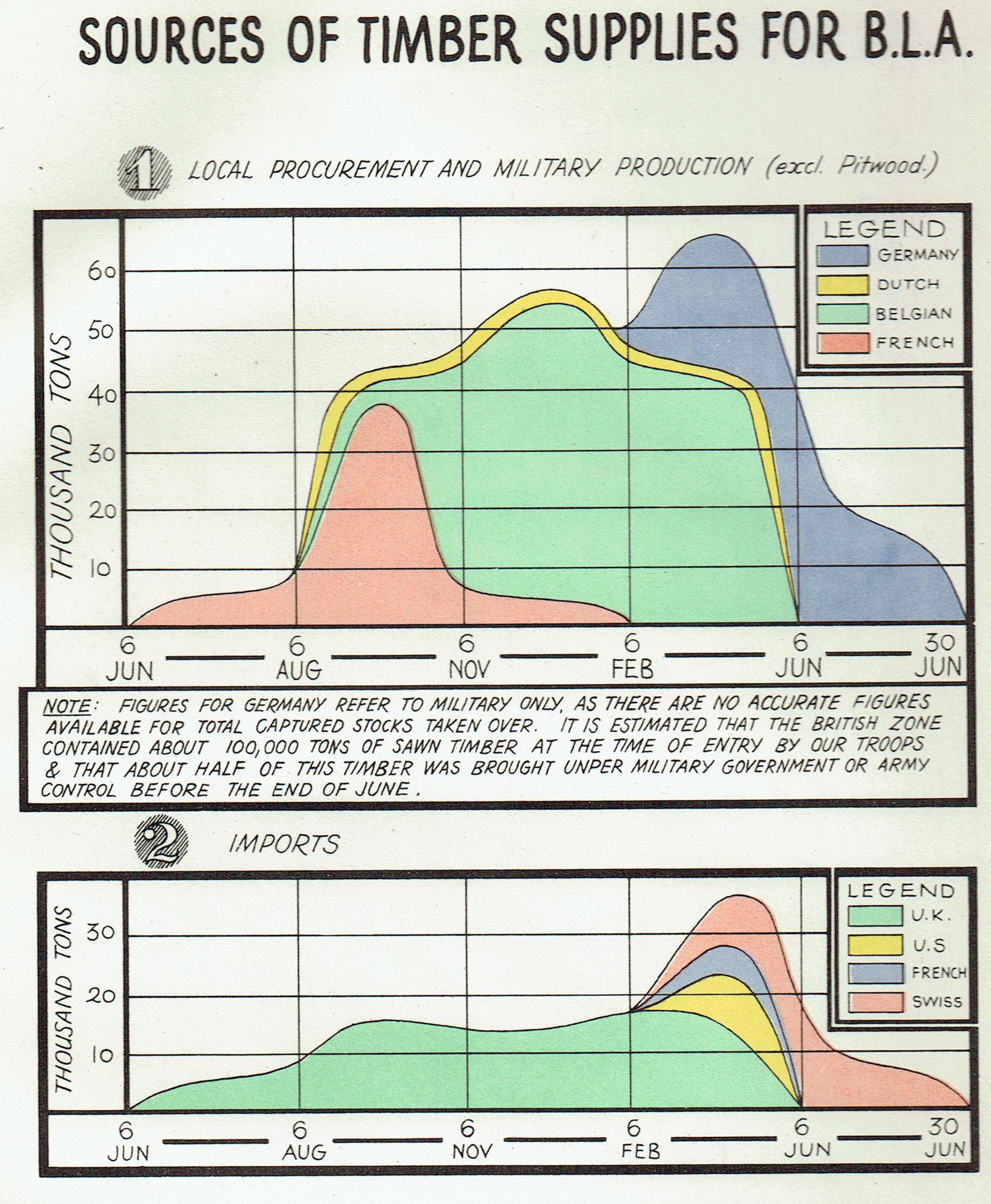
To meet the timber shortage, greatly aggravated by the loss of the ARDENNES at the beginning of the year, arrangements were completed to bring 10,000 metres cube of timber from SWITZERLAND and 12,000 metres cube from FRANCE.
Four forestry companies were deployed in BELGIUM on pitwood production in order to alleviate the acute coal shortage in BELGIUM caused partly by a shortage of pitprops.
A CRE (Works) organisationfor boosting civilian pitprop production proved effective.
By the end of March not only had the production of piles and bridging timbers been practically completed, but an average of some 600 tons per day of pitprops was being produced by military forestry companies.
Diagrams showing the production of timber by forestry units and sources of timber supplies for BLA (see picture)
CONSTRUCTION
Construction work apart from maintenance at major depots ceased in the RMA early in the New Year.
In January, however, the whole accommodation position for PW became acute when it was learnt that UK would not take any more PW from the theatre.
Accommodation, therefore, had to be provided in the L of C for some 200,000 DPs and PW. This meant an increase of 100,000 on the original plan.
Transit accommodation at CALAIS was completed by April and consisted of sleeping accommodation for 10,000 and feeding accommodation for 14,000 male personnel and 200 ATS.
The feeding accommodation was later increased to 22,000 male personnel and 300 ATS.
Major work on L of C and base installations continued in the areas of ANTWERP (where extensive damage was caused by V bombs), BRUSSELS and LOUVAIN, OSTEND, BRUGES and GHENT, BOULOGNE and LILLE.
By the end of February most major works in the base were nearing completion, including the majority of the accommodation on AA sites around BRUSSELS and ANTWERP.
Due to labour troubles, shortage of coal, and weather conditions, progress on the local manufacture of wooden huts to RE specifications was reduced to approximately fifty percent of the forecast and a sudden demand for 440 huts could not be met.
After the completion of the cutting of bridging timbers towards the end of March and with the restoration of power to sawmills, the production of wooden huts rose rapidly, until by the end of April a stock pile of hutting sufficient to accommodate 200,000 persons had been accumulated in the BRUSSELS area and no further contracts for local production in BELGIUM were placed.
After the crossing of the RHINE arrangements were made for local production of hutting under corps district arrangements in GERMANY.
An interesting task was the preparation for demolition of the “E” boat pen in OSTEND. Forty-five reinforced concrete columns supporting the concrete roof were bored centrally and vertically with diamond drills and twelve pounds to fifteen pounds of explosive (808) were inserted in each. The demolition took place on 1 May and was completely successful, no damage being done either to the port or to the town.
In order to conserve coal, projects for conversion of the larger central heating systems to oil consumption were executed. Two floating oil-driven power stations were installed at ANTWERP and GHENT during February and during their period of operation saved in all over 100,000 tons of coal.
OIL
By the end of January a further two lines of PLUTO making twelve in all had been laid and 1,400 tons were being pumped across the Channel daily. Work was in hand to connect the PLUTO lines with the ANTWERP/EINDHOVEN pipe which was almost complete.
In February the pipeline from BOULOGNE to GHENT was completed and the ANTWERP/EINDHOVEN line was in operation.
The connection between GHENT and ANTWERP was made in March and a single line was laid NORTH from EINDHOVEN to ST ANTHONIS. PLUTO was now giving an average of 3,388 tons per day.
By the end of April two lines were laid across the RHINE to EMMERICH and one was already in operation.
The last length of pipe was fitted by the QMG at a ceremony near TERMONDE on 10 May 45, and from that day two lines were in operation to GERMANY from the fifteen PLUTO lines at BOULOGNE.
Later a further extension was laid to BOCHOLT.
In all 1,125 miles of six-inch piping complete with pumping stations and storage tanks for 103,120 tons were laid in 351days at an average of three and one quarter miles per day.
The total weight of construction stores was 91,920 tons.
ROADS
The heavy frost and thaw in the early part of the year caused great deterioration in the road conditions. This coincided with operations and the paved roads suffered badly from the abnormally heavy traffic.
BELGIAN repair teams were organised and large quantities of stone moved to army areas to assist in repair and maintenance.
An extensive road repair maintenance programme for which road construction companies (supplemented by army and divisional troops and the national road authorities) were deployed along the more vital routes, proved just sufficient to keep the main axis of advance open.
DE-WATERING HOLLAND
During the month of January de-watering of selected areas in NW HOLLAND was declared to be a 21 Army Group responsibility. This urgent relief task required pumping plant with an estimated capacity of four million tons per day, the priority area to be cleared of water being about sixty square miles.
The operation of emergency electricity, provision of water supply, and repair of sewers and sewage disposal plant in the priority area had also to be carried out. It was found that the pumping capacity held in 21 Army Group stores was about 1,500,000 tons per day.
Every effort was made to supplement this with pumps obtained locally. All plants were handed over to Chief Engineer NETHERLANDS District who arranged for collection of trailer fire pumps and for the training of six newly formed DUTCH engineer units in the use of this equipment.
STORES
The RMA closed down in February. It is worth noting that during this last phase the average monthly figures of engineer stores and materials handled by stores units and moved under Engineer Stores Branch arrangements during the period, amounted to some 300,000 tons, the highest proportion being for airfield construction and bridging stores respectively.
The closest liaison was maintained with the BELGIAN Office of Mutual Aid and this organisation proved of great assistance in the local procurement and production of engineer stores.
CONCLUSION
It is possible that as a result of this history being divided into phases the magnitude of the total Engineer effort may not be realised. Some idea of the tonnages and work involved may be gained from the following figures:
- From D-day to 5 May 1945, 1,445 Bailey bridges were erected, 750,000 tons of engineer stores and 25,000 items of engineer plant and machinery were imported, while the value of local production reached £3,250,000.
- 250,000 tons of timber, one fifth of which was pit props, were felled by forestry companies.
- Over 180 miles of equivalent twenty-foot span hutting were erected and 30 miles of steel or timber huts were manufactured locally.
- 125 airfields were either constructed or repaired, equivalent to 2,020 miles of twenty-foot roadway. This figure was made up as follows:
- 1,260 miles of new graded road unsurfaced and
- 360 miles of new graded roads surfaced.
- 260 miles of repairs were done to cratered road and
- 140 miles to cratered earth road.
- Immense quantities of stone were needed for all this work and over 2,000,000 tons were quarried.
- 420 electric generators a total equivalent of 10,000 horse-power were installed together with
- 280 miles of overhead cable and
- 3,000 miles of insulated cable.
- The amount of work lying behind the great achievement of the pipeline on the Continent can be gauged by the fact that the total weight of stores involved in these installations was 97,000 tons.
- 110 tanks of bulk storage with a capacity of 101,000 tons were erected,
- 330 high pressure pumps installed and
- 1,200 miles of piping laid.
Abbreviations