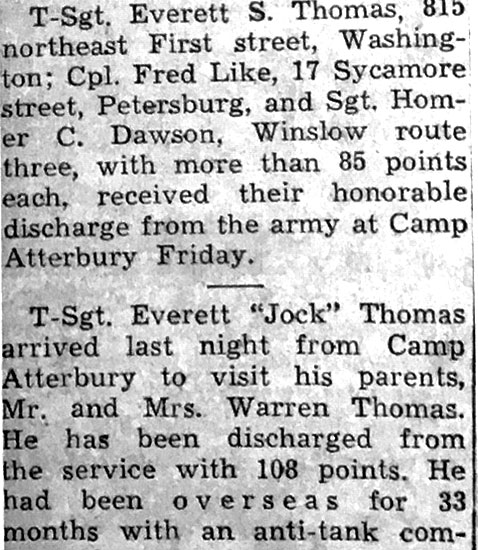
Master Sergeant Everett S. Thomas

Master Sergeant Everett S. Thomas
I was drafted into the U.S. Army at Fairfax County, Virginia, on April 22, 1941, and promptly was sent to Baltimore, Maryland. After taking the oath, I was sent to Fort George G. Meade, Maryland along with several hundred other draftees. After taking the necessary examinations, etc., I was given serial number 33000852, and assigned to the Anti-tank Company, 116thInfantry Regiment, 29thDivision. Eight days later I was promoted to Corporal.
After basic training and local exercises, the Division was moved to Fort A.P. Hill, in Virginia, for Division Maneuvers. After several weeks of training there, the Division was moved to North and South Carolina for extensive Maneuvers with the First and Second U.S. Armies. We trained in the Carolinas until December, at which time we broke camp and began moving back to Fort Meade, Maryland. During the movement back to Meade the Japanese attacked Pearl Harbor and the Country was at War. We were just pulling out of South Hill, Virginia, Sunday morning December 7th, when we got the news over the radio. I knew then I was in for a long stay.
After a ten-day furlough back in Indiana to see the folks, I returned to Fort Meade. In January 1942, the 116thR C T was moved to Camp Pendleton, Virginia, (Virginia Beach Area) for patrol duty along the Atlantic Coast. (German submarines landing saboteurs along the coastal areas.) Early spring we were relieved of this duty and returned to Fort Meade. After a short stay at Meade, back to A.P. Hill, Virginia. Here I was promoted to Sergeant, Three Striper, and command of the third platoon.
After several weeks of training at A.P. Hill, the Division moved once again to North and South Carolina. By this time July, August 1942, the Armies had grown extensively and there were some two million men in this maneuver.
From the Carolina Maneuvers the Division was sent to Camp Blanding, Florida, where we began preparation for shipment overseas. This was late August 1942. Here I was promoted to Staff Sergeant, (4 Striper.) After a short stay at Blanding, the Division entrained and sent to Camp Kilmer, New Jersey, where preparations for over-seas duty began in earnest.
During the last days of September, 1942, the Division and attached units, (18,500 men) began to board the HMS Queen Mary for shipment to England.
During the crossing, I got my first taste of combat. Off the coast of Ireland, in heavy seas, traveling alone, without convoy, we came under attack by German Submarines. During the attack, the HMS Curacoa, a British Light Cruiser, while warding off torpedos, cut too close to the Queen Mary, (85,000 tons) and was accidentally hit. The cruiser was cut completely in half, and sank in six minutes, all aboard some 300 men lost. The Queen suffered severe damage but continued on at a reduced speed to the Port of Grenoch, Scotland where we disembarked and entrained for Tidworth, England.
We trained at Tidworth for some eight or ten months, and from here the Division was sent down to Plymouth, England for extensive amphibious training, on the beaches of Slapton Sands, Southern England. We did not know it then, but we were being trained to make the initial assault against the Germans in France. Training was very hard and thorough. We had many casualties during this training. Here I was promoted to Tech/Sergeant, (5 Striper) still in command of the Third Platoon.
About the middle of May, the 29thDivision was moved up to Bournmouth area of Southern England, along with several hundred thousand men, put under tight security, under guard, and behind barbed wire fences. After extensive briefing, the 116thInfantry and units of the First Division were combined as a strike force, under the Code Name Task Force “O” under the command of Major General C.R. Hubener, First Division Commander.
On or about the 3rdof June, we began to board landing craft of every description. The Third Platoon boarded an LCT, (Landing Craft Tank) with our Half-tracks, and 57mm Guns. The Skipper named the craft the “Cherry.” As far as the eye could see, ships and landing craft were being loaded with men and equipment, guns and tanks. We sailed out of the Harbor on the night of June 3rd, and began to circle, waiting for other ships to join us. The main convoy of Force “O” cleared Portland Harbor on the afternoon of June 5th.
The movement across 100 miles of the English Channel was uneventful. Behind us, and on each side as far as you could see were ships, some five thousand in all. There was an umbrella of fighter planes overhead at all times, provided by the 8th U.S. Air Force and the Royal Air Force.
About dawn as we began to circle for landing, all hell broke loose, as the Battle Ships, Cruisers, and Rocket Ships began shelling the beach. Our LCT unloaded my Platoon in over six feet of water. The sea was terribly rough at this time. Before I could get out of the water and onto the beach, I was hit with flying shrapnel. A large hole was torn in the back of my helmet. I was also hit in the wrist, shoulder, and hip. My Jeep took a direct hit with an artillery shell and exploded. All my equipment was lost. My officer, Lt. Ferguson was critically wounded, and evacuated. I never saw him again.
We were on the beach until the late afternoon, and finally began moving inland. Our main objective was St. Lo, France. Isigny the first large French city fell on June 9th. After a few days, inland my wounds became extremely sore. The Medics transported me back to a Field Hospital where a Doctor picked out some of the shrapnel from my shoulder and wrist. Night fell while I was there and the fighting had moved much further inland. I began walking along with several other stragglers to catch up to my unit. During the night march German planes came over in force and bombed and strafed the road we were on. I spent most of this night in a ditch, half filled with water. Before dawn the next morning I hit the road again and finally caught up with my company.
It took us about a month to fight our way to St. Lo. During the fighting at St. Lo, my wrist became terribly infected. I was taken to the Field Hospital again. This time a doctor operated on my wrist, filled me up with penicillin and I returned to the line that night. Here at St. Lo we paused to build up our line for the push across France.
St. Lo fell on July 18th, (2 days after my birthday) after bitter fighting. Soon after St. Lo was taken, Allied Bombers of all types bombed an area in the German Lines, opening a hole for General Patton’s 3rdArmy to pour through. The 29thDivision was attached to the 3rdArmy at this time.
I have never seen so many planes in the air at one time in all my life. Soon after the bombing began, the wind shifted, blowing from the German Line toward the American Line, causing the smoke and debris to come our way. Some pilots lost sight of the targets and bombed the American Line. We suffered many casualties from this.
After the breakout from St. Lo the 29thwas sent down to Brest to capture this large port. Brest surrendered on September 18th. The 29thcaptured thousands of prisoners in this campaign. I lost one of my squad sergeants, and a very close friend in this fight was killed by a sniper, just a few feet from me.
By the time Brest fell, Allied Armies had cleared almost all of France. From Brest, the 29thDivision was moved to Holland to begin the assault on the German Siegfried Line. Now we were attached to the Ninth U.S. Army, under the command of General Simpson. We started battering the Siegfried Line and entered Germany on September 30th. Our main objective was Aachen. (Mud, and rain) Mud, mud, mud, it was over the tracks and wheels of all the vehicles. We lived in it, fought in it, slept in it. There wasn’t a dry spot anywhere.
Aachen surrendered on the 21stof October, and from here we fought our way through the Siegfried Line to the Roer River. Here on the frozen plains of Germany, we spent Thanksgiving and Christmas. I lost another officer here, hit by shrapnel from a German 88. The Battle of the Bulge had begun at this time, (German break-through about 60 miles south of the 29thDivision.) We were waiting for this to terminate before beginning our assault on Julich and crossing the Roer River.
On February 23 we jumped off across the Roer River and began the attack on Julich. Five days later, February 28, this city fell. This city was completely leveled. There wasn’t a single building left standing. After Julich fell, we fought our way down to the Rhine River capturing town after town on the way.
In early March we crossed the Rhine with the 101stAirborne Division, and then we really began to roll. The large German Cities of Monchengladbach, Dusseldorf, and Hanover, all were surrendering very fast. We drove to the Elbe River, and the last city the 116thcaptured was Hitzaker, Germany. Here we met the Russians. The German Nation surrendered on May 8th, 1945.
After the surrender of Germany, the Division was pulled back to Bremer-Haven, for re-assignment and guard duty of this large port. After a week or two of this duty, I was sent back to Camp Lucky Strike in La-Harve, France for the return to the States. I along with several thousand other GI’s boarded the U.S. Navy Transport at La-Harve and landed in the United States, at Boston, Massachusetts, about June 16th. I was sent to Camp Miles Standish, in Boston, and from there to Camp Atterbury. As I was walking to the PX, I saw Clyde, my brother, home from the Pacific Theater of Operations. I was honorably discharged from Camp Atterbury on June 22nd, 1945.
After the War, I re-enlisted in the U.S. Army Reserve Corps and was assigned to the 407thCriminal Investigation Division. While with this Unit I was promoted to Master Sergeant and remained in this Rank until I was Honorably Discharged again on March 31, 1953.
- Master Sergeant Everett S. Thomas
- 33000852
- Anti-tank Company
- 116thInfantry, 29thDivision
- European Theater of Operations
- Bronze Star
- Presidential Unit Citation Combat
- Infantryman’s Badge
- Purple Heart
- ETO Ribbon
- 5 Major Campaigns (Battle Stars)
- Omaha Beach Landing
- St. Lo Campaign
- Brest
- Roer River
- Rhine River
Wounded by shrapnel
T.- Sgt. Everett S. (Jock) Thomas, son of Mr. and Mrs. Warren Thomas, 815 Northwest First Street, was wounded by shrapnel in the wrist, shoulder, and hip, following the Omaha Beach landing in Normandy, according to a letter received by his parents.
Sgt. Thomas is in an anti-tank company, and is recovering nicely from his wounds. He wrote his parents June 28 as follows:
“There is not much going on around here now. Except for the continuous roar of the big artillery behind us, and too, you can see and hear the roar of the planes as they dive on the enemy up ahead. I’m only a few hundred yards from the front now.
Things are pretty badly torn up around here. There’s a little old town just to my rear that has been banged up pretty bad. I had my CP there for a while, and it got too hot there for me, so I had to scat. I mean I’ve “scatted” plenty since coming in here. Really had some close shaves. Yes, I believed I have lived a thousand years since coming in here. It’s like I told some guys a few days ago. I didn’t get it on the beach, now I don’t believe anything could hurt me.
But I don’t know whether I could take another beach landing or not. I often wonder how I got through.
No one will hear me gripe about anything if I ever get home. Boy! When Sherman said war was hell he didn’t scratch the surface. We go through a lot of hell but we have a lot of fun too. We captured motorcycles and bicycles and ride around, and we get some good French wine at times, and the Yankees are just as crazy while fighting as they are in training days - someone’s always making a crack.
My Jeep was hit on the beach by artillery fire and knocked. Before I could get back and save anything, it had washed away. I did lose some good equipment. I wasn’t going to tell you this, but you will find out anyway. I was hit by shrapnel, in my wrist, my shoulder and hip, but I didn’t stop, guess it’s a good thing I didn’t, I learned later on.
I had it bandaged, and after we were in four days, it hurt pretty badly. I went back to the dressing station and had it cut out. They were going to send me to a hospital, but I talked the Doc out of it.
My wrist got infected but I had fixed up again and it’s coming along swell now. Should have the bandage off in a couple days. These medics are right on the ball over here. They saved me from becoming a casualty. I wish I could bring my helmet home for a souvenir. It saved my life.”
Letter on VE-day
Germany May 8, 1945
Dear Mother,
I haven’t heard from you for an awful long time. I’m beginning to think you have really forgotten me this time. I had a letter from Ruth today. I’ll have to write her some time soon. I haven’t heard from Clinton, Homer, or anyone. I’m kinda in the dark really.
Well the end finally has come, hasn’t it? This is what we have been fighting, hoping, and praying for all this time. I’m very happy naturally, but it’s really just another day in the Army for me. It didn’t hit me like I thought it would. We knew it two days ago. Church services were held, a few boys got tight on some German whiskey, and that’s about all there was to it. Now we are all beginning to sweat again, just like we were doing eleven months ago, before the invasion. Will we go to the Pacific, stay here, or get to go home? We are really having some arguments about that.
No mother, I didn’t get to Berlin. We met the Russians on the Elbe River, the last barrier before a Berlin, and was pulled out of the line a couple days before the end came. It’s very beautiful country up there. I must say I really enjoyed that last push. The fighting wasn’t to bad and I really saw the country.
I understand we are moving from our present location very soon. We are going to a large city to do a little special duty. How long that will last I don’t know. They will let us know something in a few days, on how we stand. That is whether we will have to go to the Pacific or not. Don’t expect me home any time in the near future Mother, because whatever I do I know I can’t do that. Everything has priority for the Pacific first. I wish to God I could hop a plane and get home this very day. But we are still at War.
Imagine by the time you get this, Clyde will be on his way back. Poor kid I feel sorry for him. I know how he hates going back to that hell hole. Well he had a good break at any rate.
Even though the War is over they don’t slack up on us much. We still have work to do. So I must be getting along. Please write to me, give all my love, and I hope with Gods help to be seeing you in the not to distant future.
All My Love,
Everett
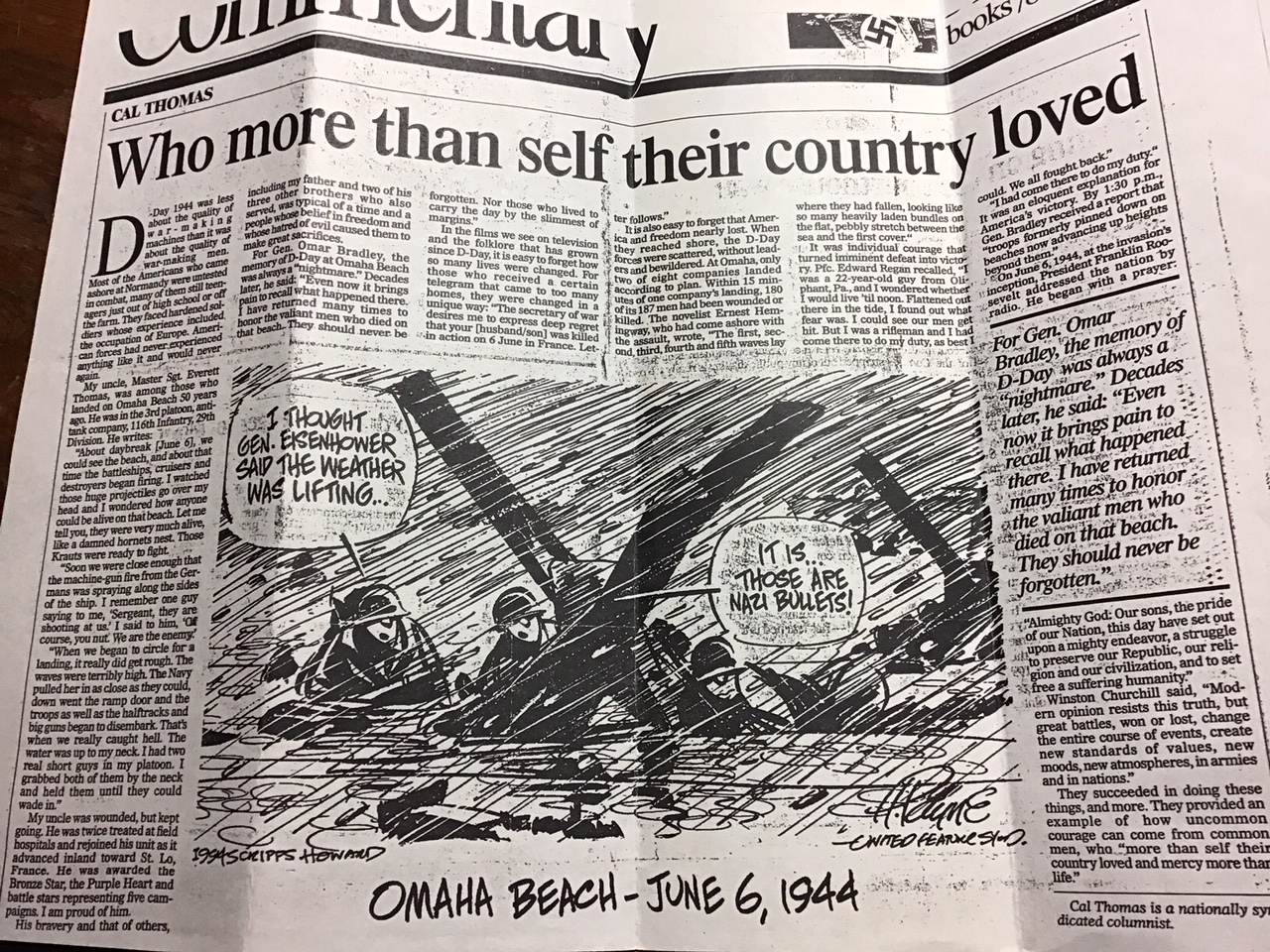
Who more than self their country loved
click to enlarge
Order of the day
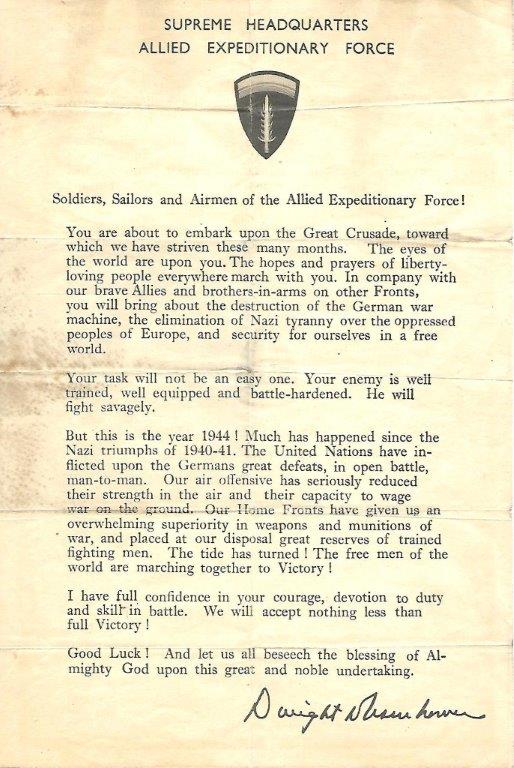
This order was issued by General Dwight D. Eisenhower to encourage Allied Soldiers taking part in the D-Day invasion of June 6, 1944. Almost immediately after France fell to the Nazis in 1940, the Allies planned a cross-channel assault on the German occupying forces, ultimately code-named Operation Overlord. The order was distributed to the 175,000 member expeditionary forces on the eve of the invasion.
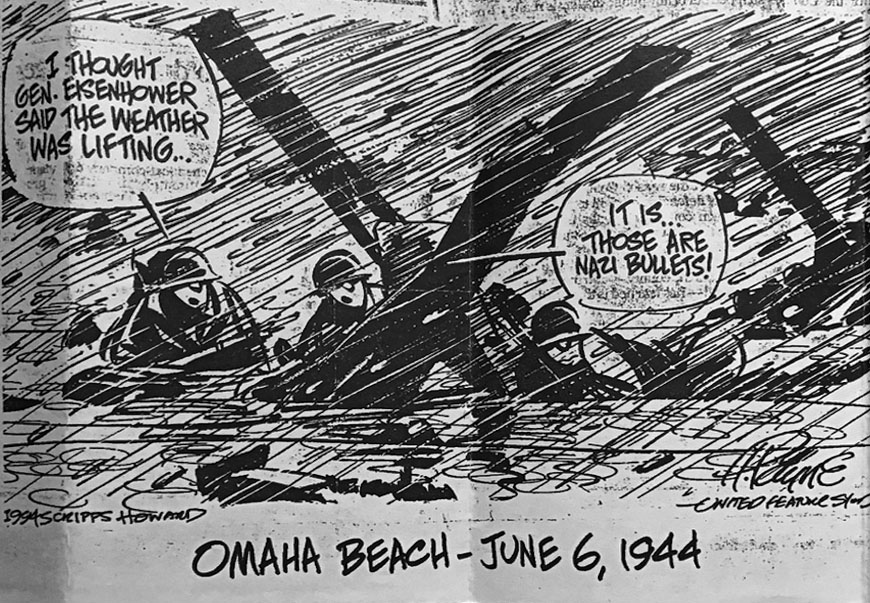
Cartoon
Cartoon about Omaha Beach June 6th 1944
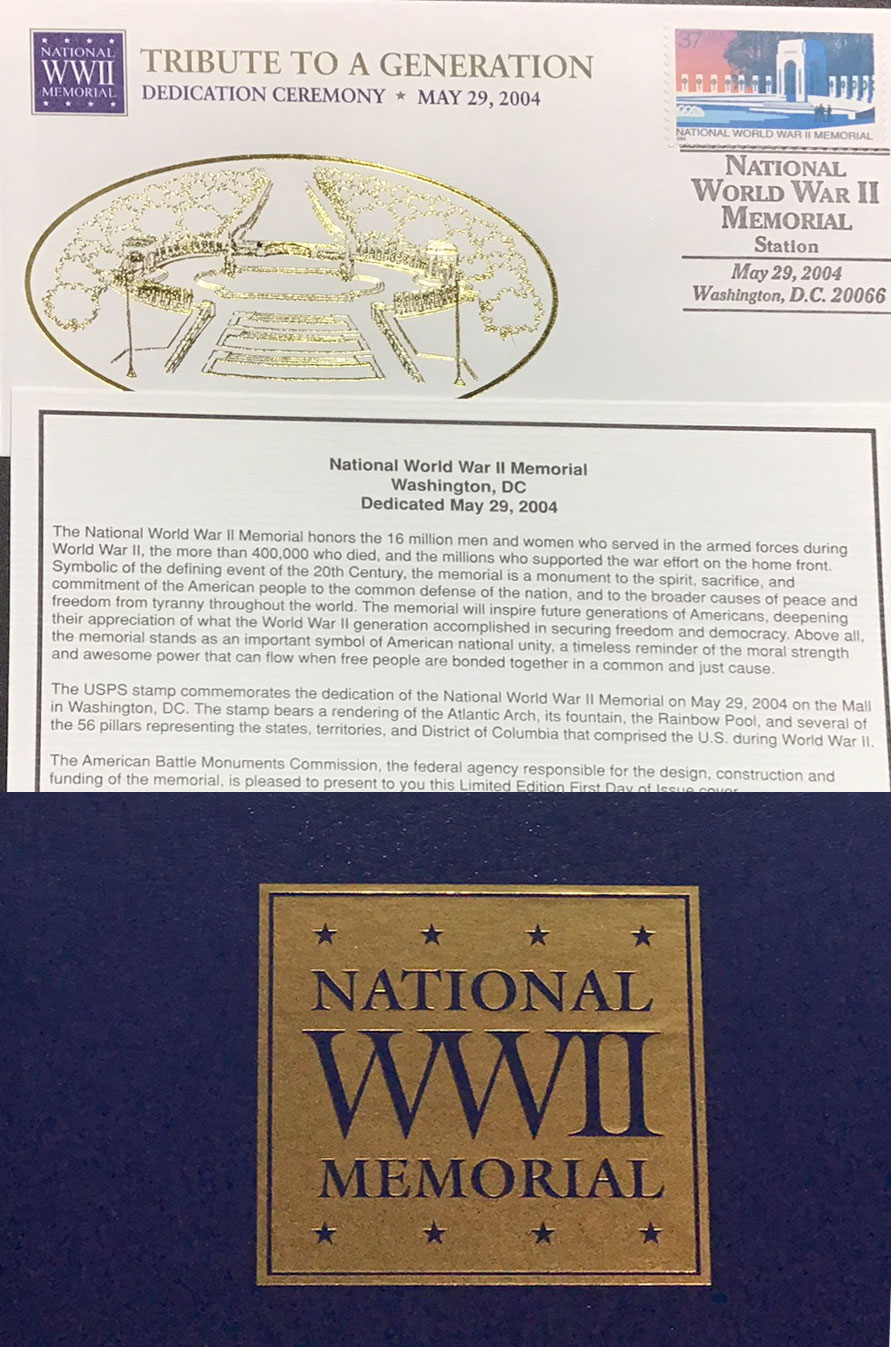
Tribute To A Generation
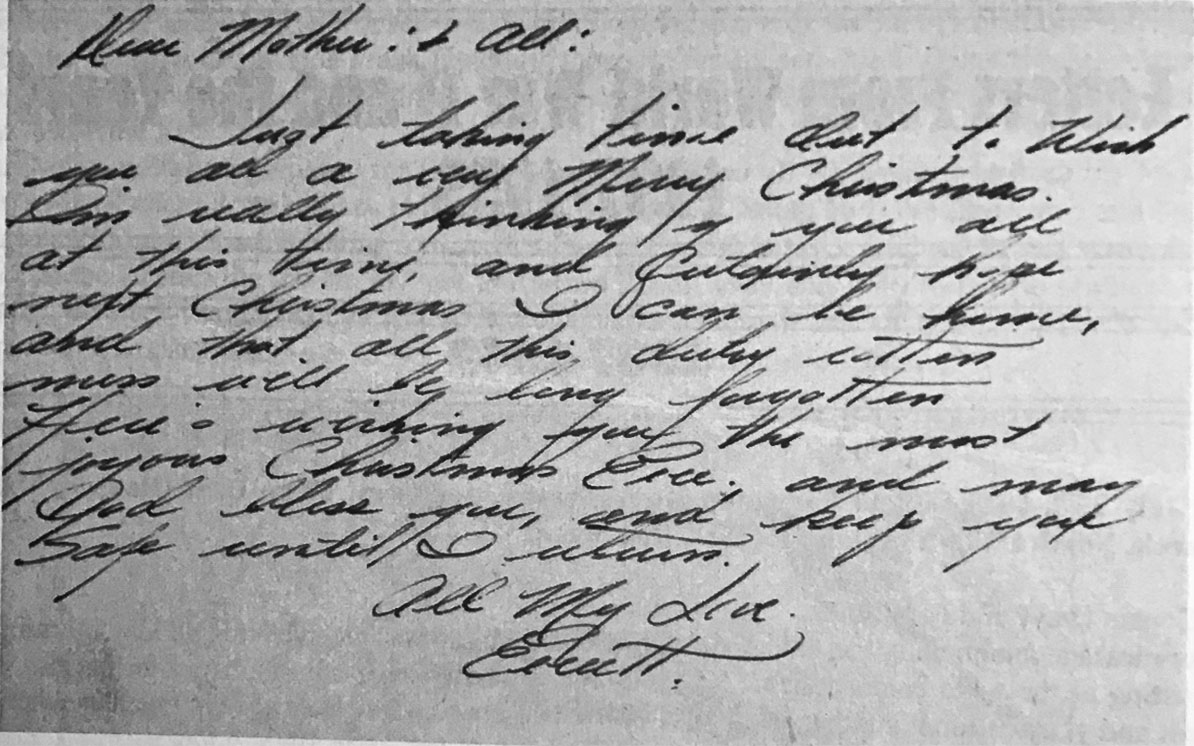
Christmas 1944
Dear Mother and All:
Just taking time out to Wish you all a very Merry Christmas. I’am really thinking of you all at this time, and Certainly hope next Christmas I can be home, and that all this dirty rotten mess will be long forgotten. Here’s wishing you the most joyous Christmas Ever, and may God bless you and keep you Safe until I return.
All My Love, Everett